The Algorithm That Missed Her
The algorithm knew what she liked.

It knew she preferred black coffee to tea.
It knew she watched documentaries late at night.
It knew she stopped scrolling whenever she saw photographs of mountains.
It knew she had searched for apartments in three different cities.
It knew she was tired.
It knew almost everything.
Except that she was lonely.
Every morning, 7:30 a.m.
Her alarm rang.
By 7:34, her phone had already prepared her world.
News selected for her.
Music chosen for her.
Messages arranged by importance.
A list of things she might want to buy.
A video recommended because, according to the system, people like her had enjoyed it.
Her name was Anika.
She was twenty-eight and worked as a product designer for a technology company.
Her job was to make digital products understand people better.
Ironically, nobody seemed to understand her.
One Monday morning, she opened her laptop and found a notification.
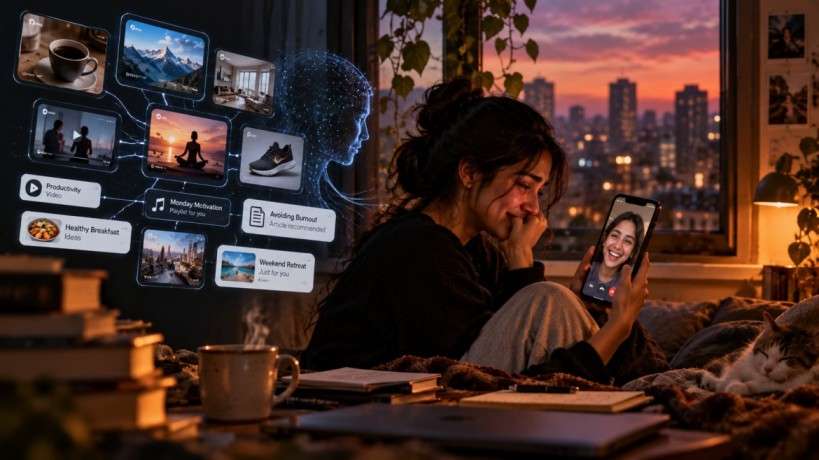
“Good morning, Anika. Here are five things you may enjoy today.”
She looked at the suggestions.
A productivity video.
A recipe for healthy breakfast.
A playlist called Monday Motivation.
An article about avoiding burnout.
And a pair of shoes she had looked at two weeks earlier.
She closed the notification.
“Perfect,” she whispered.
Then she went to work.
For the next few weeks, Anika’s life became increasingly predictable.
The algorithm knew when she usually ordered lunch.
It knew which colleagues she messaged most often.
It knew what time she stopped working.
It even noticed that she had started sleeping later.
One evening, a notification appeared.
“You seem stressed lately. Would you like some suggestions?”
Anika stared at it.
Then laughed.
“You think?”
She selected Yes.
The system suggested meditation.
A weekend wellness retreat.
A playlist designed to reduce anxiety.
A breathing exercise.
She tried none of them.
Instead, she opened her messages.
There were 47 unread conversations.
Most were work groups.
Some were promotional.
A few were old friends she hadn’t spoken to in months.
She searched for one name.
Riya.
Her best friend from university.
The last conversation was eight months old.
Riya had written:
“You disappear whenever life gets difficult.”
Anika had replied:
“I’m just busy.”
Riya had sent a heart.
Then nothing.
Anika stared at the message.
She almost typed something.
Instead, she locked her phone.
The next morning, the algorithm changed its recommendations.
It had noticed her behavior.
More self-help articles.
More mental-health podcasts.
More videos about loneliness.
More advertisements for social apps.
It was getting closer.

Or so it thought.
Then came Friday.
Anika received an email from her manager.
Her project had been cancelled.
Three months of work.
Gone.
She read the email twice.
Then closed her laptop.
Her phone immediately lit up.
“Based on your recent activity, here are some things that may help you feel better.”
She threw the phone onto the sofa.
For the first time in years, she turned everything off.
No notifications.
No music.
No television.
No laptop.
The apartment became completely silent.
She sat on the floor beside the window.
Outside, people were returning home.
A father carried his sleeping daughter.
Two boys argued over a football.
An old woman watered plants on her balcony.
A couple stood at a roadside stall sharing a cup of tea.
None of them knew her.
And suddenly, that hurt.
Anika picked up her phone.
She opened Riya’s conversation.
This time, she didn’t think.
She typed:
“Are you awake?”
Three dots appeared almost immediately.
Riya: “For you? Always.”
Anika stared at the screen.
Then she started crying.
Not because her project had failed.
Not because she was exhausted.
Because someone had answered.
Twenty minutes later, Riya called.
They spoke until midnight.
They talked about university.
About old friends.
About careers.
About mistakes.
About how both of them had spent years pretending they were doing fine.
At one point, Riya asked,
“Why didn’t you call me?”
Anika looked around her apartment.
“I don’t know.”
“You could have just said you were having a bad day.”
“I know.”
“You didn’t have to solve anything.”
Anika smiled through her tears.
“I think I forgot how to ask for company.”
There was silence on the other end.
Then Riya said,
“Then start again.”
The next morning, Anika turned on her phone.
Hundreds of recommendations appeared.
The system had already learned about her improved mood.
It suggested cheerful music.
Weekend activities.
Restaurants.
Travel destinations.
It had correctly detected that something had changed.
But it had no idea what.
Anika opened her settings.
For the first time, she looked carefully at everything the system knew about her.
Her interests.
Her habits.
Her searches.
Her purchases.
Her sleep patterns.
Her favorite songs.
Her locations.
It was an impressive portrait.
And yet, it was missing the most important part.
There was no record of the night she needed someone to call.
No measurement for the comfort of hearing an old friend’s voice.
No data point for sitting quietly with another person.
No category for saying, “I don’t need advice. I just don’t want to be alone.”
The algorithm had learned her preferences.
It had predicted her behavior.
It had studied her patterns.
But it had missed her.
Not because it was broken.
Because some parts of being human cannot be understood by watching what we click.
That afternoon, Anika met Riya at a small café.
They sat by the window for three hours.
They didn’t take photographs.
They didn’t post anything.
They didn’t check their phones.
They simply talked.

And somewhere inside a massive system, Anika’s absence from the digital world probably registered as nothing more than unusual behavior.
For once, she didn’t care.
She had finally understood something her work had never taught her.
An algorithm can learn what you choose.
It cannot always know what you need.
And sometimes, the person you need most isn’t the one your screen recommends.
It’s the one who answers when you finally say,
“Are you there?”
Explore more emotional stories and reflections in our [Short Stories] section, where we explore human connection, emotions and everyday relationships.