How Does the Ocean Move Heat Around the Earth?
Table of Contents
Imagine standing on a cold European coast in winter and learning that some of the warmth in the water offshore began under tropical sunlight thousands of kilometres away. That is not just a metaphor. The ocean is constantly picking up heat, carrying it across huge distances, releasing some of it into the atmosphere, and moving the rest into deeper water.
Understanding how the ocean moves heat around the earth explains why coastal climates can differ dramatically at the same latitude, why the tropics do not simply keep getting hotter while the poles stay cold, and why changes in ocean circulation matter for climate.
The mechanism is not one giant river flowing through the sea. It is a combination of wind-driven surface currents, differences in water density, Earth’s rotation, mixing, sinking, and rising water. Together, these processes create a planetary circulation system.
Why the ocean is such a powerful heat mover
The ocean covers more than 70 percent of Earth’s surface and absorbs enormous amounts of solar energy. Water can store a great deal of heat, so the ocean acts both as a heat reservoir and a transport system.
That is the first key to how the ocean moves heat around the earth. Heat does not have to stay where sunlight enters the water. Currents can carry warm water toward higher latitudes and move colder water back toward the tropics and into the deep ocean.
The ocean also exchanges heat with the atmosphere through evaporation, radiation, and direct contact. Waves, tides, currents, and mixing continually redistribute heat from warmer areas toward cooler latitudes and deeper layers.
So, when scientists study how the ocean moves heat around the earth, they are not looking at one process. They are looking at an interconnected system operating across different depths and timescales.
How the ocean moves heat around the earth at the surface
If you picture ocean circulation as a transport network, surface currents are its broadest visible routes.
Large-scale winds push the upper ocean. Earth’s rotation then bends moving water through the Coriolis effect, while continents and ocean basins shape the routes. The result is a system of large circular patterns called surface ocean gyres.
These gyres help move warm tropical water toward higher latitudes and return cooler water toward lower latitudes. Strong boundary currents along the western edges of ocean basins can transport particularly large amounts of water and heat.
This is why how the ocean moves heat around the earth cannot be explained by a single current. There are many connected pathways operating at different speeds and depths.
The Gulf Stream is a familiar example. Warm water flows northward from the western tropical Atlantic and continues toward the North Atlantic. Along the way, it transfers heat to the atmosphere and influences the climate of nearby regions.
So why is the Gulf Stream so warm? Mainly because it carries heat absorbed by tropical and subtropical waters northward. Its warmth is not created in the North Atlantic. It is transported there.
The deeper engine: thermohaline circulation
Wind is only part of the story. Far below the surface, another process helps explain how the ocean moves heat around the earth.
This is thermohaline circulation, a term built from “thermo” for temperature and “haline” for salinity. Both affect seawater density.
Cold water is generally denser than warm water. Saltier water is also denser than fresher water. When seawater becomes cold and salty enough, it can sink into the deep ocean.
One important example occurs in the high-latitude North Atlantic. Warm surface water travels north, loses heat to the atmosphere, and becomes colder. In some regions, sea-ice formation also leaves extra salt in the surrounding water. The resulting dense water can sink and flow southward at depth.
NOAA’s explanation of the global ocean conveyor belt
That sinking connects the surface ocean with the deep ocean. It also explains the difference between surface currents and deep ocean currents: surface circulation is strongly influenced by wind, while deep circulation is strongly influenced by density differences.
The deep circulation is therefore another major piece of how the ocean moves heat around the earth. Water that has released heat near the surface can eventually move into the deep ocean, where it becomes part of a much slower circulation system.
The ocean conveyor belt is not one simple belt
The phrase ocean conveyor belt is useful, but it can create the wrong mental picture.
There is not a single mechanical loop moving at one uniform speed. Instead, the global circulation consists of interconnected pathways. Water can move horizontally, sink, mix, rise, and join other currents.
The large-scale system is sometimes called the global overturning circulation. It includes the Atlantic Meridional Overturning Circulation, or AMOC, but AMOC is only one component of the broader global circulation.
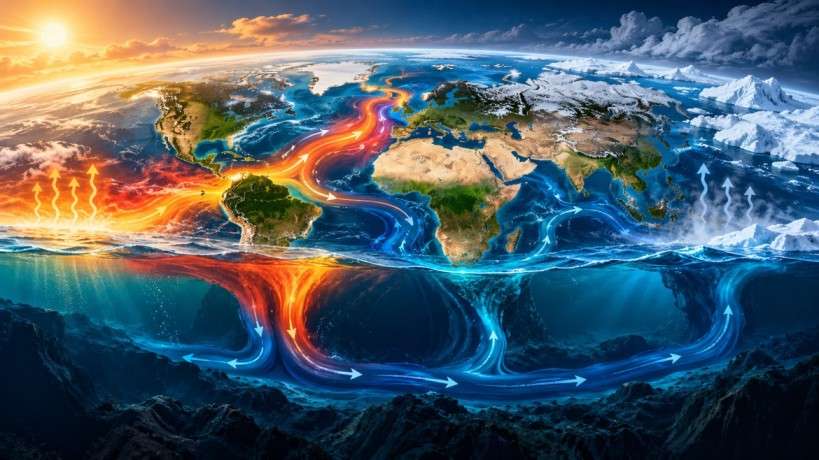
This is an important part of how the ocean moves heat around the earth. Warm surface water can travel northward, release heat, become denser, sink, and eventually return through deeper pathways. Elsewhere, mixing and upwelling bring deeper water toward the surface.
The complete journey is extremely slow compared with surface currents. NOAA estimates that a parcel of water can take roughly 1,000 years to travel through the global conveyor system.
Why upwelling matters
If water only sank, the system would eventually run out of surface water. The ocean avoids that because deep water can return upward through upwelling and mixing.
Upwelling is especially important in some coastal regions, where winds push surface water away and deeper water rises to replace it. Deep water can carry nutrients that support marine ecosystems.
It also reconnects the deep ocean with the atmosphere. Once water reaches the surface, it can exchange heat and gases with the air again.
This reveals another part of how the ocean moves heat around the earth. The ocean is not merely moving heat horizontally from one place to another. It is also moving heat vertically between the surface and the deep sea.
How much heat is actually being moved?
Ocean heat transport is enormous, but it is difficult to reduce the entire system to one simple number.
The amount of heat carried by a current depends on the temperature of the water, how much water is moving, and the direction of the flow. A large volume of moderately warm water can transport enormous amounts of energy.
The AMOC is particularly important because it carries relatively warm upper-ocean water northward through the Atlantic while colder deep water returns southward. NOAA describes the overturning circulation as one of the main mechanisms by which the ocean moves heat, salt, carbon, and nutrients.
That is why scientists monitor ocean circulation with instruments, satellites, floats, and long-term observing systems. They are not simply tracking where water goes. They are trying to understand how the ocean moves heat around the earth and how changes in circulation could affect climate.
What happens if thermohaline circulation slows down?
This is where the subject becomes more complicated.
A slowdown in thermohaline circulation would not mean the entire ocean suddenly stops moving. Wind-driven currents, tides, mixing, and other circulation processes would continue.
But a substantial change in overturning could alter where heat accumulates and how much heat is transported toward higher latitudes. Regional effects could include changes in temperature patterns, rainfall, sea level, and marine ecosystems.
Freshwater entering the North Atlantic is one reason scientists pay attention to possible changes in density-driven circulation. Freshwater is less salty than seawater, so adding large amounts can reduce surface-water density and potentially affect deep-water formation.
NASA explains that warming can make seawater less dense while melting ice can add freshwater to the North Atlantic, factors that may influence circulation strength.
NASA’s overview of changing ocean circulation and AMOC
However, it is important not to turn this into a simple “shutdown” story. The strength and future behavior of the AMOC remain active areas of scientific research, and different studies can produce different estimates of change.
A simple way to picture how the ocean moves heat around the earth
Think of the ocean as a planetary climate system with several connected parts:
- Sunlight supplies much of the initial heat.
- Winds push surface water across ocean basins.
- Earth’s rotation helps shape current directions.
- Temperature and salinity change water density.
- Sinking sends dense water into the deep ocean.
- Upwelling and mixing bring deeper water back toward the surface.
- Atmosphere-ocean exchange moves heat between seawater and air.
Put these processes together, and the basic picture of how the ocean moves heat around the earth becomes much clearer.
The bigger climate connection
The ocean’s heat-moving role explains why Earth’s climate cannot be understood by looking only at the atmosphere.
A warm ocean current can influence air temperatures, rainfall, storms, and coastal conditions. A change in deep circulation can redistribute heat and affect sea-level patterns far from where the circulation itself changes.
The ocean also absorbs a large share of the excess heat associated with human-caused global warming. That makes understanding how the ocean moves heat around the earth important for studying both today’s climate and possible future changes.
Still, circulation is only one part of the picture. Ocean heat content, atmospheric circulation, clouds, sea ice, land surfaces, and greenhouse gases all interact.
Conclusion
The simplest answer to how the ocean moves heat around the earth is that the ocean uses both surface and deep circulation to transport energy.
Winds move warm and cool water across the upper ocean. Density differences caused by temperature and salinity help drive the slower overturning circulation below. Upwelling and mixing reconnect the deep ocean with the surface.
The result is a vast, constantly changing heat-distribution system. It does not behave like a perfectly organized conveyor belt, but it plays a crucial role in keeping heat moving through the climate system.
And that may be the most important idea to remember: when the ocean changes, the effects do not necessarily stay in the ocean. A shift in where heat is stored or transported can eventually show up in the atmosphere, on coastlines, and in weather patterns far away.
Frequently Asked Questions
How does the ocean distribute heat around the globe?
The ocean distributes heat through wind-driven surface currents, large gyres, density-driven deep circulation, mixing, and upwelling. Warm water generally moves away from the tropics while colder water can return at depth.
What drives the ocean conveyor belt?
The global conveyor is driven by a combination of wind-driven circulation and density differences caused mainly by temperature and salinity. Cold, salty water can become dense enough to sink, helping drive deep circulation.
Why is the Gulf Stream so warm?
The Gulf Stream carries warm water northward from tropical and subtropical parts of the Atlantic. That water gained much of its heat from solar energy absorbed at lower latitudes.
What is the difference between surface currents and deep ocean currents?
Surface currents are strongly influenced by wind, Earth’s rotation, and the shape of ocean basins. Deep currents are more strongly controlled by differences in water density caused by temperature and salinity.
Is the ocean conveyor belt a literal single loop?
No. “Ocean conveyor belt” is a simplified description of a connected global circulation system. It contains many pathways, branches, sinking regions, mixing zones, and upwelling areas.
What happens if thermohaline circulation slows down?
A slowdown could change the distribution of heat and influence regional climate, sea level, rainfall, and marine conditions. It would not mean that all ocean currents suddenly stop.
Does the ocean move heat vertically as well as horizontally?
Yes. Heat can be carried horizontally by currents and vertically through sinking, mixing, and upwelling. This vertical movement connects the surface ocean with the deep sea.
Explore more fascinating climate and planetary science topics in our [Science] section to understand how Earth’s oceans, atmosphere and climate systems work.