Table of Contents
The wildfire can be thousands of kilometres away.
You may never see the flames. You may not even smell smoke when the fire starts.
Then, one morning, the sky looks strangely hazy. Your throat feels irritated. Your weather app suddenly shows an air-quality warning.
The fire is somewhere else.
But its smoke is now part of the air you are breathing.
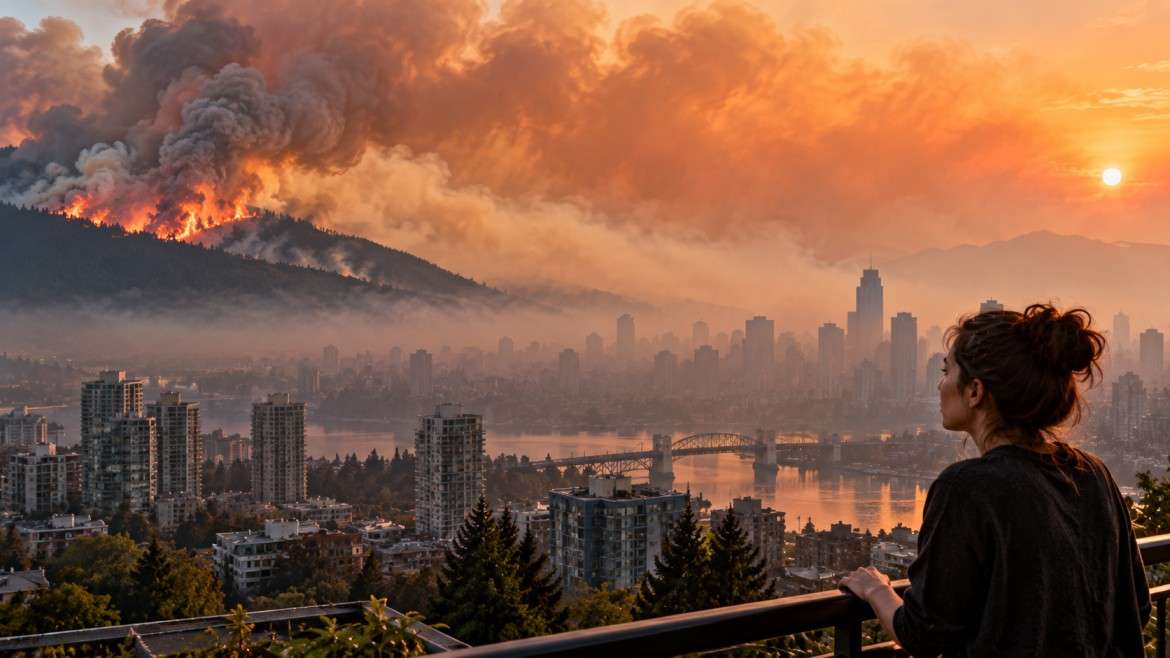
That is the growing concern behind wildfire smoke health effects. Wildfires are no longer only a problem for people living close to forests. Smoke can travel across borders and affect cities and communities far from the original fire.
And the most concerning part is often invisible: tiny particles known as PM2.5.
What Makes Wildfire Smoke Dangerous?
Wildfire smoke is not simply ash floating through the air.
It is a complicated mixture of gases and fine particles produced when vegetation, buildings and other materials burn. The U.S. Environmental Protection Agency identifies PM2.5 as the pollutant of greatest health concern in wildfire smoke because these particles are small enough to reach deep into the lungs.
That helps explain why wildfire smoke health effects can begin with something that seems minor.
A person might notice burning eyes or a scratchy throat.
Another person might start coughing.
Someone with asthma may suddenly find breathing much harder.
And for vulnerable people, exposure can contribute to more serious respiratory or cardiovascular problems.
The smoke does not need to be visible to be relevant.
What Happens Inside Your Lungs?
Think about the difference between breathing normally and breathing during a smoky afternoon.
Your lungs are designed to exchange gases with the atmosphere. They are not designed to deal with large concentrations of microscopic particles.
PM2.5 can travel deep into the respiratory system. Research summarized by the EPA shows that fine particles can contribute to inflammation and oxidative stress, while exposure can affect systems beyond the lungs, including the cardiovascular system.
This is why wildfire smoke health effects go beyond temporary discomfort.
Short-term exposure can cause:
- Coughing
- Wheezing
- Shortness of breath
- Eye and throat irritation
- Increased mucus
- Reduced lung function
- Asthma attacks
- Worsening of existing lung conditions
For some people, the consequences can be more serious.
The EPA reports associations between wildfire smoke exposure and respiratory and cardiovascular outcomes, including emergency department visits and hospital admissions.
Why Does Wildfire Smoke Affect the Heart?
This part often surprises people.
Most people naturally think of smoke as a lung problem. But the smallest particles can have effects beyond the respiratory system.
PM2.5 exposure can contribute to inflammation and other biological responses that affect blood vessels and heart function.
That is one reason researchers are interested in wildfire smoke cardiovascular risk.
The risk is particularly important for people who already have cardiovascular disease. Older adults and people with existing heart or lung conditions are among the groups that public-health agencies identify as more vulnerable to wildfire smoke.
This does not mean that every smoky day will cause a heart problem.
It means that smoke adds another environmental stressor, particularly for people whose cardiovascular systems are already vulnerable.
Why Is Wildfire Smoke Becoming a Global Problem?
The answer is partly geography.
Smoke does not respect political borders.
A large wildfire in western Canada can affect air quality in the United States. Smoke from fires can travel hundreds or thousands of miles before reaching communities far from the original flames. The EPA specifically notes that wildfire smoke can affect people both near and far from the fire.
This creates a form of transboundary air pollution.
A fire can begin as a local environmental disaster.
Its smoke can become a regional public-health problem.
In some circumstances, atmospheric circulation can transport smoke over extremely long distances.
That changes the way we should think about wildfire smoke health effects.
You do not necessarily need to live in a wildfire zone to be exposed.
Why Can Wildfire Smoke Sometimes Feel Worse Than Urban Pollution?
The comparison is more complicated than saying one is always worse.
Urban air pollution can expose people to traffic emissions, industrial pollutants and other sources over long periods. Wildfire smoke can produce intense spikes in particulate pollution during major fire events.
The composition also varies.
What burns matters.
A forest fire produces a different mixture from a fire that consumes buildings, vehicles or other manufactured materials.
The EPA notes that wildfire smoke contains a complex mixture of pollutants, while PM2.5 remains a major health concern.
So the real question is not simply whether wildfire smoke is “worse.”
It is how concentrated the pollution is, how long someone is exposed, what the smoke contains and whether the person is particularly vulnerable.
That is why wildfire smoke health effects can vary significantly from one event to another.
Who Is Most Vulnerable?
A healthy adult who spends a short period in moderately smoky air may experience temporary symptoms and recover quickly.
That does not mean everyone has the same experience.
Children, older adults, pregnant people and individuals with asthma, COPD, heart disease and certain other chronic conditions can face greater risks. Outdoor workers and emergency responders can also receive much higher exposure because they may spend hours in smoky conditions.
Children deserve particular attention because their lungs are still developing and they breathe more air relative to their body size than adults.
For someone with asthma, meanwhile, a smoky day can turn an ordinary outdoor activity into a serious breathing problem.
This is why understanding wildfire smoke health effects is partly about understanding who is breathing the smoke.
Can Wildfire Smoke Cause Long-Term Health Problems?
This is where the evidence needs careful interpretation.
Scientists have strong evidence connecting short-term PM2.5 exposure with respiratory and cardiovascular health effects.
But the specific long-term consequences of repeated wildfire smoke exposure are less completely understood.
The EPA says the evidence for short-term exposure is extensive, while there is less certainty about other exposure durations. NIOSH also describes repeated long-term exposure to high concentrations of wildland fire smoke as an area where important questions remain.
So if you search for the long term health effects of breathing wildfire smoke, you will find both established findings and areas of ongoing research.
That distinction matters.
Good health communication should not turn scientific uncertainty into either false reassurance or unnecessary fear.
Why Climate Change Is Making the Issue More Important
There is another piece of the story.
Hotter and drier conditions can increase wildfire risk in many regions. The CDC notes that climate change can increase wildfire risk through prolonged high temperatures, drought and dry conditions, with consequences for air quality and health.
This creates a difficult cycle.
More severe fires can produce more smoke.
More smoke can create larger air-quality problems.
And communities that rarely experienced major smoke events may suddenly find themselves dealing with unhealthy air.
That is one reason wildfire smoke health effects are becoming part of broader discussions about climate adaptation and public health.
How to Protect Your Lungs During a Smoke Event
You do not need to panic when smoke appears.
But you should pay attention to the air you are breathing.
The first step is to check your local air-quality information. When conditions are poor, reducing time outdoors and avoiding strenuous outdoor activity can lower exposure.
The EPA also recommends using portable air cleaners indoors and reducing indoor sources of pollution. Properly fitted N95 respirators can significantly reduce exposure to smoke particles when people need to go outside.
Practical steps include:
- Check your local air-quality index before exercising outdoors.
- Keep windows and doors closed when outdoor smoke is heavy.
- Reduce strenuous activity during poor air-quality periods.
- Use suitable indoor air filtration if available.
- Follow local emergency and public-health instructions.
- If you have a chronic condition, follow the advice and treatment plan provided by your healthcare professional.
For people with respiratory conditions, preparation matters even more. Having medication available and knowing what to do when smoke levels rise can reduce the chance of being caught unprepared.
You can also read our guide on what happens when you do not get enough deep sleep to understand another environmental and lifestyle factor that can affect how the body functions and recovers.
The Problem Does Not End When the Fire Goes Out
One common misconception is that the danger disappears as soon as the flames are under control.
Not necessarily.
Smoke can remain in the air after a wildfire, and air quality can continue to fluctuate. The CDC advises people to keep checking local air-quality information even after a wildfire has ended.
Ash and smoke can also create additional problems during cleanup and rebuilding.
That makes recovery another part of the health story.
A wildfire is an event.
Exposure can last much longer.
What This Means for the Future
Wildfire smoke is forcing societies to rethink what an air-quality emergency looks like.
It does not always begin with a fire in your neighbourhood.
Sometimes it begins with a satellite image hundreds of kilometres away, a changing wind pattern and a plume moving toward a major population centre.
That is why wildfire smoke health effects are becoming an international concern.
The solution is not simply telling people to stay indoors every time a wildfire burns somewhere in the world.
Communities need reliable air-quality monitoring, timely warnings, cleaner indoor environments and practical guidance for people who are most vulnerable.
Individuals also need to understand what PM2.5 means and why smoke exposure should be taken seriously.
The CDC’s current wildfire guidance provides practical information on symptoms, higher-risk groups and ways to reduce exposure.
The bigger lesson is simple.
Wildfire smoke can travel much farther than fire.
And in a warming world where severe wildfire events are becoming a growing concern, knowing how to respond to polluted air may become an increasingly ordinary part of protecting our health.
FAQs
What are the main wildfire smoke health effects?
The most common wildfire smoke health effects include coughing, wheezing, breathing difficulty, eye and throat irritation, and worsening of asthma or other lung conditions. More serious respiratory and cardiovascular effects can also occur.
Why is wildfire smoke becoming a global health problem?
Wildfire smoke can travel long distances across borders and affect communities far from the original fire. Large smoke events can therefore become regional or international air-quality problems.
Why is wildfire smoke worse than urban pollution?
Wildfire smoke is not automatically more harmful than urban pollution. However, major fires can produce very high concentrations of PM2.5 over large areas within a short period.
How far can wildfire smoke travel?
Wildfire smoke can travel hundreds or thousands of miles, depending on atmospheric conditions, wind patterns and the size of the fire.
Can wildfire smoke affect your heart?
Yes. Evidence links wildfire smoke and fine particulate exposure with cardiovascular effects. People with existing heart disease may be particularly vulnerable.
What are the long-term health effects of breathing wildfire smoke?
Researchers have strong evidence about many short-term effects, but the complete long-term consequences of repeated wildfire smoke exposure are still being studied.
How can you protect your lungs from fine particulate smoke?
Check air-quality information, reduce outdoor exposure during smoky periods, avoid strenuous activity outside, improve indoor air filtration and use an appropriate respirator when necessary.
Who is most vulnerable to wildfire smoke?
Children, older adults, pregnant people, people with heart or lung conditions and people with high occupational exposure can face greater risks from wildfire smoke.