Why Motivation Fails: Why Goals Collapse When You Rely on Willpower Alone
Table of Contents
You decide that this is finally the week.
You will wake up early, exercise every morning, study for two hours, stop scrolling at night and finish the project you’ve been postponing for months.
For a few days, everything feels different. You are excited. You make plans. You watch motivational videos. You imagine the person you are going to become.
Then Wednesday arrives.
You are tired. Your phone is beside you. The weather is unpleasant. The work feels boring. Suddenly, the goal that seemed so important on Monday feels strangely optional.
This is where why motivation fails becomes more interesting than motivation itself.
The problem may not be that you are lazy or lack ambition. It may be that you built a goal that requires you to repeatedly feel motivated before you can act.
And motivation is not designed to stay at the same level every day.
Why motivation fails when goals depend on feelings
Motivation is useful because it can help you start.
The problem appears when starting is treated as the entire strategy.
Imagine someone who wants to exercise five days a week. On Monday, motivation is high, so they go to the gym. On Tuesday, they are still enthusiastic. By Thursday, however, work is stressful and the desire to exercise has disappeared.
If the entire system depends on wanting to exercise, the behaviour becomes fragile.
This helps explain why goals fail when based on motivation. A goal describes an outcome, but it does not necessarily tell you what to do when your enthusiasm disappears.
Research on habit formation suggests that repeated behaviour in stable contexts can become increasingly automatic, reducing the need for conscious initiation each time.
That changes the question.
Instead of asking, “How can I stay motivated?”
Ask:
“How can I make the behaviour easier to repeat even when motivation is low?”
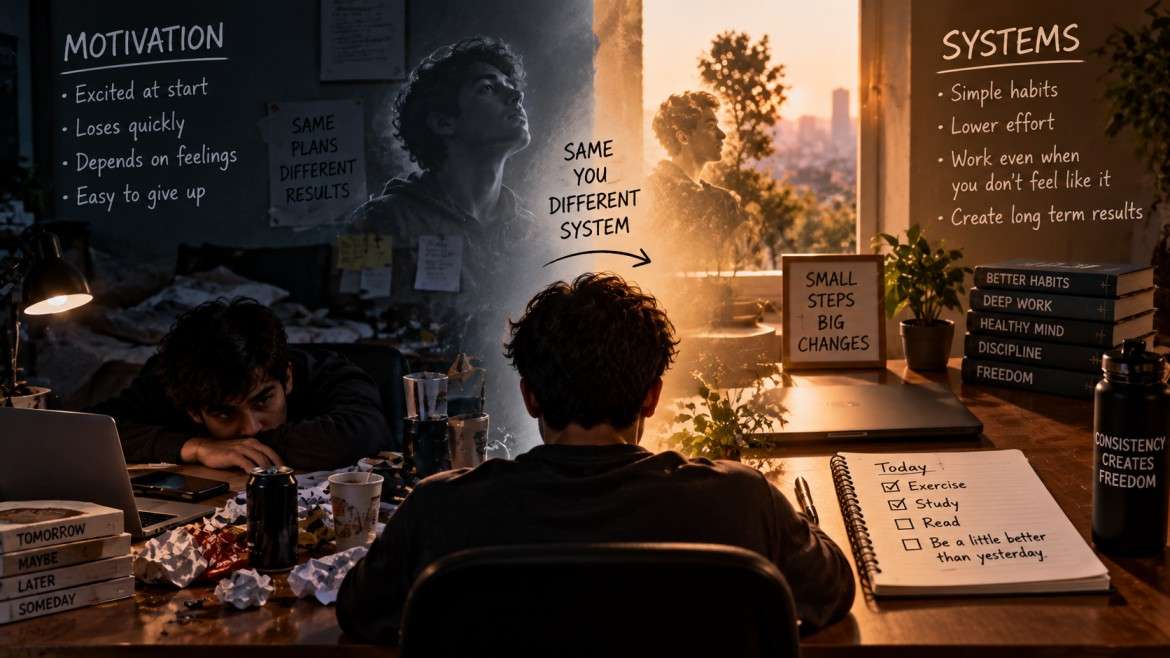
Goals tell you where to go. Systems tell you what to do.
This is the central difference in systems vs goals.
A goal might be:
I want to lose 10 kilograms.
A system might be:
I walk for 30 minutes after dinner on Monday, Wednesday and Friday.
The first describes an outcome.
The second creates a repeatable behaviour.
Goals are useful because they provide direction. But systems determine what happens on an ordinary Tuesday when the excitement has disappeared.
This is also why why motivation fails is not really an argument against having goals. Goals can tell you what matters. Systems help translate that intention into repeated action.
Research supports the importance of context in habit formation. One study found that keeping the context of a behaviour stable was associated with greater automaticity and better habit-repetition goal attainment.
That means your environment can become part of the strategy.
Discipline vs motivation: they are not the same thing
The discipline vs motivation debate often creates a false choice.
Motivation is the desire or willingness to act.
Discipline is the ability to follow through with a planned behaviour even when you do not particularly feel like doing it.
But even discipline has limits.
You cannot realistically expect yourself to make dozens of difficult decisions every day forever. A better approach is to reduce how many decisions the behaviour requires.
For example:
Instead of deciding every morning whether you will study, decide the night before:
After breakfast, I will study for 30 minutes at my desk.
Now the decision has already been made.
This approach resembles implementation planning, where a behaviour is connected to a specific cue or situation. A randomized trial found that repeatedly linking a behaviour to a routine or time cue increased automaticity and plan enactment.
The practical lesson is simple:
Do not ask motivation to make the same decision every day.
The habit loop psychology behind consistent behaviour
The habit loop psychology often described in popular culture is more useful when understood simply.
A repeated behaviour can become associated with a particular context or cue.
For example:
Cue → Behaviour → Outcome
You finish dinner.
That becomes the cue.
You put on your walking shoes and go outside.
The physical activity becomes the behaviour.
You experience the immediate satisfaction of having completed it.
After enough repetition, the cue can make starting the behaviour easier.
Research describes habits as cue-response associations that develop through repeated behaviour in consistent contexts.
This is why why motivation fails becomes less mysterious when viewed through habit formation.
You are trying to make conscious motivation do a job that repeated environmental cues can gradually help automate.
Your environment may matter more than your willpower
Consider two students.
Student A keeps their phone beside their laptop while studying.
Student B leaves the phone in another room.
Both may have identical academic goals.
But their environments are different.
Student A repeatedly faces the temptation to check notifications. Student B has removed one source of interruption before the study session begins.
This is the basic idea behind environmental design habits.
Instead of asking yourself to become stronger every time temptation appears, change the surroundings that trigger the unwanted behaviour.
You can:
- Keep your phone outside the bedroom at night.
- Put workout clothes beside your bed.
- Keep healthy food visible and convenient.
- Block distracting websites during study sessions.
- Keep your book open on your desk.
- Prepare tomorrow’s work before going to sleep.
These changes may appear small, but they alter the cues surrounding behaviour.
A recent meta-analysis also found that consistency in cues, particularly temporal and routine cues, is associated with habit strength and behaviour, although the effects vary by cue and behaviour.
What about dopamine and motivation?
Searches for how dopamine affects motivation and habit formation often produce an oversimplified explanation: dopamine equals pleasure.
The reality is more complicated.
Dopamine is involved in several brain processes, including motivated behaviour and reward-related learning. It should not be treated simply as a chemical that makes you “feel good.”
This distinction matters.
When you repeatedly check social media, for example, the attraction may involve anticipation, learning and reinforcement rather than simply receiving pleasure from every individual notification.
The same broader principle applies to productive habits.
A behaviour that becomes associated with predictable cues and rewarding outcomes can become easier to initiate over time.
So you do not necessarily need to manufacture enormous bursts of motivation.
You need to make useful behaviours repeatable.
For a deeper explanation of how dopamine participates in reward-related behaviour, this review of dopamine and motivation provides useful scientific background.
Why relying on motivation feels so convincing at first
There is a psychological trap here.
Motivation feels powerful because the beginning of a goal often comes with emotional energy.
You buy the running shoes.
You create the study timetable.
You download the productivity app.
You tell your friends about your new plan.
Everything feels fresh.
But novelty fades.
The behaviour then has to survive ordinary life.
That is the point at which why motivation fails becomes visible.
A strategy that works only when you are excited was never designed for the days when you are tired, distracted or disappointed.
The strongest systems are built around those days.
What about ego depletion theory?
You may have heard the idea that self-control works like a limited mental battery. This is associated with ego depletion theory.
However, the scientific picture is more complicated than the popular version suggests. Large-scale replication efforts have produced findings that challenge a simple, universal depletion effect, and researchers continue to debate the mechanisms involved.
The practical takeaway does not require settling that debate.
Whether or not self-control can be described as a literal “battery,” people clearly experience differences in attention, fatigue, distraction and decision-making across situations.
That gives you another reason to reduce unnecessary decisions.
If an important behaviour can be made easier through preparation, routines and environmental cues, you do not have to repeatedly negotiate with yourself about whether to do it.
How to build systems instead of relying on motivation
If you want to understand how to build systems instead of relying on motivation, start small.
1. Turn the goal into a behaviour
“Become healthier” is too vague.
“Walk for 20 minutes after dinner” is actionable.
2. Attach the behaviour to a cue
Try:
After I finish breakfast, I will study for 30 minutes.
The cue tells your brain when the behaviour begins.
3. Make starting easier
Do not design a system that requires heroic effort.
If you want to read, keep the book nearby.
If you want to exercise, prepare your clothes beforehand.
If you want to study, keep your workspace ready.
4. Reduce friction
Make the desired behaviour convenient and the unwanted behaviour slightly inconvenient.
You do not need perfect self-control when your environment is working with you.
5. Track repetition, not perfection
Missing one day does not destroy a habit.
The important question is whether you return to the behaviour rather than turning one missed session into a complete abandonment of the system.
6. Keep the context reasonably consistent
Research suggests that stable contexts can support automaticity.
That might mean studying at the same desk, exercising after the same daily routine or writing at a consistent time.
The objective is not rigidity.
It is predictability.
The real lesson behind why motivation fails
There is nothing wrong with wanting to feel motivated.
Motivation can give you energy. It can help you begin. It can make difficult work feel meaningful.
But it is a poor foundation when it becomes the only thing holding the system together.
Why motivation fails is ultimately a question about design.
If your goal requires you to feel enthusiastic every morning, your system is fragile.
If your goal is connected to a specific behaviour, cue and environment, you have something that can continue working when enthusiasm disappears.
That is the difference between hoping you will do something and creating conditions that make doing it more likely.
Frequently Asked Questions
Why motivation fails when trying to achieve long-term goals?
Motivation naturally fluctuates with mood, fatigue, stress, novelty and circumstances. Long-term goals therefore become difficult when their success depends entirely on consistently feeling motivated.
Why is motivation not enough to achieve goals?
Motivation can help initiate behaviour, but repeated action often requires planning, environmental support and habits. A system reduces the need to make the same decision repeatedly.
Is discipline better than motivation?
They serve different purposes. Motivation can provide desire and direction, while discipline and systems can help maintain behaviour when motivation is low.
What is the difference between systems vs goals?
A goal describes a desired outcome, while a system describes the repeated actions used to move toward that outcome. Both can be useful, but systems translate intentions into behaviour.
How does habit formation reduce dependence on motivation?
Repeated behaviour in a stable context can strengthen cue-response associations and increase automaticity. This can make a behaviour easier to initiate without requiring the same level of conscious motivation each time.
Does dopamine control motivation?
No. Dopamine is involved in motivation, reward-related behaviour and learning, but motivation is produced by complex interactions among multiple neural and psychological processes.
How can I stop relying entirely on motivation?
Convert goals into specific behaviours, connect those behaviours to reliable cues, reduce friction, prepare your environment and focus on consistent repetition rather than waiting to feel motivated.
Conclusion
The next time you lose motivation, do not immediately conclude that you have failed.
Ask a different question.
Was the system designed to work without motivation?
If the answer is no, the solution may not be another motivational video, a more ambitious goal or a harsher promise to yourself.
It may simply be a better system.
Because why motivation fails is not that motivation has no value. It is that motivation was never meant to carry the entire weight of long-term behaviour.
Goals give you direction.
Discipline helps you follow through.
Habits reduce the number of decisions you need to make.
And a well-designed environment quietly makes the right action easier.
That is how a goal can survive the day when motivation does not.
Explore more practical personal growth and self-care guides in our [Younag Minds] section to build better habits, routines and everyday systems.