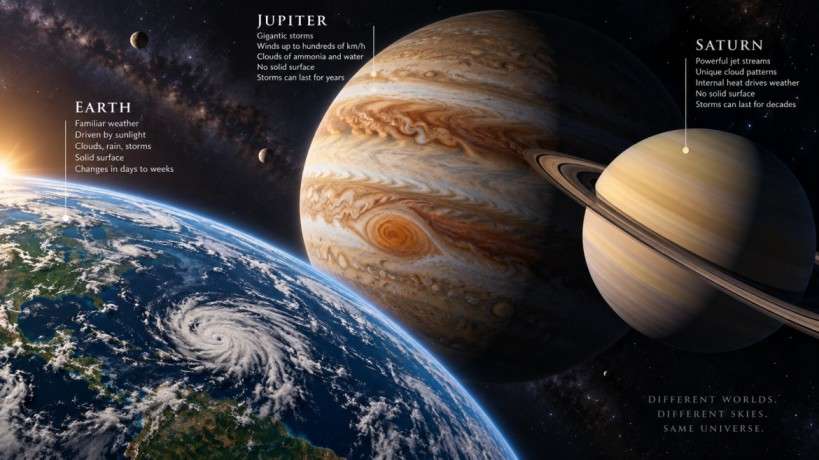
Gas Giant Weather vs Earth: Why Jupiter and Saturn Have Such Strange Weather
Table of Contents
Earth’s weather feels familiar because we experience it every day.
Clouds form, winds move across continents, rain falls, storms develop and eventually disappear. Almost everything we understand about weather happens within a relatively thin atmosphere sitting above oceans and solid ground.
Then there are Jupiter and Saturn.
Their atmospheres stretch deep into the planets. Their winds can move at hundreds of kilometres per hour. Their clouds form from substances such as ammonia and water, while enormous storms can survive for years or even centuries.
So what really separates gas giant weather vs earth?
The surprising answer is that the difference is not simply about size. Jupiter and Saturn operate as enormous, rapidly rotating fluid systems, with internal heat playing a much larger role than it does in Earth’s atmosphere.
Once you understand that, their stripes, jet streams and giant storms begin to make much more sense.
Gas giant weather vs earth: the biggest difference is the surface
The first major difference in gas giant weather vs earth is something we rarely think about when discussing weather: the ground.
Earth has a solid surface.
Jupiter and Saturn do not have a conventional solid surface that a spacecraft could land on. Their atmospheres gradually become denser and hotter as you travel downward, eventually transitioning into extreme high-pressure states of matter. NASA describes Saturn as having no true surface, with gases and liquids becoming increasingly compressed deeper inside.
That changes atmospheric circulation dramatically.
On Earth, mountains, continents and oceans interfere with moving air. They help shape weather systems and can weaken or redirect storms.
On a gas giant, atmospheric motion can continue far below the visible clouds.
This is one of the most important differences in gas giant weather vs earth.
Earth gets most of its weather energy from the Sun
Earth’s atmosphere is primarily powered by solar heating.
The Sun warms different parts of the planet unevenly. The equator receives more direct sunlight than the poles, while oceans and land heat and cool at different rates.
These temperature differences create pressure differences, which help drive winds and atmospheric circulation.
Water also plays an enormous role. It evaporates from oceans, rises, condenses into clouds and releases heat as it changes phase.
Gas giants also receive sunlight, but they have another important energy source.
Heat from inside the planet.
Jupiter and Saturn are still releasing energy left over from their formation and from processes occurring deep inside them. This internal energy can influence convection, storms and atmospheric circulation.
NASA observations have linked Jupiter’s internal heat to powerful atmospheric disturbances, while research using Cassini data found evidence that Saturn’s internal heating helps power its jet streams.
That is a crucial part of gas giant weather vs earth.
Why do Jupiter and Saturn have striped clouds?
Look at Jupiter and you immediately see something that Earth does not have: enormous horizontal bands wrapping around the planet.
These are called belts and zones.
They form in association with alternating eastward and westward jet streams.
Jupiter rotates extremely quickly, completing one rotation in roughly 10 hours. Its rapid rotation helps organise atmospheric motion into powerful east-west flows. NASA’s Juno mission found that these jet streams extend roughly 3,000 kilometres beneath the visible cloud tops.
This gives us another major clue about gas giant weather vs earth.
Earth certainly has jet streams, but they are embedded in an atmosphere interacting with a solid surface. Jupiter’s major jets are part of a much deeper circulation system.
NASA comparisons of Earth and Jupiter show that atmospheric circulation cells on Jupiter can be vastly larger than their terrestrial counterparts, and unlike Earth’s cells, they penetrate into deeper atmospheric layers rather than ending at the surface.
So Jupiter’s stripes are not simply clouds painted across the planet.
They are the visible expression of a deep atmospheric circulation system.
What drives weather on Jupiter and Saturn?
This is where gas giant weather vs earth becomes especially interesting.
On Earth, sunlight dominates the energy budget that drives large-scale weather.
On gas giants, scientists have to consider both sunlight and internal heat.
Saturn provides an excellent example.
Cassini observations helped scientists connect Saturn’s internal heat with temperature differences deeper in the atmosphere. Water vapour rising from below can condense, releasing heat and creating disturbances called eddies. These eddies can transfer momentum to jet streams, helping accelerate them.
In simple terms:
Internal heat → rising material → condensation → atmospheric disturbances → stronger jet streams
Earth has condensation too, but its atmospheric energy source is different. Earth’s large-scale circulation is primarily powered by solar heating.
That difference helps explain why gas giant weather vs earth cannot be understood simply by imagining Earth with larger storms.
Why are storms on gas giants so enormous?
Now we reach one of the strangest parts of gas giant weather vs earth.
Jupiter’s Great Red Spot is a gigantic rotating storm that has been observed for more than 300 years. NASA describes it as roughly twice the width of Earth.
Why can something like this survive for so long?
One important factor is the absence of a solid surface directly beneath the atmosphere.
On Earth, atmospheric storms eventually interact with land, mountains and other systems. Friction and changes in environmental conditions help weaken them.
Jupiter’s storms exist inside a deep atmosphere dominated by powerful jet streams and rotating flows.
That does not mean every Jovian storm lasts for centuries. Many disturbances appear and disappear relatively quickly. But the environment can support remarkably persistent vortices.
NASA observations have also shown enormous storm eruptions rising from deep water-cloud regions on Jupiter and interacting with powerful jet streams.
What are clouds made of on gas giants?
The clouds themselves are another major difference in gas giant weather vs earth.
Earth’s familiar clouds are primarily made of water droplets and ice crystals.
Jupiter has several major cloud layers associated with different substances. NASA describes likely cloud layers involving ammonia, ammonium hydrosulfide and water.
The exact cloud composition changes with altitude and pressure.
As you descend into the atmosphere, temperature and pressure rise dramatically. Different chemicals can condense at different levels, creating a layered atmospheric structure.
So when you look at a photograph of Jupiter, you are not seeing the entire weather system.
You are seeing the uppermost visible portion of a much deeper atmosphere.
For a closer look at Jupiter’s atmosphere and its powerful winds, NASA’s overview of Jupiter’s atmosphere provides useful background.
Gas giant weather vs earth: wind behaves differently too
Earth has powerful winds, including hurricanes and jet streams.
But Saturn’s atmosphere demonstrates just how extreme planetary winds can become.
NASA reports that Saturn’s upper-atmosphere winds near the equator can reach about 500 metres per second, substantially faster than Earth’s strongest hurricane-force winds.
Saturn’s jet streams move east and west at different latitudes, creating its familiar banded appearance. These are examples of zonal jet streams, meaning winds organised primarily by latitude.
Jupiter also has extremely fast winds.
NASA’s James Webb Space Telescope has detected a high-speed jet in Jupiter’s upper atmosphere travelling at about 515 kilometres per hour, above the main cloud decks.
This reveals another fascinating aspect of gas giant weather vs earth: weather does not necessarily exist in one simple atmospheric layer.
Different altitudes can contain different wind patterns.
Saturn’s hexagon shows how strange planetary fluid dynamics can become
Saturn has perhaps the most famous example of unusual planetary weather: its northern polar hexagon.
It is a six-sided pattern formed by a jet stream around Saturn’s north pole.
It is not a solid structure and there is no physical wall creating the six sides.
Instead, the shape emerges from atmospheric fluid dynamics within the rapidly rotating atmosphere.
NASA describes the hexagon as a huge wavy jet stream with winds around 200 miles per hour.
This is difficult to imagine from an Earth-based perspective because our weather systems rarely maintain such enormous geometric structures.
But rotating fluids can behave in surprising ways.
And gas giants provide natural laboratories for studying those behaviours.
Why do storms last so long on gas giants?
One of the most common questions about gas giant weather vs earth is why storms can persist for such extraordinary periods.
There is no single answer.
Several factors work together:
- Deep atmospheric circulation
- Powerful jet streams
- Rapid planetary rotation
- Internal heat
- Lack of a conventional solid surface
- Interaction between neighbouring atmospheric vortices
The Great Red Spot illustrates the result.
Its size and appearance have changed over time, so it is not a perfectly unchanged storm. But its extraordinary longevity shows that Jupiter’s atmosphere can maintain large-scale vortices far longer than most terrestrial storms.
The important point is that gas giant weather vs earth involves different physical conditions from the beginning.
Gas giant weather vs earth: a simple comparison
| Feature | Earth | Gas giants |
|---|---|---|
| Surface | Solid surface | No conventional solid surface |
| Main atmospheric energy source | Primarily the Sun | Sun + significant internal heat |
| Major cloud substance | Water | Ammonia, water and other compounds |
| Rotation | Relatively slower | Jupiter and Saturn rotate rapidly |
| Jet streams | Strong | Extremely powerful and planet-spanning |
| Storm scale | Usually regional | Can become planetary in scale |
| Atmospheric depth | Relatively shallow | Extremely deep |
| Weather structure | Strongly influenced by land and oceans | Strongly influenced by deep fluid circulation |
This table captures the central idea behind gas giant weather vs earth.
The difference is not one unusual feature.
It is the entire atmospheric architecture.
Why studying gas giant weather helps us understand Earth
It might seem strange to study Jupiter or Saturn to understand Earth’s atmosphere.
But the comparison is scientifically useful.
Both Earth and gas giants have storms, jet streams, convection and rotating atmospheric flows. The difference is that these processes operate under dramatically different conditions.
By studying Jupiter’s jets and storms, scientists can test ideas about atmospheric fluid dynamics that are difficult to isolate on Earth.
NASA describes Jupiter as a natural laboratory for understanding the interaction between intense jet streams and severe atmospheric disturbances.
That makes gas giant weather vs earth more than an astronomy comparison.
It is also a way of understanding how atmospheres work.
Frequently Asked Questions
What is the main difference between gas giant weather vs earth?
The biggest differences are the absence of a conventional solid surface, much deeper atmospheres, rapid rotation, powerful jet streams and the importance of internal heat.
Why do gas giants have stronger weather than Earth?
Their enormous atmospheres, rapid rotation, deep circulation and internal energy sources allow atmospheric structures to develop on scales that are very different from those on Earth.
Why do Jupiter and Saturn have striped clouds?
Their stripes are associated with alternating eastward and westward jet streams that organise clouds into long bands around the planets.
Why do storms last so long on gas giants?
Deep atmospheric circulation, powerful jet streams, rapid rotation and the absence of a conventional solid surface can help large vortices persist for long periods.
What are clouds made of on gas giants?
Depending on altitude and pressure, clouds can contain substances such as ammonia, ammonium hydrosulfide and water.
What drives the weather on Jupiter and Saturn?
Both receive energy from the Sun, but internal heat is also important. On Saturn, observations have linked internal heating and water condensation to processes that help power jet streams.
Does Jupiter have weather below its visible clouds?
Yes. Juno measurements indicate that Jupiter’s major jet streams extend roughly 3,000 kilometres beneath the visible cloud tops.
Does Earth have anything similar to gas giant weather?
Yes. Earth also has jet streams, cyclones, anticyclones and convection. The major difference is that these processes operate within a much shallower atmosphere strongly influenced by oceans and solid land.
Conclusion
The easiest way to understand gas giant weather vs earth is to stop thinking of Jupiter and Saturn as Earth with bigger storms.
They are fundamentally different atmospheric environments.
Earth’s weather is strongly shaped by sunlight, oceans, continents and a solid surface. Jupiter and Saturn have enormous fluid atmospheres, rapid rotation, powerful zonal jet streams and significant internal heat.
Their stripes are products of atmospheric circulation.
Their giant storms are enormous rotating structures.
Saturn’s hexagon is a manifestation of fluid dynamics.
And beneath all of it lies a much deeper atmosphere than we can see from space.
The next time you look at a photograph of Jupiter’s bands or Saturn’s strange polar patterns, you are not simply looking at clouds.
You are seeing the visible surface of a planetary-scale fluid system that behaves in ways Earth can only partly imitate.
That is what makes gas giant weather vs earth such a fascinating comparison: the same basic physics of heat, motion and fluids can produce radically different worlds.
Explore more fascinating planetary science and space topics in our [Science] section to discover how planets and their atmospheres work.