Table of Contents
A baby can start with what looks like a simple cold.
A runny nose. A little cough. Less interest in feeding.
Then suddenly, the baby’s breathing starts to change.
The chest may pull inward with every breath. The baby may breathe unusually fast, struggle to feed, or become unusually sleepy.
This is why parents often ask, why is rsv so dangerous for babies when RSV can cause only mild cold-like symptoms in many adults.
The surprising answer is that the virus does not have to be dramatically different.
The baby’s airways are.
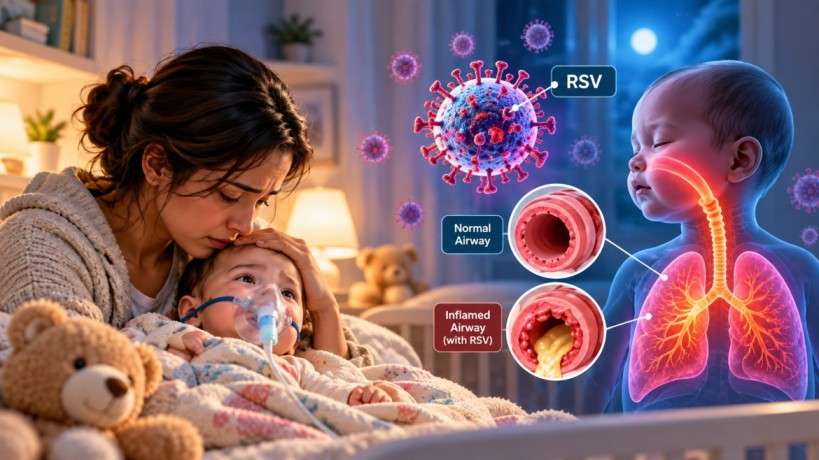
RSV can cause inflammation, mucus and obstruction in the small airways. In an infant, even a relatively small amount of swelling can make breathing much harder.
That is the key to understanding why is rsv so dangerous for babies.
What is RSV?
Respiratory syncytial virus, or RSV, is a common respiratory virus that can infect the nose, throat and lungs.
For most people, it causes symptoms similar to a cold:
- Runny nose
- Congestion
- Cough
- Sneezing
- Fever
- Wheezing
- Reduced appetite
Most infections improve on their own.
But babies, particularly very young infants, can develop more serious lower respiratory infections such as bronchiolitis or pneumonia.
That difference explains much of why is rsv so dangerous for babies.
Why are small airways more vulnerable to RSV?
This is probably the most important part of the story.
Think about a narrow drinking straw.
If the inside becomes slightly swollen or partly blocked, moving air through it becomes much harder.
An infant’s small airways are obviously not straws, but the basic principle is useful.
RSV can cause:
- Inflammation of the airway lining
- Increased mucus
- Swelling around the small airways
- Accumulation of damaged cells and secretions
WHO explains that severe RSV infection can cause small airway obstruction because of mucus and accumulated dead cells.
For a larger airway, some swelling may still leave plenty of room for airflow.
For a baby’s tiny airway, the same change can have a much bigger effect.
That is one of the clearest answers to why is rsv so dangerous for babies.
Why does RSV cause bronchiolitis in babies?
RSV is one of the major causes of bronchiolitis, an infection and inflammation affecting the small airways of the lungs.
Instead of affecting only the upper respiratory tract, the infection can move deeper into the lungs.
The result can be:
- Coughing
- Wheezing
- Faster breathing
- Difficulty breathing
- Feeding problems
- Low oxygen levels in severe cases
WHO’s 2026 childhood illness guidance specifically includes bronchiolitis in infants and young children as an important cause of respiratory distress.
This is where why is rsv so dangerous for babies becomes more understandable.
The problem is not simply that the baby has a cough.
The problem is that the infection can interfere with the basic mechanics of breathing.
What does RSV breathing look like in infants?
Parents may notice changes before they realize how serious they could be.
Watch for:
Fast breathing
The baby may suddenly breathe much faster than normal.
Chest retractions
The skin between or below the ribs may pull inward during breathing.
These are often called RSV breathing retractions.
Nostrils flaring
The nostrils may widen with each breath as the baby works harder to bring air in.
Grunting
A baby may make a grunting sound while breathing.
Wheezing
A high-pitched or whistling sound can occur when air moves through narrowed airways.
Breathing pauses
Very young infants can sometimes experience apnea, meaning pauses in breathing.
The CDC notes that infants younger than 6 months may show irritability, decreased activity, reduced feeding or apnea, and they may not always have a fever.
This is another reason why is rsv so dangerous for babies can be difficult for parents to recognize at first.
The symptoms do not always look dramatic.
Why can RSV affect feeding?
Here is another part parents sometimes overlook.
Babies need to coordinate breathing, sucking and swallowing while feeding.
When congestion or breathing difficulty increases, that coordination becomes harder.
The baby may:
- Feed for shorter periods
- Stop repeatedly to breathe
- Take much less milk
- Become tired while feeding
- Produce fewer wet diapers
Now the illness is no longer only about the lungs.
Poor feeding can contribute to dehydration, while increasing breathing effort can make the baby even more exhausted.
That combination helps explain why is rsv so dangerous for babies, particularly during the first months of life.
Which babies are more vulnerable?
RSV can become serious in any infant, but some babies have a higher risk of severe illness.
Risk is particularly concerning in:
- Very young infants
- Premature babies
- Babies with chronic lung disease
- Babies with certain congenital heart conditions
- Children with weakened immune systems
- Children with severe cystic fibrosis
- Children with certain neuromuscular conditions affecting swallowing or clearing mucus
The CDC states that the younger the infant, the greater the risk generally becomes.
WHO also identifies infants, especially those under 6 months, as being at particularly high risk of severe RSV disease.
What are the signs RSV is getting worse?
RSV can begin mildly and become more serious several days into the illness.
Parents should pay attention to changes rather than focusing on one symptom.
Seek medical advice if the baby:
- Is having difficulty breathing
- Is breathing much faster than usual
- Is not drinking enough
- Has noticeably fewer wet diapers
- Becomes unusually sleepy or inactive
- Has worsening symptoms
- Develops repeated breathing pauses
Severe breathing difficulty, blue or gray coloring, significant breathing pauses, or difficulty waking the baby require urgent medical attention.
The CDC specifically recommends medical care when a child has difficulty breathing, is not drinking enough fluids, or has worsening symptoms.
RSV is not the same as every other respiratory illness
It can be useful to understand the difference between an acute viral infection and chronic respiratory diseases.
For example, COPD is a long-term lung condition with different causes and mechanisms. We previously explored this in [why COPD is more than a smoker’s disease].
RSV, by contrast, is an acute viral infection.
The two conditions should not be confused simply because both can involve breathing problems.
The important connection is that respiratory symptoms can have very different causes, especially in different age groups.
How can nirsevimab protect babies from RSV?
One of the biggest changes in RSV prevention is the availability of long-acting monoclonal antibodies.
Nirsevimab is not a traditional vaccine.
Instead, it gives the baby ready-made antibodies that can provide protection against severe RSV disease.
The CDC currently recommends an infant RSV antibody for eligible babies entering their first RSV season when maternal RSV vaccination has not provided protection. Most infants do not need both maternal vaccination and an infant antibody.
Current CDC guidance also reports strong protection from nirsevimab against RSV-associated lower respiratory tract disease requiring hospitalization.
WHO also recognizes maternal vaccination and long-acting monoclonal antibodies as approaches for protecting infants against severe RSV disease.
Parents can check the CDC’s current RSV immunization guidance for infants and discuss eligibility with their healthcare provider.
Can RSV be prevented completely?
No prevention method makes infection impossible.
But several measures can reduce the risk of severe disease and transmission.
For babies, practical steps include:
- Wash hands before touching the baby.
- Keep sick people away from the infant when possible.
- Avoid exposing babies to tobacco smoke.
- Clean frequently touched surfaces.
- Avoid sharing cups, utensils or other objects that may carry respiratory secretions.
- Discuss available RSV prevention options with the baby’s healthcare provider.
Prevention becomes particularly important for very young or medically vulnerable infants.
So, why is rsv so dangerous for babies?
The simplest answer is small airways plus inflammation plus limited respiratory reserve.
RSV can cause inflammation and mucus in the small airways.
In an infant, those airways have very little room to spare.
If breathing becomes harder, feeding can also become harder. If feeding falls significantly, dehydration can become another concern.
That combination explains why is rsv so dangerous for babies even though RSV often causes only mild symptoms in older children and adults.
But there is an important distinction.
RSV does not automatically mean severe illness.
Most infections are mild.
The important thing is recognizing when the illness is moving from a simple respiratory infection toward breathing difficulty, poor feeding or dehydration.
What parents should remember
If a baby has RSV, don’t watch only the temperature.
Watch the breathing.
Watch the feeding.
Watch the baby’s activity and wet diapers.
The most concerning change is often not simply that the baby is coughing more. It is that the baby is beginning to struggle with basic functions such as breathing and feeding.
That is ultimately the most practical answer to why is rsv so dangerous for babies.
The virus can turn a seemingly ordinary respiratory infection into a much more serious problem when it reaches an infant’s smallest airways.
And because babies cannot tell us what they are feeling, sometimes the most important warning sign is simply a change in the way they breathe.
Frequently Asked Questions
Why is RSV so dangerous for babies under 6 months?
Very young infants have small airways and less respiratory reserve. RSV can cause bronchiolitis, breathing difficulty, feeding problems and, in severe cases, low oxygen levels.
Can RSV cause bronchiolitis in infants?
Yes. RSV is one of the major causes of bronchiolitis, which involves inflammation of the small airways in the lungs.
What does RSV breathing look like in infants?
It can include rapid breathing, chest retractions, nostril flaring, grunting, wheezing or pauses in breathing.
What are the signs RSV is getting worse in a baby?
Increasing breathing difficulty, poor feeding, reduced activity, dehydration or worsening symptoms are important warning signs.
Do all babies with RSV need hospitalization?
No. Most RSV infections are mild. Hospital care may become necessary when an infant develops significant breathing problems, dehydration, low oxygen or other complications.
How does nirsevimab protect babies from RSV?
Nirsevimab is a long-acting monoclonal antibody that provides ready-made antibodies against RSV. It is designed to reduce the risk of severe RSV disease rather than permanently prevent infection.
Are RSV monoclonal antibodies the same as vaccines?
No. Infant RSV monoclonal antibodies provide ready-made antibodies, while vaccines stimulate the immune system to produce its own immune response.
When should a baby with RSV see a doctor?
Medical attention is recommended when a baby has difficulty breathing, is not drinking enough fluids or has worsening symptoms. Severe breathing difficulty or other emergency warning signs require urgent care.
xplore more practical health and wellness guides in our [Health & Wellness] section.