Table of Contents
Look at the Universe today and it seems full of stars. But on the largest scale, something remarkable has been happening for billions of years: the cosmic factory that makes stars has been slowing down.
That immediately raises a strange question: why is cosmic star formation declining when galaxies still contain enormous amounts of gas and new stars are still being born?
The answer is not simply that the Universe is “running out of fuel.” The story is more complicated. Galaxies need the right kind of gas, in the right physical state, concentrated in the right places. They also have to avoid processes that heat, remove, or stabilize that gas before it can collapse into stars.
To understand why is cosmic star formation declining, it helps to travel back to an era when the Universe was dramatically more productive.
When did the Universe make the most stars?
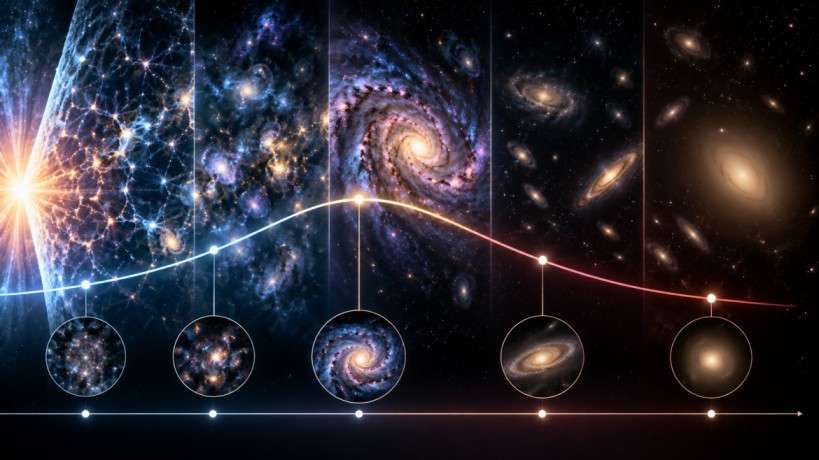
The history of star formation is not constant. Astronomers estimate that the cosmic star formation rate rose rapidly during the early Universe and reached its broad peak around redshift 2, roughly 2–3 billion years after the Big Bang. ESA calls this period cosmic noon astronomy because the Universe was at the height of its star-forming activity.
The classic Madau-Dickinson plot illustrates this rise and fall. If you have ever wondered what is the Madau Dickinson plot, it is essentially a visual history of the average rate at which stars formed across cosmic time.
The original Madau and Dickinson review placed the peak of cosmic star-formation-rate density at about 3.5 billion years after the Big Bang, around redshift 1.9, followed by a substantial decline toward the present day.
So, why is cosmic star formation declining?
The first major clue is the supply of cold gas.
Stars need more than “gas”
It is tempting to imagine a galaxy as a giant reservoir of hydrogen waiting to turn into stars.
Reality is less convenient.
A galaxy can contain plenty of gas without producing stars efficiently. The gas generally needs to become sufficiently cold and dense for gravity to overcome opposing forces and cause clouds to collapse.
This is why molecular gas star formation is so important. Dense molecular clouds are the immediate environments in which many stars are born.
Atomic hydrogen is an important part of the supply chain, but it is not automatically ready to become a star. Gas has to move through different physical phases before it can efficiently participate in star formation.
Research summarized by NASA’s Astro2020 decadal survey notes that cosmic molecular-gas content broadly follows the history of star formation, while neutral atomic gas appears to evolve more slowly.
That distinction helps explain why is cosmic star formation declining even though galaxies have not simply emptied themselves of hydrogen.
Is the Universe actually running out of gas?
Not exactly.
If the question is is the universe running out of gas to make stars, the best answer is: galaxies are gradually becoming less efficient at turning their available gas into new stars, and their supply of fresh cold material can also decline.
Galaxies are not closed containers. They receive gas from their surroundings, recycle material from older stars, and lose material through winds and other processes.
Early in cosmic history, galaxies were generally supplied by a much richer environment of cold material. Over time, the balance changed.
The cosmic web still contains enormous quantities of gas, but getting that gas into a galaxy—and then turning it into dense, star-forming clouds—is not guaranteed.
This is one reason neutral hydrogen galaxies and the reservoirs surrounding galaxies are so important to modern research. Astronomers are trying to understand not merely how much gas exists, but how efficiently galaxies can move it inward and convert it into stars.
The surprising problem: galaxies can have gas and still stop forming stars
This is where the story becomes more interesting.
A galaxy does not necessarily stop forming stars because its gas supply reaches zero.
Scientists use the term galaxy quenching for the suppression or shutdown of star formation. Several physical mechanisms can contribute, and they do not operate identically in every galaxy.
NASA researchers noted in 2026 that some quenched galaxies can retain substantial cold-gas reservoirs. One proposed mechanism is dynamical suppression, in which strong differential rotation can stabilize dense gas and make it harder for that gas to collapse into stars.
In simple terms, the gas can be there—but it may not be in a condition where gravity can easily turn it into stars.
That is a crucial part of understanding why is cosmic star formation declining.
What can stop a galaxy from forming stars?
There is no single universal “off switch.”
Several processes can interfere with star formation:
1. Gas depletion
Stars consume gas. Over very long periods, a galaxy can reduce its reservoir of material available for future star formation.
2. Gas heating
Hot gas is generally harder to compress into the cold, dense clouds needed for star formation.
3. Galactic winds
Young stars and supernova explosions can inject energy and momentum into surrounding gas. In some galaxies, powerful outflows can push gas away or prevent it from settling into the star-forming regions.
4. Supermassive black holes
Active galactic nuclei can release enormous amounts of energy. Their feedback may heat surrounding gas or drive outflows, reducing the conditions favorable to future star formation.
5. Environmental effects
Galaxies living in groups and clusters can interact with their surroundings. Gas can be stripped away or altered by the hot material surrounding the galaxy.
These processes help explain why do galaxies stop forming stars even when their histories and environments are very different.
The role of galaxy quenching
The concept of galaxy quenching is central to explaining the Universe’s long-term decline in star production.
Imagine two galaxies that each contain a significant amount of gas. One has gas that remains cold, dense, and able to collapse. The other has gas that is heated, stabilized, dispersed, or prevented from reaching the central star-forming regions.
Their total gas masses might not tell the whole story.
Their star-formation rates could be dramatically different.
Recent NASA research discussions emphasize precisely this puzzle: some galaxies can remain relatively gas-rich while becoming quiescent. The physical mechanisms responsible for quenching remain an active area of research.
That makes why is cosmic star formation declining a question about efficiency as much as quantity.
Why cosmic noon was so different
During cosmic noon astronomy, galaxies were growing rapidly and frequently contained much larger reservoirs of material capable of feeding star formation.
ESA describes the period around 2–3 billion years after the Big Bang as the era when the pace of star formation and galaxy growth reached its peak.
The Universe was also younger and more dynamically active.
Galaxies were assembling, merging, accreting material, and building stellar populations at a much faster overall rate than today.
But after the peak, several things changed simultaneously.
Fresh gas became harder to deliver efficiently. Galaxies consumed and recycled material. Some systems developed mechanisms that suppressed star formation. Others were affected by their environments.
The result was a broad decline in the global star-formation rate.
Does the decline happen in every galaxy?
No.
This is an important qualification.
The phrase why is cosmic star formation declining refers to the average behavior of the Universe, not a rule that every galaxy is becoming less active at exactly the same time.
Some galaxies are still experiencing vigorous star formation. Others have nearly stopped. Some can transition from active to quiet relatively quickly, while others continue forming stars for billions of years.
The Milky Way itself is still forming stars.
And nearby galaxies can have very different histories. For example, NASA reported in 2026 that observations of Andromeda show its star formation has declined over the past 500 million years, with an even sharper decline during the most recent 40 million years.
So the cosmic trend is an average emerging from billions of individual galaxies following different evolutionary paths.
What happens to neutral hydrogen?
The story becomes even more complicated when astronomers separate different forms of gas.
Neutral hydrogen galaxies can contain large quantities of atomic hydrogen, but atomic gas is not automatically equivalent to star-forming fuel.
The gas may need to cool, compress, become molecular, and reach sufficiently dense conditions before gravity can drive collapse.
This is why measurements of neutral hydrogen, molecular gas, dust, and star-formation rates need to be considered together.
NASA’s Astro2020 report highlights this distinction: the evolution of molecular gas appears more closely connected to the cosmic star-formation history, while atomic neutral gas has evolved differently.
That observation makes the question why is cosmic star formation declining much more interesting than simply asking how much hydrogen remains.
Could the Universe eventually stop making stars?
In the extremely distant future, star formation is expected to become increasingly rare as usable cold gas becomes harder to assemble into new stars.
But that does not mean the Universe is suddenly approaching a deadline.
The present decline is gradual and occurs over enormous cosmic timescales.
There are also different pathways through which galaxies recycle material. Stars return some matter to their surroundings through winds and explosions, and galaxies can continue interacting with their environments.
So the Universe is not simply emptying a tank.
It is undergoing a slow change in the way matter moves through galaxies.
The deeper meaning of the Madau-Dickinson plot
The Madau-Dickinson plot is powerful because it turns billions of years of cosmic history into a simple curve.
It shows an early rise, a broad peak, and a long decline.
But the curve itself does not explain the physics.
It tells us what happened, while galaxy-evolution research tries to explain why it happened.
That is why why is cosmic star formation declining remains an active research question rather than a problem with one final answer.
Astronomers are now studying the movement of gas from the cosmic web into galaxies, the transformation of atomic gas into molecular clouds, feedback from stars and black holes, and the physical conditions that determine whether gas actually collapses.
Conclusion
The answer to why is cosmic star formation declining is not that the Universe has simply run out of hydrogen.
Instead, the cosmic star-forming engine has become less efficient.
The Universe passed through a period of exceptionally rapid galaxy growth during cosmic noon. Since then, galaxies have consumed gas, struggled to acquire fresh cold material, experienced heating and outflows, and in many cases developed mechanisms that suppress the collapse of gas into new stars.
Some galaxies still have significant reservoirs of gas yet form very few stars. Others remain active. That diversity is exactly why astronomers study the entire gas cycle rather than looking at gas quantity alone.
The cosmic star formation rate is falling, but the underlying story is still unfolding.
The next major question may therefore not be whether the Universe has enough gas—but whether its galaxies can still turn that gas into stars.
Frequently Asked Questions
Why is cosmic star formation declining?
The decline results from several interacting processes, including reduced availability of fresh cold gas, gas depletion, heating, outflows, environmental effects, and galaxy-quenching mechanisms that can prevent existing gas from collapsing into stars.
Why is the Universe making fewer stars?
The Universe reached its broad peak of star formation during cosmic noon and has formed stars at a progressively lower average rate since then. Galaxies increasingly struggle to acquire and efficiently convert suitable cold gas into new stars.
When was the peak of star formation in the Universe?
The cosmic star-formation-rate density peaked roughly 2–3 billion years after the Big Bang, around redshift 2. The exact characterization depends on the dataset and model used.
Is the Universe running out of gas to make stars?
Not in the simple sense. Large amounts of gas remain in galaxies and their surrounding environments, but the supply of usable cold gas and the efficiency with which galaxies convert it into stars have changed.
Why do galaxies stop forming stars?
Galaxies can become quenched when gas is depleted, heated, expelled, or prevented from collapsing. Feedback from stars and black holes, galaxy dynamics, and environmental processes can all contribute.
What is the Madau-Dickinson plot?
It is a widely used representation of the history of the cosmic star-formation-rate density. It shows that star formation rose in the early Universe, reached a broad peak, and then declined toward the present era.
What is cosmic noon astronomy?
Cosmic noon refers to the period when the Universe’s average rate of star formation and galaxy growth reached its peak, roughly a few billion years after the Big Bang.
Why does molecular gas matter for star formation?
Molecular gas is closely associated with the dense environments where stars form. Measuring it helps astronomers understand why galaxies with apparently large gas reservoirs can nevertheless have very different star-formation rates.
Explore more fascinating space and astronomy topics in our [Science] section to discover more about galaxies, stars and the evolution of the Universe.