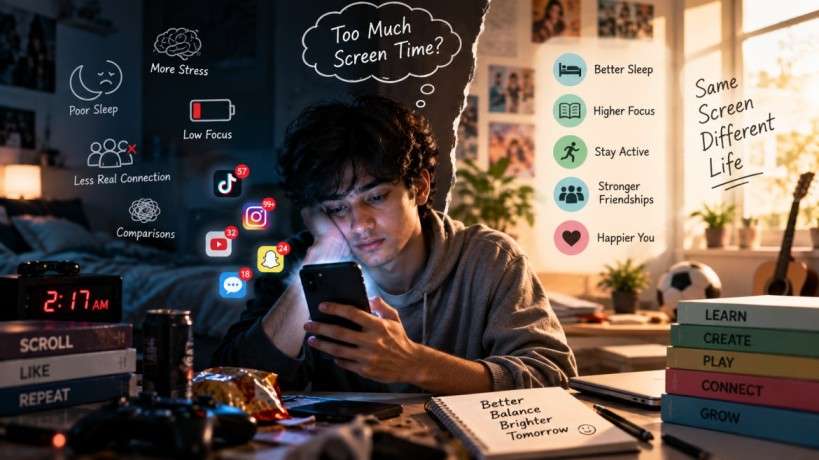
A teenager can spend three hours on a phone and still have a balanced day. Another can spend the same three hours exhausted, distracted and unable to stop scrolling at bedtime.
That is why how much screen time is too much for teens is harder to answer than it sounds. The American Academy of Pediatrics (AAP) does not recommend one universal daily screen-time limit for every teenager. Its current guidance puts more emphasis on the type and quality of media use, and on whether screens interfere with sleep, movement, school, relationships and other healthy activities.
The key to how much screen time is too much for teens is asking: What is the screen replacing?
How much screen time is too much for teens?
If you are looking for a simple answer to how much screen time is too much for teens, how much screen time is too much for teens depends on the adolescent.
The AAP’s 2026 policy notes that 1–2 hours a day or more of entertainment media may be discussed for school-aged children and teens, while stressing that healthy activities and media quality matter more than a stopwatch.
That is not a medically proven “safe limit.” For how much screen time is too much for teens, school or creative use differs from an evening of passive scrolling.

What matters more than the number
1. Sleep
When asking how much screen time is too much for teens, start with bedtime.
Teenagers generally need 8–10 hours of sleep each night. The AAP recommends avoiding screens for about an hour before bed and keeping devices out of bedrooms at night.
Notifications, gaming and emotionally intense content can also keep the brain engaged.
If a teenager regularly stays awake because of a device, that matters more than a high screen-time number by itself.
2. What are they doing?
Two hours of video-chatting with friends is not necessarily equivalent to two hours of endless scrolling. Digital media can support learning, creativity and connection, so the AAP encourages families to consider what teenagers are doing online, not only duration.
3. Is offline life still working?
This is where how much screen time is too much for teens becomes easier to judge.
Ask whether the teenager is still:
- sleeping enough
- keeping up with school
- getting regular physical activity
- eating properly
- spending time with friends and family
- maintaining hobbies and interests
If these areas are healthy, a large screen total does not automatically mean there is a problem. If several are being squeezed out, how much screen time is too much for teens becomes more about consequences than the total.
4. Can they put it down?
A teenager does not have to be “addicted” for screen use to become unhealthy. Watch for repeated distress when asked to stop, losing track of time, using screens mainly to escape difficult emotions, or feeling worse after social media.
If stopping regularly causes conflict, delays bedtime or derails responsibilities, the pattern matters.
What about social media?
Teen social media limits deserve separate consideration because screen time is not the whole story.
A teenager might spend 45 minutes messaging friends and feel socially connected. Another might spend 45 minutes comparing themselves with others, checking likes, worrying about exclusion or reading hostile comments.
Research helps explain how much screen time is too much for teens, but it does not prove that screen time alone causes depression. A systematic review of research involving children and adolescents found a large body of evidence but substantial variation between studies, making simple cause-and-effect conclusions difficult.
So when parents ask, “does screen time cause depression in teens?”, the answer needs nuance. Mental health can affect how someone uses social media, while online experiences can also affect mood, sleep, stress and social comparison.
Ask how your teenager feels after using the platform, whether they can stop when they intend to, and whether social media is interfering with sleep or real-world relationships.
Signs of too much screen time in teenagers
No single symptom answers how much screen time is too much for teens; repeated patterns matter.
Possible signs include:
- regularly staying up late because of a phone or game
- falling behind on schoolwork
- abandoning offline hobbies
- becoming highly distressed when devices are removed
- repeatedly losing track of time
- skipping exercise, meals or family interaction
- struggling to disconnect even when they want to
- feeling consistently worse after social-media use
These signs need context. A teenager working on digital art, attending an online class and talking to a distant friend may have a high screen total without the same problems as compulsive entertainment use.
How to set realistic screen time rules for teenagers
The best screen time guidelines are usually specific, predictable and realistic.
Protect key situations
Keep bedrooms at night, the dinner table and focused homework periods as phone-free zones. The AAP recommends avoiding screens for about an hour before bedtime and keeping devices out of bedrooms.
Separate school use from entertainment
A laptop needed for homework should not automatically be treated like recreational scrolling.
Target the actual problem
If gaming delays bedtime, address gaming. If social media causes constant checking, reduce notifications or change app access. Review rules when school, exams, holidays or activities change the routine.
Families looking for a practical framework can use the AAP’s Family Media Plan resources to turn general concerns into specific household boundaries.
A better way to judge teen screen time
To judge how much screen time is too much for teens, start with the essentials.
A healthy routine needs room for 8–10 hours of sleep, physical activity, schoolwork, meals, relationships, hobbies and downtime. Once those needs are protected, families can decide how much additional entertainment screen use fits their circumstances.
This is why how much screen time is too much for teens cannot be answered by one number.
Try the “after the screen” test: what happens when the device is put down?
If the teenager moves naturally to the next part of the day, the screen may be fitting into the routine. If one video becomes twenty, bedtime keeps moving later and homework gets postponed, the pattern is telling you something.
For readers who want to explore the evidence further, this systematic review of social media, depression and anxiety symptoms in children and adolescents is a useful research starting point.
The real answer is balance
So, how much screen time is too much for teens? There is no universal daily number that classifies every teenager as healthy or unhealthy.
The meaningful measure is whether screen use fits around sleep, activity, school and relationships.
The goal is not a screen-free teenage life, but keeping screens one part of the routine.
That is the practical answer to how much screen time is too much for teens: it becomes too much when the screen consistently takes more from everyday life than it adds.
Frequently Asked Questions
How many hours of screen time should a teenager have?
There is no single universal limit for all teenagers. Current AAP guidance emphasizes the type and quality of media and whether it interferes with sleep, physical activity, school, relationships and other important activities.
Is 5 hours of screen time a day too much for a teenager?
Not automatically. Five hours of mixed use is different from five hours of compulsive scrolling that displaces sleep, exercise or responsibilities.
What are the signs of too much screen time in teenagers?
Warning patterns include lost sleep, declining school performance, reduced offline activities and difficulty stopping.
Does screen time cause depression in teens?
Research has found associations between some forms of digital and social-media use and depressive symptoms, but this does not establish that screen time alone causes depression. The relationship can involve sleep, social experiences, existing mental health and the way technology is used.
What are the AAP screen time guidelines for teens?
The AAP does not currently recommend one universal daily screen-time limit for all teens. Its 2026 guidance emphasizes individualized boundaries, quality of use and protecting sleep, movement, school and relationships.
Should teenagers keep phones in their bedrooms at night?
Keeping phones and other media devices out of bedrooms can help protect sleep. The AAP recommends avoiding screen exposure for about an hour before bedtime.
How can parents set realistic screen time rules for teenagers?
Protect sleep, school, physical activity, meals and relationships first. Then create specific entertainment rules and review them when routines change.
Explore more practical guides for young people in our [Young Minds] section to learn about wellbeing, relationships, habits and everyday challenges.