Table of Contents
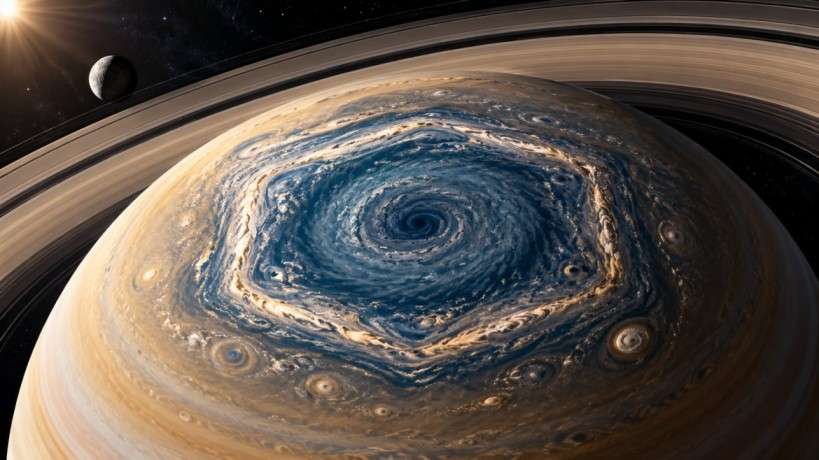
The shape looks almost too deliberate to be weather. Around Saturn’s north pole, a vast atmospheric current bends into six broad sides, creating one of the strangest patterns in space. The saturn hexagon weather pattern is not a solid object or a six-sided hurricane. It is a moving structure in a jet stream.
That distinction unlocks the mystery. The saturn hexagon weather pattern emerges from rotating fluid, strong winds, and atmospheric instability. In other words, Saturn’s bizarre geometry may be a natural consequence of physics rather than a special “hexagon-making” mechanism.
But why six sides? And why has the pattern survived for decades?
The hexagon is really a giant jet stream
The saturn hexagon weather pattern is best understood as a wavy polar jet stream surrounding Saturn’s north pole. NASA’s Cassini observations showed a feature roughly 30,000 kilometers across, with winds reaching hundreds of kilometers per hour. Inside it is a separate hurricane-like polar vortex.
So, if you searched why is there a hexagon on Saturn, the answer begins with a correction: the hexagon is not itself a storm.
It is a path followed by rapidly moving atmospheric gas.
For readers who want to see how NASA mapped this unusual feature, the NASA’s Saturn Hexagon research and imagery provides spacecraft observations and explanations from the Cassini mission.
Why can a jet stream become a hexagon?
Imagine two sections of fluid rotating at different speeds. The boundary between them experiences shear, meaning the flow speed changes sharply across a relatively small distance.
Saturn has powerful east-west jet streams, and the northern polar jet has a strong change in wind speed with latitude. Under these conditions, the flow can become unstable and develop large waves.
One major explanation treats the saturn hexagon weather pattern as a large-scale planetary wave, often described using Rossby waves Saturn research. Rossby waves occur in rotating atmospheres because rotation affects moving air differently at different latitudes. Studies have interpreted Saturn’s hexagon as a stationary or trapped Rossby wave embedded in the polar jet.
That is planetary fluid dynamics at enormous scale.
Why exactly six sides?
This is where the saturn hexagon weather pattern becomes especially interesting.
Scientists do not assume Saturn somehow “chooses” six. Mathematical models and rotating-fluid experiments have produced different polygonal patterns when researchers changed flow and rotation conditions.
In laboratory experiments designed to reproduce aspects of Saturn’s polar flow, researchers generated a six-wave pattern around a rotating fluid. Other settings produced different numbers of waves, including patterns with fewer or more sides.
So the saturn hexagon weather pattern may be the visible result of a particular instability selecting a dominant wavelength.
A 2026 study of self-organized hexagon-shaped jets in rotating fluids also found evidence that barotropic instability can help create and maintain geometrically defined flows.
This is important because a laboratory recreation of saturn hexago—more accurately, a laboratory recreation of Saturn’s hexagonal jet—does not mean researchers built a miniature Saturn. It means they reproduced some of the underlying fluid behavior.
Why does the pattern survive so long?
The saturn hexagon weather pattern was first identified in Voyager images from the early 1980s and later examined extensively by Cassini. Its persistence over several decades is one of its biggest scientific puzzles. NASA has noted that scientists still do not fully understand why the feature is so long-lived.
Part of the explanation may be Saturn’s environment.
Earth’s jet streams are affected by mountains, continents, oceans, surface friction, and constantly changing weather systems. Saturn has no solid surface interrupting its atmosphere in the same way.
That means the saturn hexagon weather pattern can exist in a comparatively smooth atmospheric environment. NASA has suggested that Saturn’s lack of solid landforms and its relatively uniform atmosphere may help such a large-scale structure remain coherent.
Why is Saturn’s hexagon only at the north pole?
If you ask why does Saturn only have a hexagon on the north pole, there is no final answer yet.
Scientists have not observed an equivalent six-sided jet at Saturn’s south pole. Cassini found that Saturn’s two polar regions can also have different atmospheric structures and seasonal behavior.
So scientists understand the saturn hexagon weather pattern much better than they once did, but they do not have a complete answer for why this exact configuration exists only in the north.
The difference could involve Saturn’s wind profile, vertical atmospheric structure, seasonal conditions, or the particular stability of the northern jet.
Can geometric storms happen on Earth?
The underlying physics is not unique to Saturn.
Earth’s atmosphere contains jet streams, Rossby waves, vortices, and other rotating-fluid phenomena. However, Earth also has continents, mountains, oceans, stronger heating contrasts, and a very different atmospheric structure.
So can geometric storms happen on Earth? Polygonal flow structures can form in rotating fluids, including in controlled laboratory conditions. But a planet-scale, long-lived six-sided atmospheric jet like Saturn’s is not a normal feature of Earth weather.
What the laboratory experiments really tell us
The pattern is valuable because scientists can test possible mechanisms in the laboratory.
Researchers can rotate fluid, change the speed difference between regions, and observe when smooth flow becomes unstable. Under suitable conditions, waves and vortices organize into polygonal patterns.
The experiments show that geometric structures can emerge naturally from rotating-fluid instability without requiring a solid object underneath.
That supports the idea that the saturn hexagon weather pattern is an emergent feature: order produced by the interaction of many moving parts.
Is the hexagon actually a storm?
Not quite.
The saturn polar vortex at the center is closer to what we normally call a storm. It has a rotating, hurricane-like structure around the north pole. The hexagon itself is mainly a jet-stream pattern.
This distinction matters when explaining how did Saturn geometric storm form. The six-sided feature is not a single swirling cloud mass that somehow developed corners. Instead, a fast-moving atmospheric current bends into a persistent wave pattern.
NASA has emphasized that Saturn’s polar vortex is not simply an Earth hurricane scaled up. Earth hurricanes are powered by processes involving warm ocean water and condensation; Saturn’s atmosphere has a different energy structure.
The deeper lesson: chaos can create order
The pattern looks like an exception to the messy nature of weather, but it may actually demonstrate something fundamental about fluids.
A turbulent system does not always produce meaningless randomness. When rotation, shear, instability, and boundaries interact in the right way, the system can settle into an organized structure.
That is why the pattern matters far beyond a strange photograph.
It gives researchers a natural example of self-organization in a planetary atmosphere. The same broad principles help scientists study saturn jet streams, atmospheric waves, vortices, and weather on other worlds.
What we know and what remains mysterious
The evidence strongly supports the idea that the saturn hexagon weather pattern is a long-lived atmospheric jet shaped by wave dynamics and instability. Rossby-wave interpretations, laboratory experiments, and numerical models have each contributed to the explanation.
But researchers still have open questions:
- Why did this particular wave number dominate?
- Why is the structure confined to the north?
- What allowed it to remain so stable for decades?
- How deeply does the pattern extend into Saturn’s atmosphere?
- What combination of wind shear and rotation originally created it?
The saturn hexagon weather pattern is therefore not a solved curiosity. It is a natural experiment that scientists continue to use to understand rotating atmospheres.
For readers interested in the latest scientific work on how these structures can emerge, the 2026 research on self-organized hexagon-shaped jets offers a useful look at modern laboratory fluid experiments.
Conclusion
The saturn hexagon weather pattern looks as if someone drew a giant geometric shape around Saturn’s north pole. In reality, there is no physical hexagon there.
There is a powerful polar jet stream, strong velocity gradients, planetary rotation, waves, and atmospheric instability. Together, those processes can organize turbulent motion into a remarkably persistent six-sided path.
Laboratory experiments show that rotating fluids can produce similar polygonal patterns, while spacecraft observations reveal how unusual Saturn’s version is.
The most useful takeaway is perhaps the simplest: nature does not always turn turbulence into disorder. Sometimes, under the right conditions, turbulence organizes itself into geometry.
And if that can happen on Saturn, other planets may be hiding equally strange patterns that we have not yet learned how to recognize.
Frequently Asked Questions
Why is there a hexagon on Saturn?
The saturn hexagon weather pattern is a wavy polar jet stream. Strong wind shear, planetary rotation, and atmospheric instability can produce large-scale waves that organize the jet into a six-sided path.
How did Saturn’s geometric storm form?
The saturn hexagon weather pattern likely formed through instability in Saturn’s polar jet. Researchers have proposed Rossby-wave and barotropic-instability mechanisms, but the exact formation history is not completely settled.
Are Rossby waves responsible for Saturn’s hexagon?
Rossby-wave models are an important explanation for the saturn hexagon weather pattern. However, instability-based models and laboratory experiments also contribute to the broader explanation.
Why does Saturn only have a hexagon on its north pole?
Scientists do not yet know. The northern and southern polar atmospheres differ, and wind profiles, seasonal effects, and vertical atmospheric dynamics may all contribute.
Can geometric storms happen on Earth?
Rotating fluids can form polygonal structures, but Earth does not naturally produce a persistent six-sided polar jet comparable to the saturn hexagon weather pattern.
Was Saturn’s hexagon recreated in a laboratory?
Yes. Rotating-fluid experiments have produced hexagonal and other polygonal patterns. These experiments help researchers study the fluid instabilities that may be involved in Saturn’s atmosphere.
Is Saturn’s hexagon permanent?
The saturn hexagon weather pattern has lasted for at least several decades of observation, but scientists cannot say that it is permanent. Its extraordinary persistence remains an open research question.
Explore more science and space topics in our [Science] section to discover more fascinating explanations about the universe, planets and the world around us.