Table of Contents
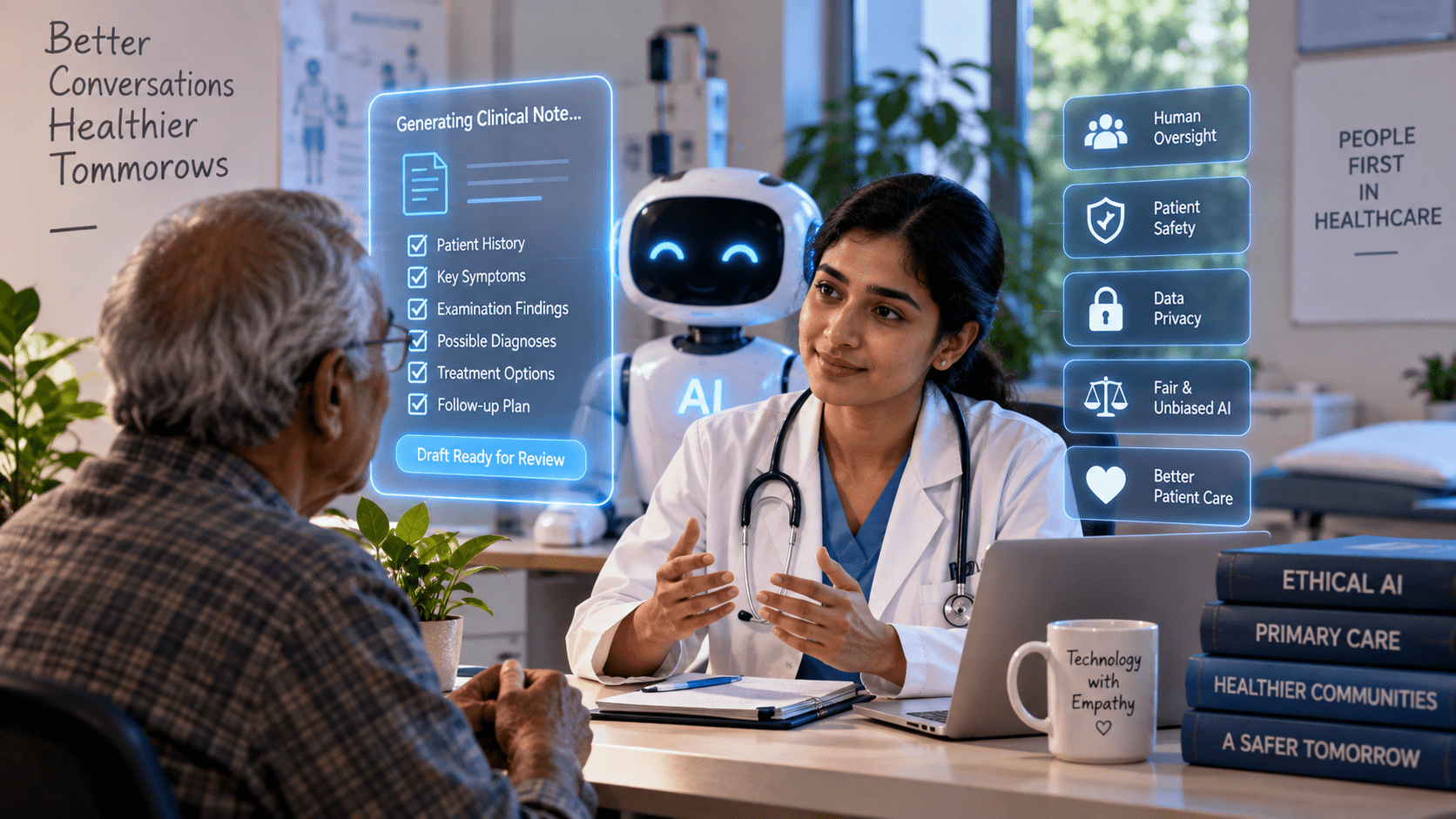
Imagine visiting your doctor and noticing something unusual: instead of spending much of the appointment typing into a computer, the doctor is looking at you, listening carefully and having a normal conversation.
An AI system is quietly helping in the background.
It may turn the conversation into a draft clinical note, highlight information that deserves attention, or help organize a patient’s medical history. But there is an uncomfortable question behind this convenience: what happens if the AI gets something wrong?
That is why safe ai in primary care is not simply about finding smarter software. It is about deciding where AI belongs, where it does not, who checks its work, how patient information is protected, and who remains responsible when something goes wrong.
The technology is moving quickly. Healthcare’s rules and safeguards have to move with it.
What Does Safe AI in Primary Care Actually Mean?
Safe ai in primary care means using artificial intelligence in ways that improve healthcare without allowing the technology to introduce unacceptable risks to patients.
That sounds straightforward, but healthcare is different from many other environments where AI is used.
A wrong recommendation in a shopping app may be inconvenient. A wrong suggestion in a medical consultation could affect a diagnosis, medication or treatment decision.
The World Health Organization says AI used in health should put human autonomy, safety, transparency, accountability, equity and sustainability at the center of its design and use.
In practice, safe ai in primary care therefore means treating AI as a clinical tool—not as an independent doctor.
Where Can AI Help in Primary Care?
The safest applications are often the ones where AI assists with a clearly defined task rather than making an important decision by itself.
Ambient clinical scribes
One of the fastest-growing applications is the ambient clinical scribe.
These systems can listen to a patient-clinician conversation and generate a draft medical note. The clinician can then review, correct and approve the documentation.
The attraction is obvious: less time spent typing and potentially more attention directed toward the patient.
A 2026 survey of UK general practitioners found that users commonly reported efficiency benefits, but it also found meaningful concerns about errors, consent and medicolegal accountability.
That is the important distinction.
AI can prepare the note. The clinician still needs to decide whether the note is accurate.
AI diagnostic decision support
Another application is AI diagnostic decision support.
A system might identify patterns in medical information, flag a potential concern or provide a clinician with additional information to consider.
This can be useful because primary-care clinicians deal with a huge variety of symptoms and conditions.
But safe ai in primary care requires the clinician to understand what the tool is intended to do and where its limitations lie.
The FDA’s January 2026 final guidance on clinical decision-support software distinguishes certain non-device clinical decision-support functions from software that falls under medical-device regulation.
In other words, not every piece of software that says something medical is regulated or validated in exactly the same way.
The Human Must Stay in the Loop
This may be the single most important principle behind safe ai in primary care.
AI should support clinical judgment rather than quietly replace it.
Consider a hypothetical example.
A patient visits a clinic with fatigue, weight loss and persistent abdominal discomfort. An AI system highlights several possible explanations based on the information entered by the clinician.
That output can be useful.
But the doctor still has to ask follow-up questions, examine the patient, consider medical history, interpret test results and decide what action is appropriate.
This is the human-in-the-loop AI in primary care model.
The human is not there simply to click “approve.” The clinician remains an active decision-maker who can question, reject or override the AI’s recommendation.
The AMA’s 2026 policy work similarly emphasizes AI as an assistive technology rather than an autonomous decision-maker and stresses physician oversight.
For safe ai in primary care, that distinction is fundamental.
What Are the Biggest Risks of AI in Primary Care Medicine?
AI can fail in several different ways.
1. It can be wrong
AI systems can produce plausible-looking information that is incorrect.
A clinical note might omit an important detail. A decision-support system might miss a relevant factor. A generative AI model might produce an answer that sounds confident even when its reasoning is flawed.
WHO has specifically warned that generative AI can produce authoritative-looking but incorrect health information.
That is why clinical ai safety cannot be based on how convincing the output sounds.
2. Bias can affect performance
An AI system is influenced by the data used to develop and evaluate it.
If certain populations are poorly represented, performance may differ between groups.
This becomes particularly important in primary care because patients vary enormously in age, language, ethnicity, socioeconomic circumstances, disability and health conditions.
WHO identifies bias, inequity and inclusiveness as major concerns in AI for health.
A system that works well for one population is not automatically safe for every population.
3. Privacy can be compromised
Healthcare information is highly sensitive.
An AI tool may process medical histories, symptoms, conversations, test results or other personal information. That creates questions about where the data goes, how long it is stored, who can access it and whether it is used for other purposes.
For readers interested in the broader principles behind responsible health AI, WHO’s guidance on AI ethics and governance in healthcare provides a useful framework for understanding privacy, accountability and human oversight.
This is particularly relevant to ambient clinical scribes.
How Do Ambient AI Scribes Protect Patient Privacy?
An ambient scribe can be useful, but how do ambient AI scribes protect patient privacy? is not a question with one universal answer.
Different products can have different data practices, technical architectures, contracts and security controls.
A responsible implementation should establish clear rules around:
- Patient consent
- Data collection
- Data storage
- Access permissions
- Retention periods
- Data transmission
- Whether information is used to train other systems
- How patients can raise concerns
Consent is especially important because the technology may be capturing a conversation that would otherwise remain between the patient and clinician.
A 2026 UK study found that consent practices among primary-care AI-scribe users were inconsistent, while researchers also reported accuracy concerns, particularly in complex and multilingual consultations.
That means safe ai in primary care cannot be achieved simply by installing an AI scribe and assuming the technology will handle privacy automatically.
AI Should Be Tested in the Real World
Another overlooked part of safe ai in primary care is continuous evaluation.
An AI system may perform well during development and still behave differently when introduced into a busy clinic.
Real patients speak differently. Medical histories are messy. Conversations are interrupted. Multiple people may be present. Patients may use different languages or accents.
The 2026 UK ambient-scribe research found higher reported error rates in situations including multiparty consultations, complex histories and non-English encounters.
This is why healthcare organizations need mechanisms to monitor AI performance after deployment—not just before launch.
Safety should be an ongoing process.
Who Is Liable for AI Medical Errors in a Clinic?
This is one of the hardest questions surrounding healthcare AI ethics.
There is no single worldwide rule saying that one party is always responsible for an AI-related medical error.
Liability can depend on the country, professional standards, the technology involved, contracts, the clinician’s actions, the healthcare organization’s role and the circumstances surrounding the error.
That makes it risky to tell clinicians simply, “The AI made the mistake, so the AI company is responsible.”
The opposite claim—that the clinician automatically carries every form of responsibility—is also too simplistic.
The AMA has recently argued that accountability should be aligned with the party best positioned to understand, prevent and mitigate a particular AI-related risk, rather than automatically assigning every error to the physician.
For safe ai in primary care, responsibility needs to be clearly defined before the system is deployed.
What Should a Safe Primary-Care AI System Look Like?
A useful framework is to ask five questions before introducing an AI tool.
1. What exactly is the AI allowed to do?
A system designed to draft notes should not quietly become a diagnostic engine without appropriate validation and oversight.
2. Who checks its output?
Every clinically meaningful AI output needs an appropriate level of human review.
3. What happens when it fails?
Clinics should have a process for identifying, correcting and reporting errors.
4. How is patient data protected?
Privacy should be part of the system design rather than an afterthought.
5. Can performance be monitored?
Organizations should know whether the system works equally well across relevant patient groups and clinical situations.
These safeguards turn safe ai in primary care from a vague aspiration into something that can actually be managed.
AI Should Make the Consultation More Human, Not Less
There is an interesting paradox here.
One reason clinics are interested in AI is that healthcare professionals spend enormous amounts of time on administrative work.
If an AI scribe reduces documentation burden, the clinician may have more time to look at the patient rather than the screen.
But if the AI introduces errors that require constant correction, creates privacy concerns or distracts the clinician from the conversation, the promised benefit becomes much smaller.
Recent research on ambient AI in primary care suggests exactly this tension: these systems can improve efficiency while simultaneously introducing concerns about accuracy, consent, bias and accountability.
The goal should therefore not be more AI.
It should be better healthcare with carefully controlled AI.
What Does the Future of AI in Primary Care Look Like?
The future of safe ai in primary care is unlikely to involve one giant system making every medical decision.
A more realistic model is a collection of specialized tools.
One might help document consultations. Another might assist with imaging or clinical information. Another could identify patients who may need follow-up.
The clinician remains responsible for understanding the patient as a whole.
This approach also fits the direction of current healthcare guidance. WHO emphasizes human oversight, transparency, accountability, safety and equity, while regulators such as the FDA are developing more specific frameworks for different types of clinical software.
The technology will continue to change.
The principles should not.
Frequently Asked Questions
How can AI be used safely in primary healthcare?
Safe ai in primary care requires defined use cases, appropriate validation, human oversight, privacy protections, monitoring for errors and clear accountability. AI should support rather than replace clinical judgment.
What are the risks of AI in primary care medicine?
Major risks include inaccurate outputs, biased performance, privacy breaches, poor integration into clinical workflows, automation bias and unclear accountability when an AI-supported decision causes harm.
What are ambient clinical scribes?
Ambient clinical scribes use AI to capture conversations between clinicians and patients and generate draft clinical documentation. The clinician should review and approve the resulting note rather than accepting it blindly.
How do ambient AI scribes protect patient privacy?
Protection depends on the specific system and its implementation. Important safeguards include informed consent, appropriate data security, access controls, limited data retention and clear policies governing how patient information is used.
What is human-in-the-loop AI in primary care?
It means AI can generate suggestions or information, but a qualified healthcare professional remains involved in reviewing the output and making the clinical decision.
Can AI replace primary-care doctors?
AI can automate or assist with particular tasks, but current guidance emphasizes that AI should support rather than replace human clinical judgment.
Who is liable for AI medical errors in a clinic?
There is no universal answer. Liability depends on the jurisdiction and circumstances, including the roles of clinicians, healthcare organizations and technology providers. Clear accountability arrangements are therefore important before deployment.
The Safest AI May Be the AI That Knows Its Limits
The most useful way to think about safe ai in primary care is not as a race toward completely autonomous medicine.
It is a question of boundaries.
AI can listen, summarize, flag, organize and assist. But healthcare still requires context, judgment, communication and responsibility.
A good AI system should therefore make a clinician more capable without making the clinician less attentive.
That means checking its work, protecting patient information, testing it across different populations and making sure someone remains accountable for the final medical decision.
The future of primary healthcare may contain much more AI than today’s clinics. The real measure of progress, however, will not be how much AI is installed.
It will be whether patients receive safer, more personal and more effective care because it is there.
Explore more practical health and wellness guides in our [Health & Wellness] section to learn about healthcare, medical technology and healthier living.