Table of Contents
Men’s Grooming Market in India Is Growing Rapidly – Here’s Why
For years, men’s grooming in India followed a fairly predictable routine: a haircut, a shave, deodorant, shampoo and perhaps a bottle of aftershave.
That picture is changing fast.
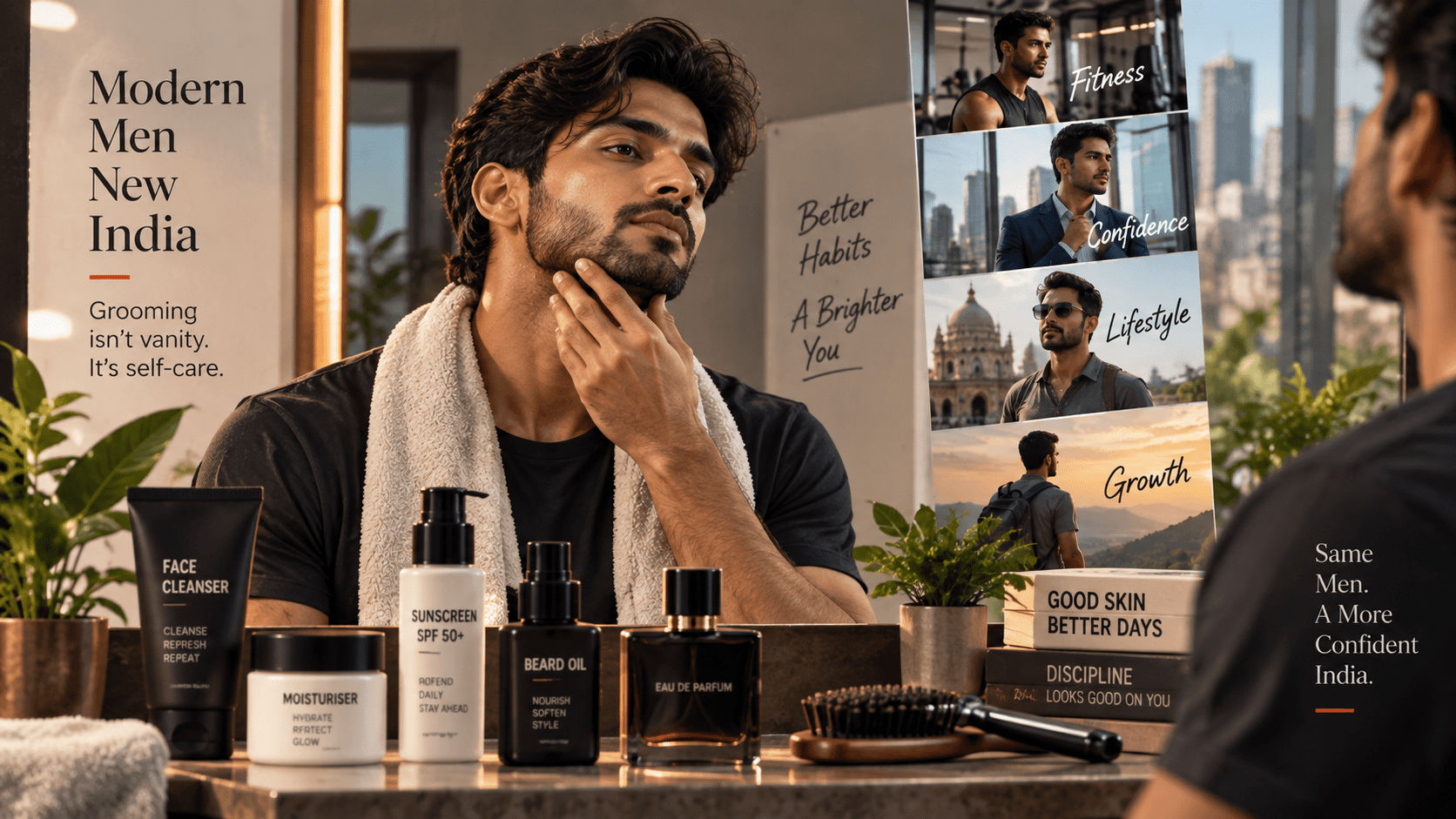
Today, Indian men are increasingly buying face cleansers, moisturisers, sunscreens, beard oils, hair serums, perfumes, body washes, styling products and grooming devices. For younger consumers especially, grooming is becoming less about vanity and more about self-care, confidence, appearance and everyday lifestyle.
This shift is creating a significant commercial opportunity. Industry estimates vary because researchers define the category differently, but they point in the same direction: the men’s grooming market in India is expanding rapidly.
According to the India Brand Equity Foundation (IBEF), India’s men’s grooming market was estimated at around ₹20,500 crore ($2.3 billion) in 2024 and is projected to reach approximately ₹38,300 crore ($4.3 billion) by 2033.
Other research firms produce different market-size estimates because they include different products and segments. But the bigger story remains the same: Indian men are spending more on grooming, while the meaning of grooming itself is expanding.
So, what is driving the growth of the men’s grooming market in India?
From shaving to self-care
Perhaps the biggest change is cultural.
For generations, products designed for men were largely centred around shaving and basic hygiene. A razor, shaving cream, shampoo and deodorant were considered enough for most routines. Specialised skincare could easily be dismissed as unnecessary.
That attitude is becoming less common.
A modern grooming routine might now include a facial cleanser, moisturiser and sunscreen in the morning, followed by hair styling, beard maintenance and fragrance. Some consumers are even becoming familiar with skincare ingredients such as niacinamide, salicylic acid, hyaluronic acid and ceramides.
The change is particularly visible among younger consumers.
Research from NielsenIQ (NIQ) highlights growing interest among young male consumers in ingredient-led products, local and natural brands, and a combination of online and offline shopping experiences.
That signals a broader transformation.
Men’s grooming is no longer simply about selling products labelled “for men”. It is increasingly becoming part of a wider beauty, wellness and self-care ecosystem.
Gen Z is changing what modern masculinity looks like.
One of the strongest forces behind this transformation is India’s younger population.
Gen Z has grown up with Instagram, YouTube, short-form video, influencers, celebrities and instant access to information. Grooming advice that once came primarily from barbers, friends or family members can now come from dermatologists, creators, athletes and online communities.
A young professional preparing for a job interview may search for skincare advice.
A university student may experiment with fragrances or hairstyles.
A fitness enthusiast may become interested in body care and haircare.
And someone growing a beard can find hundreds of tutorials explaining how to maintain it.
The result is a subtle but important change in how grooming is perceived.
It is becoming less about traditional ideas of masculinity and more about personal presentation and identity.
Looking good for a date, maintaining a professional appearance, taking care of your skin after a workout or simply enjoying a particular fragrance can all become perfectly normal reasons to spend money on grooming.
Social media turned grooming into a visible habit.
The beauty industry has always been influenced by images, but social media has dramatically accelerated that effect.
Grooming is naturally visual.
Before-and-after transformations, hairstyle tutorials, skincare routines, fragrance reviews and beard-styling videos are perfectly suited to Instagram, YouTube and short-form video platforms.
That gives brands something traditional advertising could not offer as easily: continuous product discovery.
A consumer can watch a demonstration, hear someone’s experience, search for reviews and purchase the product within minutes.
Influencers and creators have also helped make male skincare more socially acceptable. When actors, athletes, fitness personalities and creators openly discuss moisturisers, sunscreen, haircare or fragrances, these products become easier to associate with everyday male life.
Of course, not every influencer recommendation is reliable. Consumers still need to distinguish genuine education from paid promotion.
But from a market perspective, social media has made grooming discoverable, discussable and aspirational.
E-commerce made experimentation easier.
India’s rapid growth in digital commerce has also changed how consumers discover and purchase grooming products.
A consumer living outside Mumbai, Delhi or Bengaluru no longer has to depend entirely on products available at a nearby shop. Online marketplaces and brand websites provide access to a much wider selection.
Research from Grand View Research projects strong growth for India’s men’s grooming products industry over the coming years, with digital commerce and greater product accessibility among the important forces supporting expansion.
This matters because online shopping changes consumer behaviour.
People can compare prices.
They can read reviews.
They can discover smaller brands.
They can research ingredients.
And they can purchase specialised products privately.
For categories that were once considered embarrassing or unnecessary, that privacy can make experimentation easier.
The men’s grooming market in India is attracting both new digital-first brands and established FMCG companies.
The rise of direct-to-consumer, or D2C, businesses has further accelerated the transformation.
Indian brands such as Beardo, Bombay Shaving Company, Ustraa and The Man Company helped demonstrate that there was a market for brands built specifically around modern male consumers.
Instead of selling only a razor or shaving cream, brands could build an entire grooming identity around their customers.
That strategy also attracted established consumer-goods companies.
As the category expanded, larger FMCG and personal-care companies began showing greater interest in digitally native grooming brands and adjacent personal-care categories.
This is an important signal.
When major companies start competing for the same consumer, it suggests that men’s grooming has moved beyond being a small niche.
Skincare could become one of the fastest-growing segments of the men’s grooming market in India.
Shaving remains an important category, but the definition of men’s grooming is becoming much broader.
One of the biggest opportunities is skincare.
Indian men are increasingly exposed to conversations about acne, pigmentation, tanning, oily skin, sun protection, premature ageing and skin-barrier health.
These concerns are not fundamentally different from those experienced by women. What is changing is how confidently products addressing those concerns are being marketed to men.
Instead of a single generic “men’s face wash”, consumers can now find products positioned around specific needs such as oil control, hydration, acne care, sensitive skin and sun protection.
The wider beauty industry is helping normalise this behaviour.
Once skincare becomes part of everyday life, there is less reason for men to remain outside the category.
This could gradually move the industry from “men’s grooming” toward “men’s beauty and personal care”.
That distinction is commercially important because it opens the door to more categories and potentially higher spending per consumer.
Fragrance is becoming part of personal identity
Fragrance is another category benefiting from this cultural shift.
For many Indian men, deodorant was traditionally the default product associated with smelling fresh. Perfume was often reserved for weddings, parties, dates or other special occasions.
That behaviour is changing.
Fragrance is increasingly being treated as part of everyday personal style.
A consumer might choose one scent for work, another for an evening out and another for a special occasion. Social media has also created large online communities around fragrance discovery, reviews and recommendations.
For brands, this makes fragrance particularly attractive because it can become an emotional purchase.
A consumer is not simply buying something that prevents body odour.
He is buying a scent, identity and experience.
Haircare and beard care are expanding the opportunity.
Hair remains another major pillar of the men’s grooming market in India.
India’s climate, pollution, changing hairstyles and increasing awareness of appearance create demand for shampoos, conditioners, hair oils, styling products, serums and hair-loss solutions.
Beard culture has added another layer.
Growing a beard is no longer necessarily a single decision followed by months of doing nothing. Different beard styles have created demand for beard oils, washes, balms, trimmers and styling products.
This is one of the clearest examples of how consumer behaviour creates new markets.
A basic activity develops into a routine.
The routine creates multiple product categories.
And those categories create opportunities for specialised brands.
The market is moving beyond India’s biggest cities.
It would be easy to assume that the growth of men’s grooming is limited to India’s largest metropolitan areas.
It isn’t.
Cities such as Mumbai, Delhi, Bengaluru and Hyderabad remain important markets, but digital access and expanding retail networks are helping grooming products reach consumers in smaller cities and towns.
This could become one of the most important growth opportunities over the next decade.
India has hundreds of millions of male consumers, yet grooming spending has historically been relatively underdeveloped compared with many mature consumer markets.
Even a modest increase in average spending can therefore create a substantial opportunity.
For brands, the next wave of growth may not come only from convincing existing premium consumers to spend more. It could also come from bringing entirely new consumers into categories such as skincare, fragrance, beard care and body care.
Premium grooming is becoming more attractive.
Another trend shaping the market is premiumisation.
Consumers who once purchased the cheapest available shampoo, razor or deodorant may now be willing to pay more for better ingredients, fragrance, packaging, convenience or specialised benefits.
That does not mean Indian consumers are abandoning affordable products.
Instead, the market is becoming more segmented.
Mass-market products will continue to dominate large parts of the category, while premium and niche brands can attract consumers who are willing to spend more.
For businesses, this creates an opportunity to compete on more than price.
Brands can differentiate through formulation, experience, identity, convenience and trust.
But rapid growth does not guarantee success.
A growing market also creates intense competition.
Consumers now have more brands, products and marketing claims competing for their attention.
That makes differentiation increasingly difficult.
A new men’s grooming company cannot simply put a beard graphic on a bottle and expect customers to remain loyal.
Consumers are becoming more informed. They can compare ingredients, reviews, prices and alternatives within seconds.
Trust will therefore become increasingly important.
Brands that provide genuinely useful products, transparent claims and good customer experiences may have an advantage over companies that rely entirely on aggressive influencer campaigns.
There is also a growing need for better consumer education.
Skincare, for example, is not automatically better simply because a product contains a fashionable ingredient. Grooming should ultimately be about appropriate products and consistent habits rather than continuously buying new products.
What could the future of men’s grooming in India look like?
The next phase of the men’s grooming market in India is likely to be more sophisticated.
Traditional categories such as shaving, deodorant and shampoo will remain important. But much of the growth opportunity is likely to come from adjacent categories, including skincare, fragrance, hair styling, beard care, body care and grooming technology.
Personalisation could become increasingly important as well.
Rather than selling one generic “men’s skincare routine”, brands may increasingly develop products and recommendations around age, skin type, lifestyle, climate and specific concerns.
India’s enormous geographic and climatic diversity makes this especially interesting.
A grooming routine that works for someone living in humid Mumbai may not feel identical to one suited to a consumer experiencing Delhi’s dry winter climate or someone living in a hot coastal region.
This creates opportunities for brands that understand Indian consumers rather than simply importing global beauty trends.
The bigger change is cultural.
Ultimately, the growth of the men’s grooming market in India is not simply a story about razors, moisturisers or perfumes.
It reflects a broader change in how Indian men think about appearance and self-care.
The old idea that grooming should be minimal is gradually giving way to a more flexible attitude: take care of your skin, look after your hair, smell good, dress well and build a routine that works for you.
For businesses, that represents a rapidly expanding consumer opportunity.
For consumers, the change is simpler.
Grooming does not always have to be about impressing someone else.
Increasingly, it is about feeling confident in your own appearance.
And that cultural shift may ultimately prove more powerful than any individual product trend.
For businesses, the men’s grooming market in India represents a rapidly expanding consumer opportunity.
Quick Answer: Why is men’s grooming growing rapidly in India?
The men’s grooming market in India is growing because of changing attitudes toward masculinity and self-care, Gen Z consumption habits, social media, e-commerce, D2C brands, rising awareness of skincare and haircare, premiumisation, and growing access to grooming products beyond India’s largest cities.
Frequently Asked Questions
Is men’s grooming a growing market in India?
Yes. Multiple market-research estimates indicate strong long-term growth, although the exact market size varies depending on the products and services included. IBEF estimates India’s men’s grooming market at approximately ₹20,500 crore in 2024 and projects it to reach around ₹38,300 crore by 2033.
What products are included in men’s grooming?
Men’s grooming can include shaving products, skincare, haircare, beard care, fragrances, deodorants, body care and electric grooming devices. As consumer habits evolve, the category continues to expand into new personal-care segments.
Why are young Indian men buying more skincare products?
Social media, greater awareness of skincare ingredients, influencer and celebrity culture, changing attitudes toward masculinity and easier online access have helped make skincare more mainstream among younger men. NIQ’s research also points to interest in ingredient-led products and local and natural brands among younger male consumers.
Will men’s grooming continue growing in India?
Current market forecasts indicate continued expansion over the coming years. Some of the strongest opportunities are likely to come from skincare, haircare, fragrance, beard care, premium products and greater adoption in Tier-2 and Tier-3 cities.
What is driving India’s men’s grooming market?
The major drivers include changing consumer attitudes, Gen Z, social media, e-commerce, D2C brands, greater product awareness, premiumisation and the expansion of grooming beyond traditional shaving and hygiene products.
Interested in learning more about skin health? Read our guide to Skin Barrier to understand why protecting the skin barrier is becoming an important part of modern skincare.