Table of Contents
Some of the brightest objects in the universe have managed to hide in plain sight.
NASA’s Chandra X-ray Observatory has now uncovered a previously unrecognized population of cosmic objects that produce unusually low-energy X-rays while apparently emitting enormous amounts of ultraviolet radiation. Researchers have identified 84 hypersoft X-ray sources across six nearby galaxies, including Andromeda and the Pinwheel Galaxy.
The discovery is surprising for another reason: these objects may connect two very different astronomical mysteries. They could represent previously overlooked stages in the evolution of some systems that eventually produce Type Ia supernovae, while their intense ultraviolet output may help explain how gas between stars becomes ionized.
So, what are hypersoft X-ray sources in astronomy, and why did it take so long to find them?
The answer begins with an unusual gap in our view of the Universe.
What are hypersoft X-ray sources?
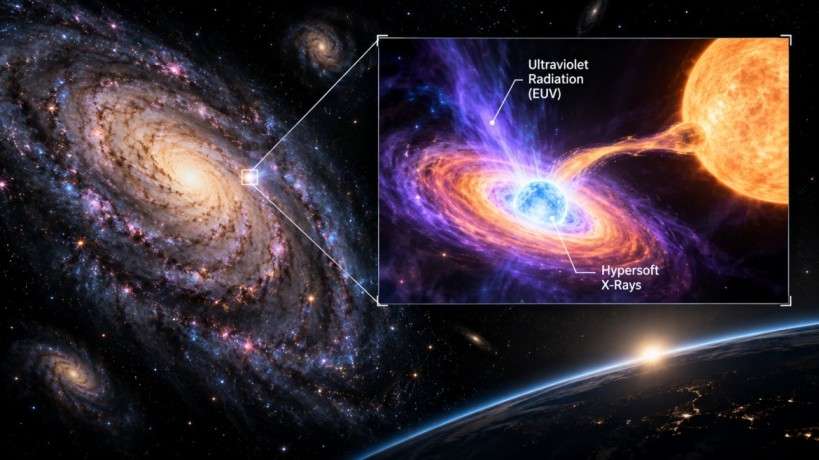
Hypersoft X-ray sources are a newly identified class of luminous, point-like cosmic objects that produce X-rays concentrated almost entirely at the lowest energies detectable by Chandra.
The discovery team found the sources by searching Chandra’s archive for objects visible in the telescope’s lowest X-ray-energy range but disappearing at higher energies. The result was a population with an unusual spectral signature: lots of very soft X-rays and little or no higher-energy X-ray emission.
The researchers identified 84 hypersoft X-ray sources in six galaxies. Two were spiral galaxies—M31, the Andromeda Galaxy, and M101, the Pinwheel Galaxy—while four were elliptical galaxies. They were also found in both regions containing active star formation and areas dominated by older stars.
That diversity makes the discovery particularly interesting.
It suggests that hypersoft X-ray sources may not be one simple type of object. Instead, several kinds of compact binary systems could potentially produce similar behavior.
Why are they called “hypersoft”?
The word “soft” in X-ray astronomy refers to relatively low-energy X-rays.
Think of the electromagnetic spectrum as a huge range of light, from radio waves through visible light to X-rays and gamma rays. X-rays themselves occupy a range of energies. A source producing mostly lower-energy X-rays is described as “soft.”
Hypersoft X-ray sources push that behavior unusually far.
Their detectable X-ray emission is concentrated mainly below about 0.3 keV, with the strongest examples appearing in Chandra’s lowest-energy band. Their spectra also suggest that much of their total radiation output may actually occur in the extreme-ultraviolet, or EUV, part of the spectrum.
This creates an unusual combination:
- Extremely luminous overall
- Exceptionally soft X-ray emission
- Potentially strong EUV radiation
- Difficult to detect with conventional X-ray observations
And that last point explains the mystery.
Why were hypersoft X-ray sources hidden?
The question why were hypersoft X-ray sources hidden has two major answers.
First, their X-rays are unusually low in energy. Chandra is an extraordinarily sensitive X-ray observatory, but detecting very soft X-rays from distant galaxies can require long observations. The telescope’s sensitivity also decreases toward the lowest energies.
Second, the radiation these objects may produce most strongly—the extreme ultraviolet—has a serious problem.
Hydrogen and helium gas between stars absorb EUV photons very efficiently. For distant sources, that material can create an almost impenetrable barrier between the source and an observer.
In other words, astronomers may have been looking through a cosmic filter.
This means hypersoft X-ray sources could have been producing enormous amounts of radiation without leaving an obvious signal in the parts of the spectrum astronomers could easily observe.
The Chandra team overcame part of this problem by looking for the faint low-energy X-ray footprint that these otherwise hidden EUV-bright objects leave behind.
How did Chandra discover hypersoft X-ray sources?
The discovery did not require a new spacecraft or a completely new survey.
Instead, astronomers went back through existing observations.
The team searched the publicly available Chandra X-ray Observatory archive for objects that appeared at the lowest X-ray energies but disappeared at higher energies. This unusual contrast became a way of identifying candidates that conventional searches might overlook.
That approach is one reason hypersoft X-ray sources are such an interesting example of archival astronomy. Sometimes a major discovery is not about collecting new data—it is about asking an old dataset a better question.
NASA’s Chandra team describes this as overcoming an observational “blind spot” that had prevented astronomers from recognizing this population earlier.
For readers interested in the original discovery and the Chandra observations, NASA’s official Chandra report on hypersoft X-ray sources provides the observational details and imagery.
What could be producing these mysterious objects?
This is where the story becomes more complicated.
Astronomers do not yet know exactly what hypersoft X-ray sources are.
The leading idea is that many involve a compact object pulling material away from a companion star. Possible compact objects include:
- White dwarfs
- Neutron stars
- Black holes
When matter falls toward a compact object, gravitational energy can heat it and produce radiation.
These systems are examples of X-ray binary systems, in which two objects orbit one another and material can move from one companion toward the compact object.
But the newly discovered sources appear to be behaving differently from the more familiar X-ray binaries astronomers already know.
The central mystery is therefore not simply “What object is this?”
It is also:
Why is this familiar type of binary system producing such an unusual spectrum?
Hypersoft vs supersoft X-ray sources
The phrase hypersoft vs supersoft X-ray sources can be confusing because the names sound almost interchangeable.
They are not.
Supersoft X-ray sources are an established category of astronomical objects characterized by very low-energy X-ray emission. Hypersoft sources are a newly recognized population whose emission is even more concentrated toward the lowest X-ray energies and may peak substantially into the EUV regime.
The distinction is therefore about the extreme spectral behavior observed in the new population.
A simple way to think about it is:
| Feature | Supersoft sources | Hypersoft sources |
|---|---|---|
| X-ray energy | Very low | Extremely low |
| EUV contribution | Can be important | May dominate much of output |
| Classification | Established category | Newly identified population |
| Nature | Several possible systems | Still being determined |
| Detection | Difficult | Particularly challenging |
This does not mean every supersoft source is a hypersoft source. The new category was created because the observed objects occupy an unusually extreme part of the soft-X-ray regime.
Could they be connected to Type Ia supernovae?
This may be one of the most important implications.
Type Ia supernovae are thermonuclear explosions involving white dwarfs. Astronomers use these explosions in cosmology, including measurements related to the expansion of the Universe.
Yet the exact evolutionary pathways that lead to Type Ia explosions remain an important research question.
Some hypersoft X-ray sources may represent stages in the evolution of systems containing accreting white dwarfs. As a white dwarf gains material from a companion, its mass and physical state can change.
The researchers therefore suggest that some hypersoft sources could be previously overlooked stages associated with potential Type Ia supernova progenitors.
That is a possibility, not a settled conclusion.
Scientists still need to determine the physical nature of individual sources before establishing how many, if any, eventually produce Type Ia explosions.
Could hypersoft sources explain interstellar gas ionization?
There is another mystery hiding in the discovery.
Galaxies contain enormous amounts of gas between their stars. Radiation can ionize this gas by removing electrons from atoms.
Hot, massive stars produce ultraviolet radiation and are an important source of ionization. But they do not necessarily explain all of the observed ionization, particularly when more energetic photons are required.
This is where hypersoft X-ray sources become intriguing.
Their likely strong EUV emission could provide energetic photons capable of ionizing gas that ordinary stellar populations cannot fully explain.
So, can hypersoft sources explain interstellar gas ionization?
Possibly—but researchers are not claiming that they have solved the problem.
Instead, the discovery introduces a previously overlooked population that could contribute to the missing ionizing radiation budget. A 2025 study proposed that cool but highly luminous EUV-emitting sources could provide some of these photons, and the new observations provide a population worth investigating.
Why the EUV matters so much
The extreme ultraviolet region is one of astronomy’s observational trouble spots.
EUV photons sit between ultraviolet radiation and X-rays. They can carry enough energy to reveal important physical processes, but they are readily absorbed by gas.
That creates an unusual paradox.
An object can be extremely bright in EUV radiation while appearing faint or almost invisible to telescopes observing other wavelengths.
This may be the central reason hypersoft X-ray sources remained unidentified.
The discovery therefore does more than add another category to an astronomical catalogue. It suggests that the Universe may contain many energetic objects whose most important radiation is concentrated in a wavelength range that is exceptionally difficult to observe.
What makes the discovery important?
The significance of hypersoft X-ray sources comes from the questions they could help answer.
Researchers are now investigating at least three major possibilities:
1. A hidden population of binary systems
There may be many compact binaries whose radiation has been underestimated because their emission falls into difficult-to-observe energy ranges.
2. Clues to Type Ia supernova evolution
Some sources may correspond to stages in the evolution of accreting white dwarfs that could eventually become Type Ia supernova progenitors.
3. A previously overlooked source of ionizing radiation
Their intense EUV output could contribute to the ionization of gas between stars and possibly influence how the interstellar medium evolves.
These possibilities are connected by one idea: we may have been missing an important part of the Universe simply because we could not see its preferred form of light.
What happens next?
The discovery of hypersoft X-ray sources is the beginning rather than the end of the investigation.
Astronomers need to observe more examples, measure how their brightness changes, study their environments and determine whether they contain white dwarfs, neutron stars, black holes or some combination of these systems.
Follow-up observations across different wavelengths will also be important.
If the objects really are producing huge amounts of EUV radiation, their effects may be detectable indirectly through surrounding gas even when the EUV photons themselves cannot travel freely to Earth.
Future studies could therefore turn a mysterious population into a useful astronomical tool.
Conclusion
Hypersoft X-ray sources are unusual because they are both powerful and difficult to see.
Chandra uncovered 84 candidates across six galaxies by searching for objects that produce unusually low-energy X-rays while apparently generating intense ultraviolet and EUV radiation. Their extreme softness may explain why previous surveys largely missed them.
Their true nature remains uncertain, but compact binary systems involving white dwarfs, neutron stars or black holes are leading possibilities. If some contain accreting white dwarfs, they could provide clues about Type Ia supernova progenitors. Their EUV emission could also contribute to the ionization of gas between stars.
The deeper lesson is perhaps the most fascinating one: astronomy is not limited only by how bright an object is. Sometimes the real problem is where that object’s light lives on the spectrum.
And Chandra’s discovery suggests there may still be entire populations of cosmic objects waiting in those difficult-to-see windows.
Frequently Asked Questions
What are hypersoft X-ray sources in astronomy?
Hypersoft X-ray sources are a newly identified population of luminous objects that emit unusually low-energy X-rays, with evidence suggesting that much of their radiation may be produced in the extreme-ultraviolet region.
How did Chandra discover hypersoft X-ray sources?
Astronomers searched the Chandra archive for objects visible at its lowest X-ray energies but absent at higher energies. This unusual spectral signature revealed 84 candidate sources across six galaxies.
Are hypersoft and supersoft X-ray sources the same?
No. Supersoft sources are an established category of very soft X-ray emitters. Hypersoft X-ray sources represent a newly identified population with an especially extreme concentration of low-energy X-rays and probable EUV emission.
Could hypersoft sources explain interstellar gas ionization?
They could contribute to it. Their probable EUV emission may provide ionizing photons that are difficult to explain using hot stars alone, but researchers have not established that hypersoft sources are the complete explanation.
Why were hypersoft X-ray sources hidden?
Their low-energy X-rays are difficult to detect, while EUV radiation is strongly absorbed by hydrogen and helium gas between stars. These two effects make the objects unusually difficult to observe directly.
Are hypersoft sources X-ray binary systems?
They may be. Researchers think many could involve a black hole, neutron star or white dwarf accreting material from a companion star, but their exact nature is still under investigation.
Could hypersoft sources become Type Ia supernova progenitors?
Some may be associated with evolutionary stages involving accreting white dwarfs that could eventually lead to Type Ia supernovae. This is a proposed connection, not yet a confirmed pathway for the entire population.
How many hypersoft X-ray sources have been found?
The 2026 Chandra study identified 84 hypersoft X-ray sources across six nearby galaxies. The number could increase as researchers search additional archival observations.
Explore more fascinating space and astronomy topics in our [Science] section to discover more about the universe, planets and cosmic discoveries.