Table of Contents
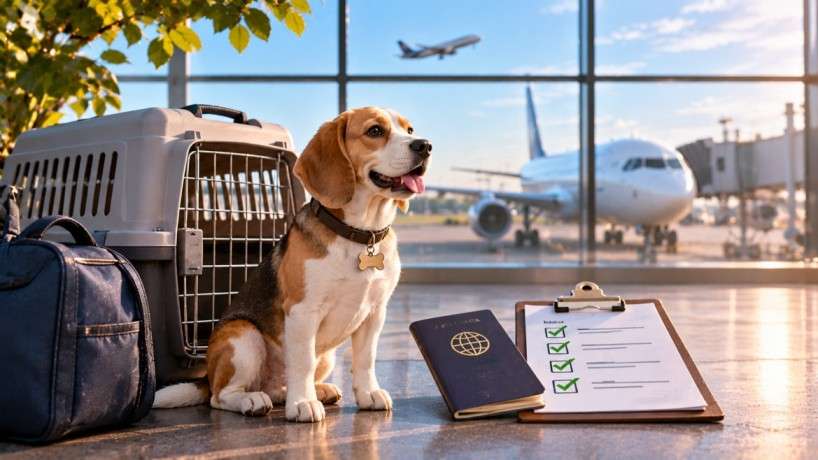
Biscuit’s paperwork is perfect, and he still might not get on his flight.
Picture a four-year-old beagle standing at a check-in desk in Chicago. His owners hold a vet-signed, government-stamped health certificate. The agent looks at his crate, shakes her head, and says it isn’t a compliant travel container. The certificate is flawless. Biscuit isn’t flying today.
Biscuit is fictional, but versions of this happen to real dogs. The reason is that how to travel internationally with a pet isn’t one set of rules. It’s several, written by different authorities who don’t coordinate, and each one can say no on its own.
Follow Biscuit through a round trip from Chicago to Lisbon and back, and you’ll see every checkpoint, who controls it, and the one most owners check last: getting home.
How to travel internationally with a pet ?
Think of five gates, each controlled by a different body:
- Your vet and your own country’s export authority
- The airline
- Any transit country on the route
- The destination’s border and animal-health service
- Your home country’s re-entry rules

Passing one gate doesn’t pass the others. Rules also depend on the species, the countries involved, your route and your pet’s vaccination history, and they change. Use this guide as a map, then confirm each gate on the official page.
Our test case: Maya and Dan live in Chicago and will spend six months in Lisbon. Biscuit weighs 11 kg, is microchipped and has a current rabies vaccination. They’ll fly Chicago to Frankfurt, change aircraft, continue to Lisbon, and come back the same way.
Gate 1: the vet and the export paperwork
The first step in how to travel internationally with a pet is the vet’s office, but the vet works to the destination’s rules, not yours. For the EU, that means three things the European Commission and national authorities set out:
- An ISO-standard microchip implanted before the rabies vaccination. A vaccine given before the chip doesn’t count, and the dog must be vaccinated again.
- A rabies vaccination given when the dog is at least 12 weeks old, followed by a wait of at least 21 days after the primary vaccination.
- An EU animal health certificate issued by an official vet no more than 10 days before arrival.
In the US, that certificate usually needs endorsement from USDA APHIS (the federal agency that checks and stamps export health certificates). USDA’s pet travel pages list requirements by destination, and some countries use stricter windows than 10 days. Since the stamp has to land inside the window, book the vet visit early enough to leave a buffer for endorsement.
Two terms trip people up. A pet passport is a booklet used for travel between EU countries and Northern Ireland. A health certificate is a single-trip document for entering from outside. A passport issued in England, Scotland or Wales no longer works for entering the EU, so UK travellers need an animal health certificate instead, as GOV.UK explains. UK dogs also need a vet-given tapeworm treatment before returning to Great Britain, and before arriving in Finland, Ireland, Malta, Northern Ireland or Norway.
Some routes add a rabies titre test, a blood test that measures antibodies to rabies. It requires a lab, a waiting period and sometimes months of lead time. Great Britain, for example, asks for a three-month wait after the blood sample for pets from unlisted countries.
Gate 2: the airline
Airlines add their own layer to how to travel internationally with a pet, and it’s the one governments never check. A valid certificate proves Biscuit meets the border rules. It doesn’t oblige a carrier to take him.
Most airlines base their container rules on the IATA Live Animals Regulations. The crate must be large enough for the dog to stand, sit and turn around, and snub-nosed breeds need a container about 10% larger. IATA doesn’t certify any particular crate, so “airline approved” on a product page proves little. Airlines can reject a container at check-in.

Airlines also decide on their own:
- Whether a dog flies in the cabin or the hold (Biscuit is too big for the cabin on most carriers)
- Which breeds they accept, since many restrict snub-nosed dogs in the hold, or ban them
- How recent the health certificate must be
- Whether weather or temperature conditions block pet travel that day
Gate 3: the layover
A layover adds a question that most guides on how to travel internationally with a pet skip: does the dog actually enter the connecting country?
Pet relocation specialists generally say the deciding factor is whether the pet changes aircraft. If Biscuit stays on the same aircraft, he doesn’t enter the layover country. If he changes aircraft, that country’s rules may apply.

Here, Frankfurt and Lisbon are both in the EU, so one EU health certificate should cover the journey, but Maya and Dan should still ask the airline how it routes and handles him. Change the route and the answer changes. USDA says a pet connecting through an EU country on the way to a non-EU destination needs an EU transit health certificate, in the same format as if the EU country were the final stop.
Some countries also restrict certain dog breeds, and that can bite at a connection. A direct flight removes this gate entirely, which is why it’s worth paying more for one.
Gate 4: the destination border

At the border, the question isn’t whether you know how to travel internationally with a pet. It’s whether this dog’s paperwork matches this dog. Officers check the certificate, the vaccination record and the microchip number, and may scan the chip. In the EU, you may need to arrive through a designated travellers’ point of entry.
Why do pets get quarantined at customs? The border’s job is keeping rabies out. When documents are missing, dates don’t line up, or the chip number doesn’t match, a country may refuse entry, hold the animal, or send it back. Policies differ by country.
Do you need an import permit? For a personal dog entering the EU, the usual route is certificates, not permits. Some countries do require a permit, so check the destination authority’s page before booking.
Gate 5: getting home
Plenty of advice on how to travel internationally with a pet ends at the arrivals hall. The return trip is where Biscuit’s story gets tricky, because the EU certificate he used to enter Portugal does nothing for US re-entry.
Under CDC rules, every dog entering or returning to the US must be healthy, at least six months old, microchipped, and accompanied by a CDC Dog Import Form receipt. The CDC says this applies to working dogs too. For dogs that have only been in rabies-free or low-risk countries, that receipt is essentially the requirement.
The trap comes if the family adds a side trip to a country the CDC classes as high risk for dog rabies. A US-vaccinated dog needs a CDC Certification of U.S.-Issued Rabies Vaccination form, completed by a USDA-accredited vet and endorsed by USDA before the dog leaves the US. The CDC says it can’t be issued retroactively, and USDA-endorsed export certificates issued after July 31, 2025 no longer count for re-entry. The CDC’s dog import FAQs cover the details.
Other home countries have their own rules:
- UK: a UK animal health certificate is valid for four months of re-entry to Great Britain, but only if the rabies vaccination stays valid. If it expires mid-trip, the certificate can’t be used to return.
- Canada: the Canadian Food Inspection Agency requires a rabies vaccination certificate for dogs over three months old, and Canada’s rules didn’t change when US rules did.
The timeline for how to travel internationally with a pet, working backwards
Treat this as a flying-with-a-pet-internationally checklist, and adjust to your destination:
- Three to four months out: Check all five gates. Confirm whether a titre test is needed, since it sets the whole schedule. Choose your route and airline.
- About two months out: Make sure the microchip reads, and that it was implanted before any rabies vaccination you plan to rely on. Book any vaccination at least 21 days before travel if the destination requires a wait.
- One month out: Measure your dog, buy the crate and start crate training. Book the accredited vet appointment.
- Final 10 days: Get the health certificate issued and endorsed inside the destination’s window, leaving a buffer for endorsement.
- Before leaving home: Complete anything the return trip needs first. Print every document, and carry originals.

Biscuit does board in the end. Not because the paperwork was perfect, but because Maya and Dan asked each gate its own question and wrote the answers down. The honest answer to how to travel internationally with a pet is that it’s five small projects, not one big one. Before you book anything, open one document, list the five authorities, and email or check each. Ten minutes of that beats a surprise at the check-in desk.
FAQ
What documents do I need to fly my dog overseas?
Usually a microchip record, proof of rabies vaccination, and a health certificate for the destination, often vet-issued and government-endorsed within a short window. Some countries add a titre test or permit. Your home country may need separate return paperwork.
Can my dog travel during a flight layover?
Yes, but it depends on whether the dog changes aircraft. If it does, the connecting country’s rules may apply, and some routes through the EU need a transit certificate. Check with both the airline and the transit country’s authority.
Do dogs need a passport to travel internationally?
There’s no universal pet passport. EU-issued passports work for travel between EU countries and Northern Ireland. For entering from outside, you typically need a health certificate, and a UK-issued passport can’t be used to enter the EU.
Can airlines refuse pets with valid health certificates?
Yes. The certificate satisfies border authorities, not the carrier. Airlines can refuse over an unsuitable container, a restricted breed, the dog’s fitness to fly, or weather conditions.
Do I need an import permit for my pet?
Often not for a personal dog moving between the US, UK, Canada and the EU, where certificates and vaccinations do the job. Some countries do require permits, so check the destination authority’s page.
Why do pets get quarantined at customs?
Rabies prevention. If documents are missing or inconsistent, the authority may hold the animal until it can be sure of its status, or refuse entry. Complete, matching paperwork is the best protection.
Is how to travel internationally with a pet different for cats?
The five-gate logic is the same, but the rules aren’t identical. The CDC’s import requirements discussed above are for dogs, and other countries treat cats and dogs differently. Look up your species specifically.
You can read more article like that by visiting our travel section. To read article like that click here .