Table of Contents
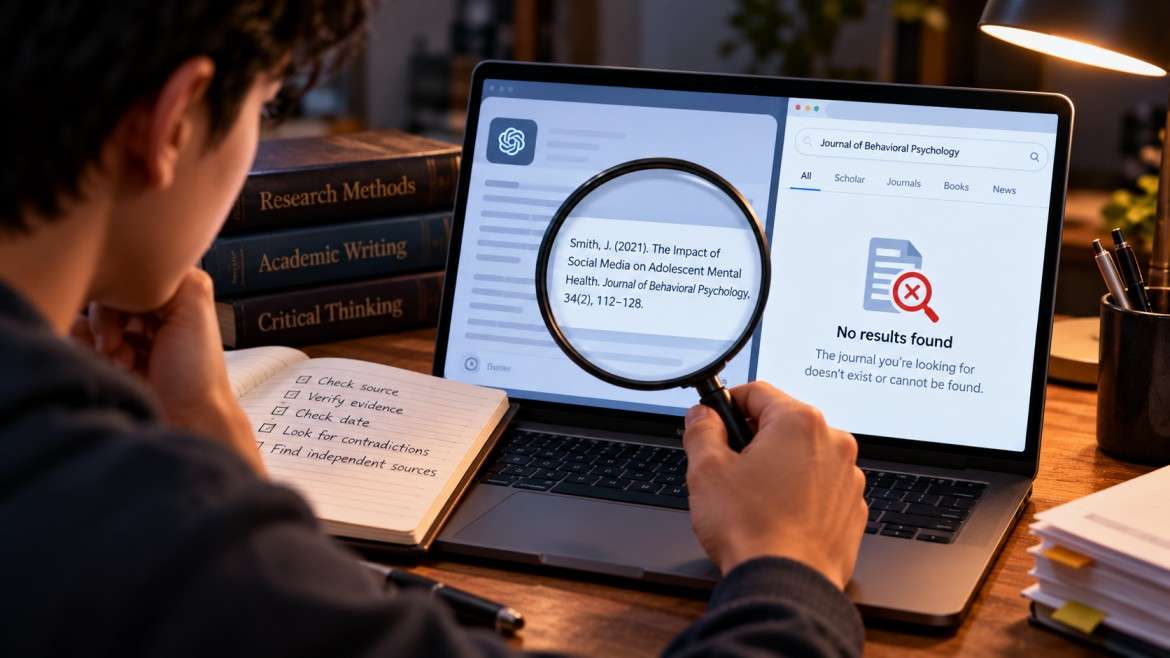
The citation looked perfect. Author name, journal title, year, even page numbers.The student pasted it into the bibliography, hit submit and felt great. Two weeks later the teacher left one line in the margin: “I can’t find this journal. Does it exist?”It didn’t. The AI had made it up, and it did it in the calm, polished voice of someone reading from a textbook.
That voice is the real trap, and it’s why every student needs a repeatable habit for how to check if an AI answer is reliable. The method below takes about a minute for small stuff and ten minutes for anything that touches a grade. It’s five questions: source, evidence, date, contradiction and independent confirmation.
Why smooth answers feel true

I call it the AI fluency illusion. When something is written clearly, confidently and in clean grammar, our brains quietly stamp it “probably right.” Chatbots are very good at clear, confident, grammatical writing. They are not automatically good at being right.
In practice, a model can hand you a wrong date, an invented quote or a source that doesn’t exist, and the sentence will read exactly like a correct one. There’s no hesitation in the voice. You can’t hear the mistake.
Most advice on how to check if an AI answer is reliable stops at “write a better prompt.” That only fixes half the problem. A better prompt can improve an answer, but it can’t tell you whether the answer is true. The checking has to happen outside the chat window. That’s the whole idea behind AI verification for students: treat the answer as a lead, not a result.
How to check if an AI answer is reliable: the five questions
Here’s the whole method on one screen.
- Source: Where did this come from?
- Evidence: What actually holds it up?
- Date: Is it still true today?
- Contradiction: Does anyone disagree?
- Independent confirmation: Can someone who never spoke to the AI back it up?
Each question catches a different kind of mistake. Skip one and you leave a gap for the error to slip through.

1. Source: where did this come from?
Ask the AI for sources, but treat them as a to-do list, not proof. Then:
- Search the exact title in Google Scholar, a library database or the publisher’s site.
- If it gave you a link, open it. Broken and invented links can look very convincing.
- Search the author and publication in a separate tab to confirm they’re real.
Now the sneakier version. The source is real, but it doesn’t say what the AI claims. Here’s how to check if an AI cited source actually supports the claim: open it, press Ctrl+F, search for the key number or phrase and read the sentence around it. If you can’t find the claim in the text, you don’t have a source. You have decoration.
Try it: take one citation from your last AI answer and find it in under two minutes. If you can’t, you’ve just learned something useful.
2. Evidence: what’s holding this up?
A claim without evidence is just a sentence. Look for named studies, real numbers, original documents. Ask yourself whether it’s a checkable fact or an opinion wearing a lab coat.
Phrases like “studies show” and “experts agree,” with no study or expert named, are where invented material likes to hide. Vague plurals are a warning light.
3. Date: is this still true?
Models learn up to a cutoff and can miss what changed afterward. Tools with web search help, but they can also grab an old page and present it as fresh.
Here’s how to spot outdated information in AI responses. Be extra suspicious of:
- Prices, fees and deadlines
- Laws, rules and exam patterns
- “Latest” or “current” anything
- Who holds which job
- Software versions and health guidance
Find the publication date of the best source you found, then ask what could have changed since. For school, check your own syllabus year or your board’s latest circular. Staleness is the quiet half of how to check if an AI answer is reliable, because outdated answers sound just as sure as current ones.
4. Contradiction: who disagrees?
Search for the opposite on purpose. Try the claim plus “myth,” “criticism” or “debunked.” You’re not being cynical. Real answers survive pushback.
If the AI gave you one side of a topic that’s actually debated, and never mentioned it’s debated, that’s your cue to dig.
5. Independent confirmation: who else can vouch for this?

This is the big one. “Independent” means not the same chat, not the same model and not a website that copied the same text. AI-written pages get republished all the time, so five results saying the same thing can still be one answer wearing five hats.
Find two unrelated reliable sources: a textbook, a university or government page, a respected news outlet, a peer-reviewed paper.
Professional fact checkers have a trick for this called lateral reading. They leave the page and open new tabs to see what others say about it. In a Stanford study, fact checkers who read this way reached better-supported conclusions than historians and undergraduates, and they did it in far less time. You can read the research paper on lateral reading yourself. That sideways move is the heart of independent confirmation research.
A worked example (invented, but typical)
Say a student asks, “Does sleeping less than seven hours hurt exam scores?” and gets this back: “A 2019 study in the Journal of Applied Sleep Science found students sleeping six hours scored 12 percent lower. This is the accepted guideline in all schools.”

| Question | What you do | What you’d probably find |
|---|---|---|
| Source | Search the journal name | Nothing. Red flag |
| Evidence | Hunt for the 12 percent figure | It appears nowhere |
| Date | Check “accepted guideline” | Guidelines change, so check a health agency |
| Contradiction | Search “sleep and exam performance criticism” | Plenty of real research, with nuance by age and context |
| Independent confirmation | Check a national health body and a university sleep centre | They say sleep matters, but not that exact claim |
The verdict is a common one. The big idea (sleep matters) survives. The specific claim (the study, the number, the “all schools”) doesn’t. That’s usually not a total lie. It’s something true blended with something invented, which is harder to catch.
Why asking AI to check its own answer does not work
It’s tempting. “Are you sure?” “Double-check that.” But it’s the same system, with the same blind spots, working from the same patterns. It might agree with itself. It might flip a correct answer to a wrong one because you sounded doubtful. And unless it’s actually searching the live web, it has no new information to compare against.
It’s like asking the kid who copied your homework whether your homework is right. That isn’t a method for how to check if an AI answer is reliable.
What you can do is ask it for leads. “What exact terms would I search to verify this?” is a great prompt. “Is this true?” is not.
How to check if an AI answer is reliable when you’re short on time
Not every question deserves the same effort. Match the work to the stakes.
- The 60-second version (low stakes, casual curiosity): Does the source exist? Is the date okay? Does one unrelated site agree?
- The 10-minute version (graded work, health, money, law): all five questions.
My honest opinion: if it’s going into something you submit, spend the ten minutes. A zero for a fake citation costs a lot more than ten minutes.
UNESCO is heading in a similar direction at the policy level. Its work on media and information literacy covers more than chatbots, but a curriculum being built for South and Southeast Asia with IGNOU in India and a Sri Lankan teacher-training centre draws on UNESCO’s Global MIL Framework, piloted in over 40 countries, and includes modules on areas like algorithm literacy. If you read up on UNESCO AI literacy efforts, notice that the starting point is media and information literacy, not a separate AI rulebook. You can read the full interview on UNESCO’s site. The curriculum was due to be finalized in July 2026, and the habit it teaches is the same one this article is about: ask how information got in front of you before you trust it.
A checklist for evaluating AI generated explanations in school
Screenshot this or paste it into your notes app.
- I found every source myself
- I opened each source and found the claim in the actual text
- Key numbers appear somewhere other than the chatbot
- I know the date of my best source
- I searched for disagreement
- Two independent sources match
- I can explain the answer in my own words, without the screen
That last box matters most. If you can’t explain it without looking, you haven’t checked it. You’ve copied it. It’s also the shortest honest answer to how to check if an AI answer is reliable when the clock is running.

For parents and teachers
Students are already using these tools. A ban is hard to enforce and teaches nothing. A better move is to ask for the working.
Instead of “Did you use AI?”, try “How did you check it?” Ask students to submit their sources plus one line on what each source confirmed. Treat it like showing your steps in maths. Stanford’s free Civic Online Reasoning curriculum is a good starting point, since it was designed to help students tell reliable information from fake information online using a fact-checker mindset. Teaching how to check if an AI answer is reliable works best when it’s routine, not a one-off lecture. edsource
Try this tonight
Pick one AI answer you used this week. Run the five questions. Time yourself.
Chances are you’ll find one thing that’s slightly off, a date, a number or a source that says something a little different. That small, mildly annoying moment is where you really learn how to check if an AI answer is reliable, and no article can teach it as well as one fake citation you catch yourself.
FAQ
How should students check whether an AI answer is reliable?
Use five questions: where did it come from (source), what backs it up (evidence), is it current (date), does anyone disagree (contradiction) and can unrelated sources confirm it (independent confirmation). The short version of how to check if an AI answer is reliable is this: never let the chatbot be the last stop.
How to check if an AI answer is reliable when I only have five minutes?
Confirm the source exists, check the date and find one unrelated reliable page that agrees. If any of the three fails, don’t use the claim.
How do I check if an AI-cited source actually supports the claim?
Open the source, search for the key phrase or number and read the surrounding sentence. If it isn’t there, or says something different, the citation doesn’t support the claim, even if the source is real.
Can I trust AI answers that include links?
Not automatically. Links can be dead, wrong or invented, and real links can say something different from what the AI claims. Always open them.
Why doesn’t asking AI to check its own answer work?
It’s the same system with the same blind spots, and it may simply agree with itself. Use it to generate search terms, then verify elsewhere.
How can I spot outdated information in AI responses?
Watch for prices, rules, laws, exam patterns, “current” office-holders and software versions. Find the date on your best source and ask what could have changed since.
Is it okay to use AI for school at all?
That depends on your school’s rules, so check them. If it’s allowed, use AI to explain and brainstorm, and verify anything you plan to submit.
You can explore more practical guides on AI, technology and digital literacy in our [AI & Technology] section.