Table of Contents
For the past two years, the cheapest way to get a near-frontier AI model was to download one from China. Alibaba’s Qwen, DeepSeek, Zhipu’s GLM: free weights, no sales call, no strings.
Now Beijing is asking a question that would have sounded absurd in 2025. What if we stop handing this out?
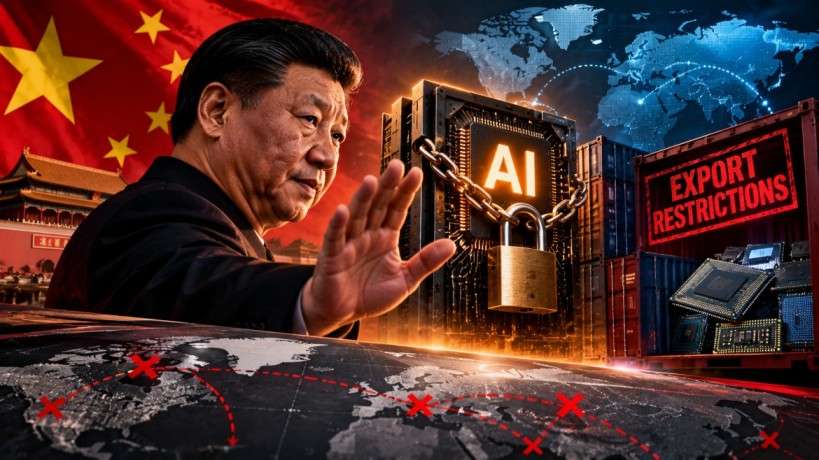
That question sits at the centre of China AI and chip export controls, and it may be the most important tech policy story most people haven’t heard properly yet.
One honest note before we start, because I don’t want to oversell this. As of 20 October 2026, nothing is final. There is no published rule and no official timeline. What exists is a set of proposals, leaked consultations, and a pattern of tightening that is hard to ignore. Let’s walk through what’s real, what’s reported, and what it means for anyone who builds with, buys, or invests in AI.
What Actually Happened
On 21 July 2026, the Financial Times reported that China’s Ministry of Commerce (MOFCOM) was quietly sounding out the country’s biggest AI and chip names. Per Unite.AI’s summary of the report, the list included Alibaba, ByteDance, Zhipu (known abroad as Z.ai), and Huawei. The topic was how to keep China’s best technology, and its most promising start-ups, from ending up in Western hands.
Two details matter here. First, officials are still gathering feedback, with no draft rule and no schedule. Second, The Next Web notes that officials have stressed any curbs might apply only to future models, not ones already released. The companies themselves reportedly warned regulators that stricter rules could slow China’s own AI progress.
Why does a leak like this matter if nothing is decided? Because Beijing rarely telegraphs export policy in advance. When it speaks, it usually acts. That is why China AI and chip export controls is now a topic that developers in Berlin, Bangalore, and Boston are all watching.
The Three Things on the Table

Reports describe three separate ideas. They’re easy to blur together, so here they are one at a time.
1. Limits on model weights and training data.
Weights are the files that hold what a model learned. China is weighing limits on foreign users downloading them, and on moving training data abroad. Overseas customers could still use the models as hosted online services, so this is about downloads, not about shutting the door entirely.
2. Limits on who can manufacture Chinese chip designs.
This one is aimed at foreign factories. The idea is to stop chipmakers such as TSMC or Qualcomm from producing advanced semiconductors based on designs created by Chinese firms like Huawei, Alibaba, and ByteDance.
3. Limits on foreign takeovers of strategic start-ups.
The trigger here was agentic AI. Reports point to Meta’s roughly $2 billion purchase of the start-up Manus, a deal Chinese regulators later forced to unwind. Beijing doesn’t want that to happen twice.
Notice the shift in mindset. China isn’t only worried about what leaves in a shipping container. It’s worried about ideas, files, designs, and companies that walk out the door.
Why Beijing Is Doing This Now
Here’s my read of the motives, based on what’s been reported and what the timeline shows.
Because it finally has something worth protecting. For years, China played catch-up and wanted every door open. Now several of its labs are close to the frontier. When you lead, openness starts to feel like a gift to your rivals. The FT report reportedly reflected exactly that confidence.
Because Washington wrote the playbook. The US has policed advanced chip exports for years. In January 2026 it moved to allow limited Nvidia H200 sales to approved Chinese buyers under case-by-case licensing, which shows the US itself keeps tuning the dial. In June 2026, US officials briefly blocked foreign access to some of the most capable American models before reversing course weeks later. Beijing has watched all of this and is building similar levers pointed the other way.
Because it wants self-sufficiency. Cut off from the best US chips, Chinese firms leaned hard on domestic designs and workarounds. Those designs are now valuable, and foreign factories still make much of the world’s advanced silicon. Guarding the blueprints makes strategic sense.
Because money is a security issue now. In June 2026, Beijing broadened its rules on cross-border deals touching Chinese technology and data, and reportedly told developers such as Moonshot AI to get government approval before accepting US capital. Export policy and investment policy are merging into one toolkit.
Put these together and you can see why China AI and chip export controls isn’t a single rule. It’s a posture.
First, What Is the MOFCOM Technology Export Catalog?
If you’ve seen the term MOFCOM technology export catalog and nodded politely, here’s the plain version.
It’s an official list of technologies that China either bans or restricts from being exported. If your technology is on it, you need a licence or you can’t send it abroad at all. According to reporting, it’s one of Beijing’s three main export-control regimes, alongside two lists covering dual-use goods.
This isn’t new territory for AI. When the catalogue was revised in 2020, it added items such as personalised recommendation technology and AI interactive interfaces, a change widely linked to the TikTok sale debate. So when reports say new AI measures could be folded into “the next revision” of the catalogue, that’s the mechanism. Adding a line to a list is quick and quiet. No new law is needed.
That’s the signal to watch. If model weights and chip design provisions land in the next catalogue update, the era of freely downloadable Chinese frontier models starts closing.
What Does This Mean for Open-Source Models?

This is the question I’d expect most readers to care about. How do China’s AI export rules affect open-source models?
Short answer: it depends on what exactly gets written, and nobody outside Beijing knows yet.
What we do know:
- Chinese open-weight models, including Qwen, Doubao, GLM, and DeepSeek, became a cheap alternative for companies trying to cut AI bills.
- Reports describe talks about curbing overseas access to the most capable models, including unreleased systems and open-weight releases.
- Weights already published online can’t be recalled. Any restriction would bite mainly on future releases.
So the practical risk isn’t that your current model disappears. It’s that your next upgrade may not be downloadable. If your product is built on the assumption that a free Chinese model will always be there, that’s now a design risk worth planning for. Keep your architecture model-agnostic, and keep a fallback.
Also worth knowing: hosted access would reportedly stay available. You might end up paying per call instead of running the weights yourself.
Why Is China Targeting Chip Clustering and Interconnect Technology?

I want to be careful here, because this is where many articles get sloppy.
The reports I found don’t describe a specific Chinese rule on chip interconnect technology. What they describe is a plan to control Chinese chip designs and who can manufacture them. So treat “interconnect controls” as an area to watch, not a confirmed policy.
But the logic is easy to understand, and it’s worth explaining. Training a large AI model doesn’t rely on one chip. It relies on thousands of chips talking to each other very fast. The links between them, the interconnect, decide whether a cluster behaves like one giant computer or a pile of slow ones.
That’s why US rules have long treated interconnect as a key metric. Earlier American controls used chip-to-chip bandwidth to decide which processors were restricted. Nvidia’s H800, for example, was essentially an H100 with interconnect bandwidth cut sharply.
If China wants to protect its hardware advantage, the link technology is a natural thing to guard. For firms such as Huawei that have built large clusters from domestic chips, the way chips connect may be as valuable as the chips themselves. Interconnect design is a chip interconnect technology china debate that experts will keep a close eye on, and I’d expect more detail if the catalogue is revised.
What About Chinese AI Agent Restrictions?
Agents are AI systems that act, not just answer. They book, buy, code, and click. Beijing clearly regards them as strategic.
The reported Chinese AI agent restrictions are mostly about ownership. Regulators want to stop foreign companies buying promising agentic AI start-ups, and the Manus case shows they’re willing to force a deal to unwind. That is a very different kind of control from a chip licence. It says: the talent and the team are strategic assets too.
If you’re a founder in this space, the lesson is blunt. A Chinese start-up with frontier-level agent work should now assume foreign acquisition may need approval, or may not be possible. If you’re an investor, read your term sheet twice.
Don’t Forget the Domestic Rulebook
Export controls get the headlines, but China already regulates AI heavily at home. That context matters, because it shows Beijing’s instincts.
The Cyberspace Administration of China (CAC) rules for generative AI services came into force in 2023. As I understand them, they require providers to meet content and security obligations and, for public-facing services, go through filing or assessment steps. China has also added labelling rules for AI-generated content. These CAC generative AI rules and wider China AI regulations are about control of what AI says and does inside China. Check current official texts before you rely on exact details, because this area changes fast.
The export side is the other half of the same instinct. Inside, regulate the output. Outside, regulate the flow. One state, two directions. That’s the bigger picture behind China AI and chip export controls.
What’s the Difference Between US and China Semiconductor Export Controls?

Here’s the comparison I’d want if I were reading this cold.
Direction. US controls mostly limit what goes into China: advanced chips, chipmaking tools, and, briefly this year, access to certain American models. China’s proposals limit what flows out: model weights, training data, chip designs, and company ownership.
Method. US rules lean on technical thresholds, such as performance and interconnect measures, backed by licences. China’s approach, so far, works through a catalogue of restricted technologies, plus approvals for deals and investment. It’s more about categories and permission than about published performance numbers.
Flexibility. Washington has shown it can reverse itself. It allowed limited H200 sales in January 2026 and lifted its June model restrictions within weeks. Beijing’s plans are still consultations, so we haven’t seen how flexible it will be.
Goal. The US says it’s protecting national security and slowing a rival’s military and AI progress. China’s stated and reported goal is to protect leading technology and keep Western companies from buying or copying it. Different language, strikingly similar logic.
If you want a one-line summary: the US is building a wall around what China can get. China is considering a wall around what it can give.
The Catch: This Might Hurt China Too
Let me argue against myself for a moment, because a good analysis should.
Chinese tech firms reportedly warned that tighter rules could slow their own progress. Free, widely used models bring global developers, feedback, and influence. Restrict them, and you give up some of that. There’s also a mixed message: Xi Jinping urged global AI cooperation at the World AI Conference in Shanghai just before the report surfaced, pledging support to developing countries.
And enforcement is hard. Files can be copied. Models already out can’t be pulled back. Any serious regime needs clear licence criteria and end-user checks, and none exist yet.
So, will this harden into a wall, or stay a bargaining chip? Honestly, nobody knows. Even the reporting says it may not be clear until something is put in writing. That uncertainty is itself a story.
What to Watch Next ?

Three signs will tell you whether this is real:
- A revised MOFCOM catalogue. If the weights or chip-design lines appear, the plan is live.
- Licence rules. Look for clear criteria and end-user checks. Without them, it’s just a headline.
- The next flagship release. If a major Chinese lab ships its newest model as hosted-only rather than open-weight, read that as a signal.
So, Why Is China Tightening Control?
Because it now believes its AI and chip work is strategic, not just commercial. Because Washington proved that export controls can be a lever. And because Beijing wants to keep the know-how, the designs, and the best start-ups at home.
For builders, the takeaway is practical: don’t bet your product on free access to the next Chinese model. For everyone else, it’s a reminder that AI has stopped being a pure tech story. It’s now trade policy, industrial policy, and security policy rolled into one.
Whatever lands in the end, China AI and chip export controls will shape who gets the best AI, at what price, and under whose rules.
This article reflects reported developments as of 20 October 2026. Several details are proposals and may change.
FAQ: China’s AI and Chip Controls
What are China AI and chip export controls?
They are proposed and existing limits on how Chinese AI models, training data, and chip designs leave the country, plus restrictions on foreign purchases of strategic Chinese tech firms. Per reports, the main proposals are still under consultation and not yet law.
Why is China tightening control over AI models and chips?
Mainly to protect technology it now considers a strategic advantage, to match the pressure it feels from US export controls, and to keep leading start-ups from being acquired by foreign firms.
What AI technologies are restricted in China’s export control list?
China’s catalogue of restricted technologies has covered AI-related items before, such as personalised recommendation tech and AI interactive interfaces since 2020. Newer items such as model weights, training data, and chip designs are under discussion, not confirmed.
How do China’s AI export rules affect open-source models?
If adopted, they could limit foreign downloads of future open-weight releases. Models already published stay out there. Hosted access would reportedly remain possible.
Why is China restricting chip clustering and interconnect technology?
I haven’t found confirmation of a specific rule. The reported focus is on chip designs and manufacturing. Interconnect matters because linking thousands of chips is essential for training large models, so it’s a likely area of interest.
What are the Chinese AI agent restrictions?
Reported measures focus on limiting foreign takeovers of strategic start-ups, especially in agentic AI. Beijing reportedly forced the unwinding of Meta’s Manus acquisition.
What are the CAC generative AI rules?
They are China’s domestic rules for generative AI services, covering content and security duties for providers. They are separate from export controls and focus on what AI services do inside China.
What’s the difference between US and China semiconductor export controls?
US rules limit what flows into China, using technical thresholds and licences. China’s proposals limit what flows out, using a technology catalogue and deal approvals.
Will these rules definitely become law?
No. Officials have decided nothing public, there’s no timeline, and companies have pushed back. Watch the next catalogue revision.