Table of Contents
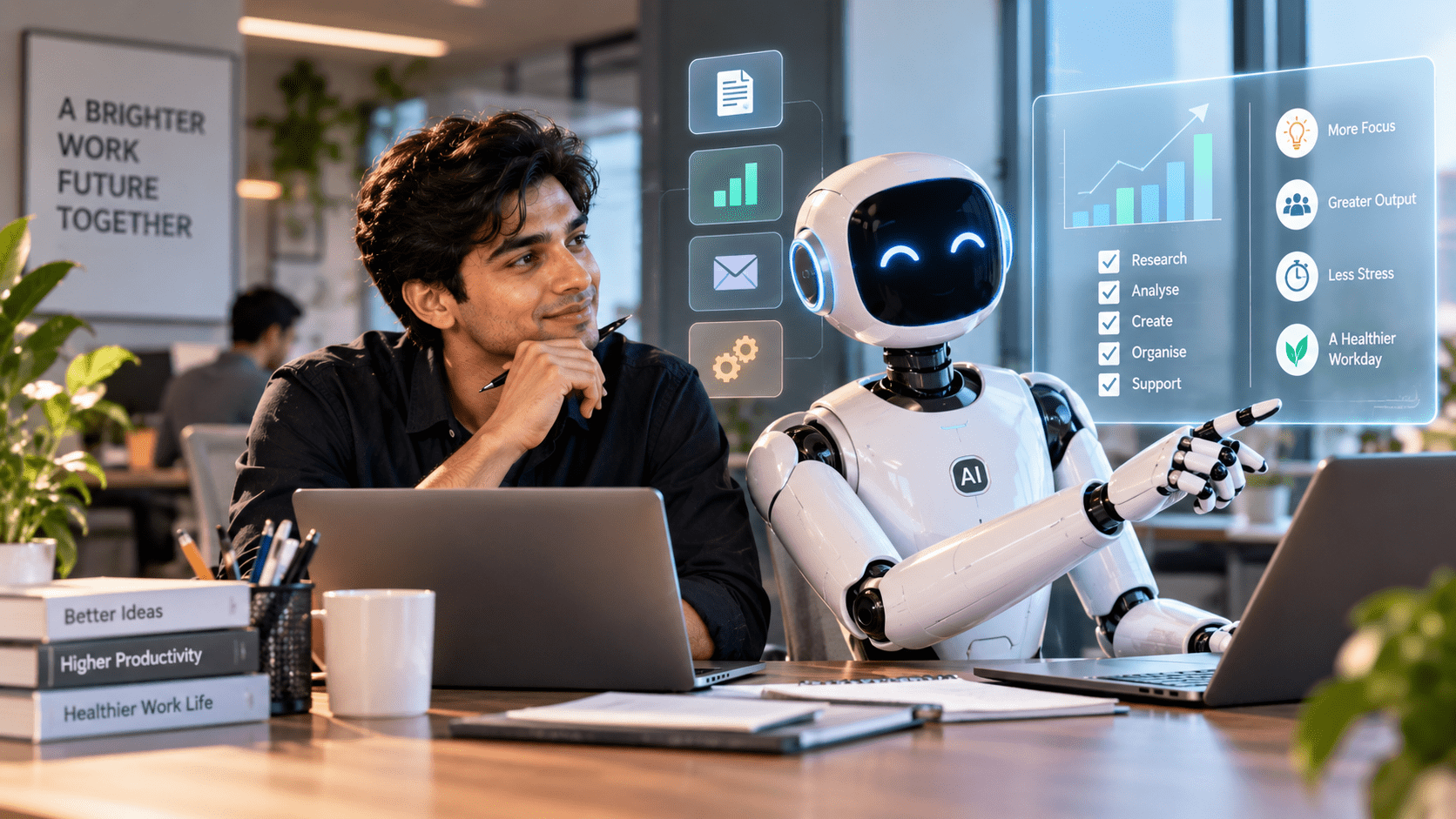
Working with AI coworkers is becoming one of the most important changes in the modern workplace. Artificial intelligence is no longer limited to answering questions, generating text or helping employees search for information. New AI systems can increasingly perform multi-step tasks, interact with software, analyse information and support entire business workflows.
But this raises a basic question for anyone watching the transformation: what is an AI coworker?
An AI coworker is an artificial-intelligence system designed to work alongside human employees by carrying out specific tasks, supporting decisions or managing parts of a workflow. Unlike a simple chatbot that waits for a question, an AI coworker can potentially take an objective, complete several steps and return a result with limited human intervention.
The idea is still developing, but businesses are already experimenting with this model. Microsoft’s 2025 Work Trend Index described the emergence of human-agent teams, while its research found that many business leaders expected AI agents to become increasingly integrated into workplace processes.
The result could be a workplace where humans and AI systems operate as a single team.
What Is an AI Coworker?
So, what is an AI coworker in practical terms?
An AI coworker is a digital AI system that performs defined work alongside people. It may research information, analyse data, draft documents, monitor processes, answer customer questions, organise information or perform repetitive digital tasks.
The important distinction is that an AI coworker is designed around work, rather than simply conversation.
For example, imagine a marketing employee who asks an AI system to analyse the previous week’s advertising campaigns.
A basic chatbot might explain how campaign analysis works.
An AI coworker could potentially access approved campaign data, compare performance, identify unusual results, prepare a report and highlight areas that require human attention.
That difference explains why what is an AI coworker has become a more important question as AI agents become more capable.
An AI coworker doesn’t necessarily need a human-like personality or appearance. It can operate through a workplace application, an AI agent interface or an automated workflow running in the background.
How Is Working With AI Coworkers Different From Using AI Tools?
There is an important difference between working with AI coworkers and simply using an AI tool.
Traditional software generally waits for instructions and performs a specific function.
A generative AI assistant can respond to prompts, create content or provide information.
An AI coworker aims to take this one step further by participating in a broader workflow.
For example, a sales employee might use AI to write an email. That is AI assistance.
But an AI coworker could potentially research an approved list of prospects, organise relevant information, prepare personalised draft messages and place them into a review queue.
The human employee remains responsible for reviewing and approving the work.
This is why what is an AI coworker cannot be answered simply by saying “an AI chatbot.” The emerging concept is closer to a digital team member with access to selected tools, information and processes.
Working With AI Coworkers Could Change Everyday Jobs
The most significant effect of working with AI coworkers may not be the disappearance of entire jobs.
It may be the transformation of what employees spend their time doing.
Many jobs contain a mixture of repetitive and high-value activities.
A marketing manager might spend part of the day collecting reports and another part developing strategy.
A financial analyst might spend hours preparing spreadsheets before analysing what the numbers mean.
A customer-service employee might answer dozens of similar questions before dealing with more complicated customer problems.
AI coworkers could potentially handle portions of the repetitive workload.
That could give employees more time for activities requiring judgement, creativity, communication and relationship-building.
Microsoft’s research has described this emerging model as human-agent collaboration, with employees increasingly expected to delegate work to AI agents and manage their outputs.
Working With AI Coworkers Could Make Small Teams More Powerful
One of the most interesting opportunities is for startups and small businesses.
A small company may not have enough employees to maintain separate specialists for research, data analysis, customer support and content production.
Working with AI coworkers could allow a small human team to access additional digital capabilities without creating a separate full-time position for every repetitive function.
Imagine a five-person e-commerce company.
One AI coworker could monitor customer feedback.
Another could prepare weekly sales reports.
Another could research competitors.
Another could help organise marketing data.
The five human employees would still make strategic decisions, manage relationships and take responsibility for the company.
The AI systems would effectively expand the team’s capacity.
This is one reason what is an AI coworker is becoming an important business question rather than merely a technology question.
What Can an AI Coworker Actually Do?
The capabilities of an AI coworker depend heavily on the system, its permissions and the tools connected to it.
Potential applications include:
- Researching information
- Summarising documents
- Analysing business data
- Preparing reports
- Drafting emails and documents
- Supporting customer service
- Organising tasks
- Monitoring defined business metrics
- Assisting software development
- Supporting marketing workflows
- Finding patterns in large datasets
However, capability should not be confused with reliability.
An AI coworker can produce incorrect information or misunderstand a task. The more consequential the work, the more important human review becomes.
Understanding what is an AI coworker therefore also means understanding what it should not be trusted to do without appropriate oversight.
Working With AI Coworkers Requires New Skills
As working with AI coworkers becomes more common, employees may need a different combination of skills.
Knowing how to write prompts will remain useful, but it is unlikely to be enough.
Employees may increasingly need to know how to:
Define objectives: Clearly explain what outcome an AI system is expected to produce.
Delegate work: Decide which tasks are appropriate for an AI coworker.
Review outputs: Check whether the result is accurate and useful.
Provide feedback: Correct errors and improve future outputs.
Manage permissions: Understand what information and systems an AI agent can access.
Make final decisions: Retain responsibility for important decisions.
This could create a new form of workplace management in which employees supervise both humans and digital agents.
Microsoft has referred to workers who build and manage AI agents as “agent bosses,” reflecting this shift in workplace responsibilities.
What Is an AI Coworker Going to Mean for Managers?
Managers may experience an especially significant change.
Today, managers primarily coordinate people, budgets, projects and technology.
In a workplace built around AI agents, they may also need to coordinate digital workers.
That means deciding:
- Which tasks should be automated?
- Which tasks require human approval?
- Which AI agent should handle a particular workflow?
- How should AI performance be evaluated?
- What information should an AI system be allowed to access?
- Who is responsible when an AI-generated result is wrong?
This makes what is an AI coworker an important question for management teams.
Managers will need to understand not just what AI can do, but where AI should and should not be used.
Working With AI Coworkers Does Not Mean Trusting AI Blindly
One of the biggest mistakes companies could make is treating AI coworkers as infallible employees.
They are not.
AI systems can hallucinate information, misunderstand instructions, miss context or produce convincing but incorrect answers.
That makes verification essential.
Working with AI coworkers should therefore involve a clear division of responsibility.
AI can perform defined tasks.
Humans provide oversight, judgement and accountability.
For low-risk activities, an organisation may allow greater automation.
For sensitive areas involving finances, legal decisions, personal information, employment decisions or safety, stronger human controls may be necessary.
The objective should not be maximum automation.
It should be appropriate automation.
Data Privacy Will Become More Important
Another major issue surrounding what is an AI coworker is access to information.
A human employee may have access to company documents, customer information or internal systems. If an AI agent receives similar permissions, the organisation must understand exactly what the system can access and what actions it can take.
An AI coworker that can only summarise publicly available information presents a relatively limited risk.
An agent that can access confidential customer records and send external emails creates a much more significant security challenge.
Businesses will therefore need clear access controls, monitoring and governance.
Employees also need to understand what information they should never place into an AI system without appropriate authorisation.
Working With AI Coworkers Could Affect Employment
The employment question is unavoidable.
If AI coworkers become capable of performing more tasks, some roles will change and some tasks may disappear.
But the future is unlikely to be as simple as “AI replaces everyone.”
Microsoft’s 2025 Work Trend Index found that 33% of surveyed business leaders were considering headcount reductions, while 78% were also considering hiring for new AI-related roles.
That suggests a more complicated transition.
Some jobs may shrink.
Some may become more productive.
Some may be redesigned.
And entirely new responsibilities may emerge.
For employees, the most useful response may therefore be learning how to work effectively with AI rather than assuming AI will remain separate from their profession.
What Is an AI Coworker Compared With a Human Employee?
The comparison becomes clearer when we consider strengths.
An AI coworker can potentially process large quantities of information quickly, operate continuously, repeat tasks consistently and work across digital systems.
A human employee brings contextual understanding, empathy, ethical judgement, creativity, physical-world awareness and responsibility.
Neither is perfect.
AI may process information quickly but misunderstand a customer’s emotional situation.
A human may understand that situation but take much longer to analyse thousands of records.
The future workplace could therefore combine the strengths of both.
That is the real promise behind working with AI coworkers.
Microsoft’s 2025 Work Trend Index described the emergence of human-agent Microsoft AI Agents
Working With AI Coworkers Could Change the 9-to-5
AI systems do not necessarily need to follow traditional working hours.
A company could have an AI coworker monitoring a defined business process overnight and preparing a report before employees begin work the next morning.
A customer-service agent could potentially handle routine requests outside normal business hours.
A research agent could process information continuously and alert a human when it finds something significant.
This could increase organisational responsiveness.
But it could also create a problem: if AI is always working, will humans be expected to keep up?
Companies will need clear boundaries to ensure that AI-powered productivity does not simply turn into pressure for employees to produce more every hour.
India Could Become an Important AI Coworker Market
India is particularly interesting in this transition because of its large technology workforce, expanding digital economy and significant services sector.
Microsoft reported in its 2025 India findings that 93% of Indian business leaders surveyed intended to use AI agents to extend workforce capabilities within the following 12–18 months.
That doesn’t mean every Indian company will immediately employ autonomous AI agents.
It does show strong interest in the human-agent model.
Indian businesses across technology, finance, customer service, e-commerce and professional services could increasingly experiment with AI-supported workflows.
For India’s large pool of young professionals, this could make AI literacy an increasingly valuable career skill.
The Future of Working With AI Coworkers
The next stage of working with AI coworkers is unlikely to involve simply giving AI more tasks.
The bigger transformation will involve redesigning workflows around human and machine strengths.
A company may begin by using AI to draft reports.
Later, the AI may collect the data automatically.
Eventually, it may identify important changes and recommend actions.
The human employee then becomes responsible for evaluating those recommendations and deciding what happens next.
That progression changes the role of the worker from doing every step manually to directing and supervising a system that performs many of the steps.
This could make certain employees dramatically more productive.
It could also increase the value of people who understand both their profession and AI.
What Is an AI Coworker? The Bottom Line
So, what is an AI coworker?
It is an AI-powered digital system designed to work alongside humans by performing tasks, supporting workflows, analysing information or completing defined processes.
The concept goes beyond using AI as a simple chatbot.
At the same time, working with AI coworkers does not mean handing complete control of a business to artificial intelligence.
Human employees will remain essential for judgement, accountability, creativity, relationships and decisions that require context.
The workplace is therefore unlikely to become purely human or purely artificial.
Instead, the emerging model is a human-AI team.
For employees, learning working with AI coworkers could become as important as learning how to use previous generations of workplace technology.
For businesses, understanding what is an AI coworker could determine whether AI becomes a genuinely useful workforce capability or simply another collection of disconnected software tools.
The companies that adapt successfully may not be those that automate everything.
They may be the ones that learn how to put the right AI coworker next to the right human employee for the right task.
Frequently Asked Questions
What is an AI coworker?
An AI coworker is an AI-powered system designed to work alongside human employees by performing defined tasks, supporting workflows, analysing information or assisting with business processes.
What is an AI coworker capable of doing?
Depending on its design and permissions, an AI coworker can research information, analyse data, draft content, prepare reports, monitor processes, support customer service and perform other digital tasks.
Is working with AI coworkers the same as using ChatGPT?
Not necessarily. ChatGPT and similar systems can act as AI assistants, while an AI coworker may be connected to business systems and designed to complete multi-step workflows with greater autonomy.
Is working with AI coworkers going to replace human employees?
Some tasks and roles may be automated or significantly changed, but AI can also augment employees and create new responsibilities. The effect will vary across industries and occupations.
What skills are useful for working with AI coworkers?
Useful skills include clear communication, AI literacy, task delegation, critical thinking, data awareness, output verification and the ability to understand when human judgement is required.
Why is what is an AI coworker becoming an important workplace question?
As AI agents become more capable of performing multi-step tasks, businesses and employees need to understand how these systems should be integrated into teams, what they can safely do and where human oversight remains necessary.