Table of Contents
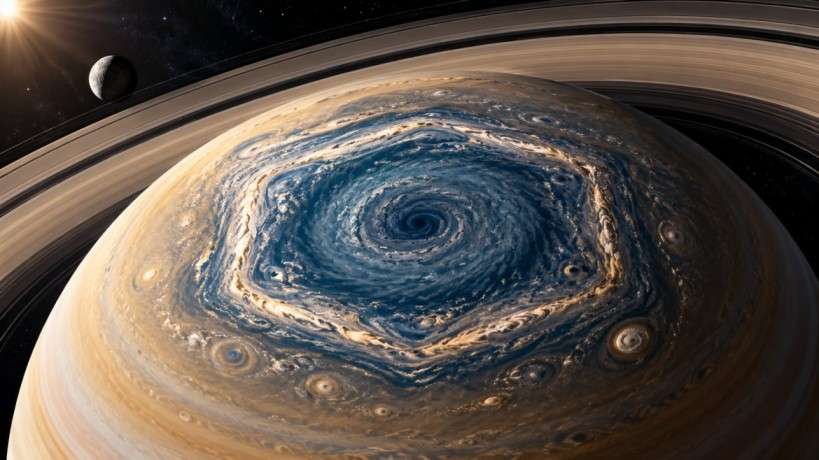
Saturn already had one of the strangest weather systems in the solar system: a giant six-sided pattern circling its north pole. Now, astronomers have found something almost as surprising on the other side of the planet.
The saturn south pole decagon is a huge, evolving atmospheric wave with ten distinct sides. Hubble observations show that it has been developing since at least 2023, becoming increasingly clear in images taken over the following years.
At first glance, it looks like Saturn has simply created a southern version of its famous northern hexagon. But the resemblance is misleading. The saturn south pole decagon is not a copy of the hexagon, and scientists are still working out exactly why the southern atmosphere has produced a ten-sided structure.
The discovery raises an even bigger question: if Saturn’s atmosphere can naturally create geometric patterns, what does that tell us about how weather works on a planet with no solid surface?
What exactly is Saturn’s new decagon?
The saturn south pole decagon is a large atmospheric wave embedded within one of Saturn’s powerful jet streams. It is centered around 63 degrees south latitude and extends through multiple atmospheric layers.
That last detail is important.
This is not simply a strange cloud that happens to look like a polygon in one photograph. Hubble observed the feature at different wavelengths, allowing scientists to examine different atmospheric altitudes. The pattern changes position slightly depending on the wavelength because the observations are sampling different levels of Saturn’s atmosphere.
The saturn decagon is therefore better described as a three-dimensional atmospheric structure than as a flat shape painted onto Saturn’s clouds.
NASA describes it as the first large, regular-sided jet pattern observed in Saturn’s southern hemisphere.
[LINK 1: Insert a relevant Hubble/Saturn decagon resource here]
Why does Saturn produce geometric weather?
The obvious question is how did the saturn decagon form?
The short answer is that Saturn’s atmosphere is dominated by enormous rotating flows. Fast-moving jet streams interact with slower-moving air, creating instability and waves.
Think of a fast river flowing alongside slower water. The boundary between them can become uneven, producing waves and swirling structures. Saturn’s atmosphere operates on the same broad physical principles, although on a vastly larger scale.
Scientists studying saturn atmospheric waves are particularly interested in the interaction between wind speed, latitude, rotation and atmospheric stability.
Saturn rotates rapidly, and its atmosphere contains powerful east-west jet streams. The interaction between those flows can create waves that become organized rather than remaining completely chaotic.
The saturn south pole decagon may therefore be an example of atmospheric self-organization: a complicated fluid system naturally producing a surprisingly regular pattern.
But there is a catch. Scientists do not yet have a complete explanation for why this particular wave has ten sides.
Saturn’s decagon vs. the famous northern hexagon
The comparison between the saturn south pole decagon vs north pole hexagon is unavoidable.
Saturn’s northern hexagon has been observed for decades. It is a six-sided wave embedded in a powerful polar jet stream and has remained remarkably stable.
The newly identified southern feature is different.
| Feature | North Pole | South Pole |
|---|---|---|
| Shape | Hexagon | Decagon |
| Number of sides | 6 | 10 |
| Known from | Voyager-era observations | Hubble observations |
| Structure | Polar jet-stream wave | Jet-stream wave |
| Long-term behavior | Stable for decades | Still evolving |
| Scientific status | Well studied | Newly identified |
The saturn south pole decagon is especially interesting because it appears to be evolving. Researchers found subtle evidence of the structure in Hubble observations from 2023, while later observations showed it becoming more clearly defined.
That means astronomers may be watching a large-scale atmospheric pattern develop rather than merely discovering an old feature that had been hidden from view.
Why did Hubble only see the decagon now?
The question why did Hubble only see the saturn decagon now has a surprisingly nuanced answer.
It is not necessarily because the structure suddenly appeared in 2026.
Hubble observations show that the feature was already present in 2023. Earlier observations contained hints of an undulating band, but the pattern was not yet obvious enough to identify confidently as a decagon.
Ground-based observations in 2025 provided additional clues, while Hubble’s sharper view helped researchers examine the structure in much greater detail.
This is one of the strengths of long-term astronomy.
A single photograph can show what something looks like. A sequence of observations can show how it changes.
The Hubble OPAL program has been particularly valuable for this purpose. OPAL repeatedly observes the giant planets so scientists can track atmospheric changes over many years rather than relying only on occasional spacecraft encounters.
What is the Hubble OPAL program?
The hubble opal program saturn observations are part of a much larger effort to monitor the atmospheres of Jupiter, Saturn, Uranus and Neptune.
OPAL stands for Outer Planet Atmospheres Legacy. Rather than sending a spacecraft to each planet every year, astronomers use Hubble to create long-term records of the planets’ clouds, storms and atmospheric patterns.
That long baseline is exactly what made the new discovery possible.
The saturn south pole decagon was identified by comparing observations across multiple years. Scientists could see that a subtle wave was becoming more pronounced over time.
[LINK 2: Insert a relevant NASA OPAL Saturn observations resource here]
This also explains why the discovery matters beyond the shape itself. Astronomers are not simply collecting unusual photographs. They are building a long-term record of planetary weather.
Is the southern decagon a giant storm?
Not exactly.
Calling the saturn south pole storm a “storm” can be misleading because the decagon itself is primarily an atmospheric wave associated with a jet stream.
Saturn does have a powerful polar vortex, which is a large rotating atmospheric system around the pole. The decagonal structure is located within the broader circulation and jet-stream environment.
The distinction is similar to the difference between a river and a wave moving through it. The river is the large flow; the wave is a pattern moving through that flow.
The saturn south pole decagon is closer to the second example.
This distinction also helps explain why the feature can have such a regular shape without being a solid structure. Nothing is physically holding ten corners in place. The geometry comes from the behavior of moving gas.
Could the decagon be related to Saturn’s hexagon?
Possibly, but scientists need more observations before drawing a strong connection.
The saturn south pole decagon and northern hexagon occupy similar atmospheric environments: both are large-scale patterns associated with polar jet streams.
However, they have different shapes and different observed histories.
The northern hexagon has remained stable for decades. The southern pattern is still being tracked and appears to be changing.
One possibility is that differences in wind speeds, atmospheric layers, seasonal conditions or wave dynamics cause the two poles to organize themselves differently.
That is why saturn decagon research could become an important test of planetary fluid dynamics. If scientists can explain why one pole produces six waves while another develops ten, they may learn more about how rotating atmospheres select particular patterns.
Is the Saturn south pole decagon permanent?
The answer to is saturn south pole decagon permanent is currently no one can say.
The northern hexagon has survived for more than four decades of observations, making its stability remarkable. The southern feature has only recently become clearly identifiable.
Researchers therefore need continued observations to determine whether the saturn south pole decagon will remain a long-lived structure, change shape, weaken or disappear.
That uncertainty is scientifically useful.
If the decagon continues developing, Hubble and future observations could provide a rare opportunity to watch planetary atmospheric dynamics unfold over time.
What does this teach us about planetary weather?
The most fascinating lesson from the saturn south pole decagon is that weather does not always look random.
On Earth, clouds and storms can appear chaotic because they are influenced by mountains, oceans, land surfaces and constantly changing temperature differences.
Saturn is different. It is a gas giant with no solid surface like Earth’s continents. Its atmosphere extends deep into the planet, and its enormous rotating flows can persist on scales that have no direct equivalent in ordinary terrestrial weather.
That makes Saturn a natural laboratory for studying fluid dynamics.
The saturn south pole decagon gives scientists another example of how rotating gases can organize themselves into large-scale structures.
And there is an intriguing possibility: the ten-sided pattern may not have been “designed” by anything. It could simply be what Saturn’s atmosphere does when its physical conditions happen to favor that particular wave pattern.
The bigger mystery is still ahead
The discovery of the saturn south pole decagon does not close the mystery of Saturn’s geometric weather. It expands it.
Now scientists have two dramatically different polar patterns to compare: a long-lived northern hexagon and an evolving southern decagon.
Why six sides in one hemisphere and ten in the other?
Why did the southern structure become visible only recently?
Will it remain stable?
And could other, less obvious atmospheric waves be hiding elsewhere on Saturn?
Those questions make the saturn south pole decagon more than a spectacular image. It is a new natural experiment occurring on a planet more than a billion kilometers from Earth.
Conclusion
The saturn south pole decagon is a remarkable reminder that planetary weather can be far more organized than it appears.
Hubble has revealed a ten-sided atmospheric wave embedded in Saturn’s southern jet stream, with observations showing that the structure has been developing since at least 2023. Scientists know what the feature looks like and understand the broad physics of rotating atmospheric waves, but its exact origin and long-term future remain open questions.
The comparison with Saturn’s northern hexagon makes the discovery even more valuable. Instead of giving scientists one strange geometric weather system to explain, Saturn now offers two.
And that may be the real scientific opportunity: by comparing them, researchers can learn why a turbulent atmosphere sometimes produces geometry—and why the geometry is not always the same.
Frequently Asked Questions
What is the Saturn south pole decagon?
The saturn south pole decagon is a large, evolving ten-sided atmospheric wave embedded within a powerful jet stream around Saturn’s southern polar region.
How did the Saturn decagon form?
Scientists are still determining the exact formation mechanism. The likely explanation involves interactions between fast and slow atmospheric flows, planetary rotation, jet-stream dynamics and atmospheric waves.
Is the Saturn decagon the same as the northern hexagon?
No. The saturn south pole decagon has ten sides, while the northern feature has six. They are similar because both are associated with powerful jet streams, but their shapes and observed behavior differ.
Why did Hubble only discover the decagon recently?
Hubble observations show that the feature was already present by 2023, but it was initially subtle. Later observations made the ten-sided structure increasingly clear.
Is Saturn’s south pole decagon permanent?
It is not known yet. Unlike the northern hexagon, which has remained stable for decades, the southern feature appears to be evolving and requires continued observation.
Is the decagon a storm?
Not exactly. It is primarily an atmospheric wave within a jet stream. Saturn also has a rotating polar vortex surrounding the pole.
What is the Hubble OPAL program?
OPAL, or Outer Planet Atmospheres Legacy, is a Hubble observing program that makes long-term observations of Jupiter, Saturn, Uranus and Neptune to study changes in their atmospheres.
Can geometric weather patterns occur on other planets?
Yes. Rotating planetary atmospheres can produce waves, vortices and organized structures. Saturn’s hexagon and decagon are particularly striking examples, but the underlying fluid dynamics are not unique to Saturn.
Explore more fascinating space and planetary science topics in our [Science] section to discover how planets, atmospheres and the universe work