Table of Contents
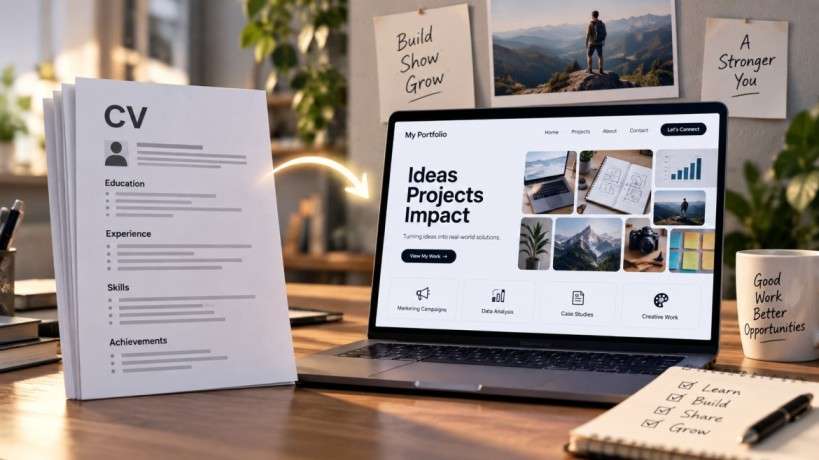
A CV can tell an employer what you have done. A portfolio can show them what you can actually do.
That difference is becoming increasingly important for students, career switchers, freelancers, marketers, analysts, developers, researchers, and other professionals whose abilities can be demonstrated through projects.
Learning how to build a career portfolio is therefore not about replacing your CV. It is about creating evidence behind the claims on it.
Harvard’s Mignone Center for Career Success describes portfolios as an important way to showcase skills, talents, and accomplishments, particularly in creative, technical, and engineering fields. Its portfolio resources also highlight options such as GitHub Pages and Adobe Portfolio.
Career Portfolio vs Resume: What Is the Difference?
The simplest way to understand career portfolio vs resume is this:
| Resume/CV | Portfolio |
|---|---|
| Summarizes your experience | Demonstrates your experience |
| Mostly text | Text, visuals, files, links and results |
| Usually 1–2 pages | Can contain multiple projects |
| Says what you achieved | Shows how you achieved it |
| Designed for quick screening | Designed for deeper evaluation |
Understanding career portfolio vs resume helps you use both strategically.
A resume is still important. Harvard describes a resume as a concise summary of abilities, education, and experience.
But career portfolio vs resume should not be treated as an either-or decision.
The best approach is to use career portfolio vs resume together: the resume gets attention, while the portfolio provides evidence.
When considering career portfolio vs resume, think of the resume as the headline and the portfolio as the proof.
That is the real advantage of understanding career portfolio vs resume.
Why You Should Learn How to Build a Career Portfolio
The first reason to learn how to build a career portfolio is simple: employers cannot always judge your practical ability from job titles.
Consider two candidates:
Candidate A:
“Knowledge of digital marketing, analytics and SEO.”
Candidate B:
“Completed an SEO audit, identified technical issues, researched keywords and created an optimization plan.”
Candidate B can attach the actual work.
That is why how to build a career portfolio should focus on evidence rather than impressive descriptions.
A strong portfolio can demonstrate:
- Problem-solving
- Communication
- Research
- Technical ability
- Creativity
- Analytical thinking
- Project execution
- Industry knowledge
Learning how to build a career portfolio also forces you to organize your achievements instead of forgetting them.
How to Create a Work Portfolio Without Experience
One of the biggest myths about portfolios is that you need a job before you can create one.
You don’t.
Knowing how to create a work portfolio without experience begins with understanding that “experience” can come from more places than employment.
Academic projects, personal experiments, volunteer work, simulations, case studies, competitions, research assignments and independent projects can all demonstrate skills.
Harvard’s career guidance similarly notes that coursework, academic projects, student leadership, volunteer work and independent portfolio projects can help candidates demonstrate skills even without professional experience.
So how to create a work portfolio without experience?
Try this formula:
Learn → Build → Document → Explain → Publish
For example:
Learning digital marketing → creating a mock campaign → documenting the strategy → explaining the decisions → publishing the case study.
That is a genuine demonstration of ability.
When learning how to create a work portfolio without experience, never pretend that a personal project was paid client work.
Instead, clearly label it:
- Personal project
- Academic project
- Practice project
- Case study
- Volunteer project
- Independent research
That makes how to create a work portfolio without experience both ethical and useful.
How to Build a Career Portfolio Around Projects
The strongest answer to how to build a career portfolio is to organize it around problems you solved.
Don’t simply create a page called “My Projects” and upload random files.
For every project, answer five questions:
- What was the problem?
- What was your role?
- What process did you follow?
- What did you create?
- What did you learn or achieve?
This framework makes how to build a career portfolio much more compelling.
For example:
Project: Social Media Campaign
Challenge: A hypothetical brand needed stronger Instagram engagement.
Approach: Audience research, content planning and competitor analysis.
Execution: Created a 30-day content strategy.
Output: Content calendar, creative concepts and performance dashboard.
Learning: Identified which content formats could improve engagement.
That is far stronger than simply writing “Social Media Marketing Project.”
Professional Portfolio Examples for Non Designers
You do not need to be a graphic designer to benefit from a portfolio.
Here are some professional portfolio examples for non designers:
Digital Marketer
- Campaign strategy
- SEO audit
- Keyword research
- Ad concepts
- Analytics dashboard
- Content strategy
Data Analyst
- Excel dashboard
- SQL project
- Power BI report
- Data-cleaning project
- Business analysis
Business Student
- Market research
- Competitor analysis
- Business case study
- Presentation
- Financial model
Political Science Student
- Policy analysis
- Research paper
- Survey analysis
- Public-policy case study
- Constitution-related research
These professional portfolio examples for non designers show that portfolios are about evidence, not aesthetics.
More professional portfolio examples for non designers can include writing samples, presentations, research projects and strategic recommendations.
The best professional portfolio examples for non designers focus on skills employers actually need.
Digital Career Portfolio Websites
You don’t necessarily need to hire a developer to create a portfolio.
Several digital career portfolio websites allow professionals to create online collections of their work.
Common options include:
- Personal websites
- GitHub Pages
- Notion
- Adobe Portfolio
- Other portfolio-building platforms
Harvard’s portfolio resources specifically mention GitHub Pages for showcasing coding, research and technical work.
When evaluating digital career portfolio websites, choose the platform based on your profession.
A developer may benefit from GitHub Pages. A creative professional might prefer a visual portfolio platform. A marketer may want a personal website containing case studies.
The best digital career portfolio websites are not necessarily the most visually complicated.
Good digital career portfolio websites should be:
- Easy to navigate
- Mobile-friendly
- Fast
- Professionally written
- Easy to share
- Focused on your work
Your choice among digital career portfolio websites should therefore follow your career objective.
How to Showcase Work Samples Online
The next challenge is how to showcase work samples online without overwhelming visitors.
Do not upload twenty unrelated files.
Select your strongest five to eight projects.
For each project, provide:
Context → Problem → Process → Work → Result → Lesson
This structure explains how to showcase work samples online while keeping the visitor interested.
Another important principle in how to showcase work samples online is to show the actual output whenever possible.
Instead of saying:
“I know Power BI.”
Show:
“Here is a dashboard I created using a public dataset.”
Instead of saying:
“I understand SEO.”
Show:
“Here is an SEO audit and optimization strategy.”
That is the real power of how to showcase work samples online.
How to Build a Career Portfolio That Tells a Story
A portfolio should not feel like a digital storage folder.
Learning how to build a career portfolio means creating a professional story.
Your homepage could answer:
Who are you?
What do you do?
What problems can you solve?
What evidence proves it?
Then organize projects according to your target role.
If you’re applying for marketing jobs, prioritize campaigns, research, analytics and content.
If you’re applying for data roles, prioritize dashboards, analysis and problem-solving.
If you’re applying for consulting, prioritize structured case studies and strategic recommendations.
This is another reason how to build a career portfolio should begin with the job you want, not the platform you want to use.
Career Portfolio vs Resume: Should You Still Have a CV?
Yes.
The career portfolio vs resume debate can become misleading if it suggests that one replaces the other.
Your resume should remain concise and targeted. Your portfolio can provide additional depth.
Think of career portfolio vs resume like this:
Resume: “I have this skill.”
Portfolio: “Here is evidence that I can use this skill.”
That makes career portfolio vs resume a complementary relationship.
In fact, the best career portfolio vs resume strategy is to connect the two. Add your portfolio URL to your resume, LinkedIn profile and relevant applications.
How to Create a Work Portfolio Without Experience: A 7-Day Challenge
If you’re still asking how to create a work portfolio without experience, start small.
Day 1: Choose your target role.
Day 2: Find three skills repeatedly mentioned in job descriptions.
Day 3: Choose one skill and create a small project.
Day 4: Document your process.
Day 5: Turn the project into a case study.
Day 6: Publish it.
Day 7: Add it to your resume and LinkedIn.
This is one of the fastest ways to understand how to create a work portfolio without experience.
You don’t need ten projects. One excellent project is better than ten unfinished ones.
How to Showcase Work Samples Online Without Looking Fake
When learning how to showcase work samples online, transparency matters.
Never exaggerate:
- Client results
- Revenue
- Conversion rates
- Job responsibilities
- Professional experience
If you created a hypothetical campaign, say so.
If you used a public dataset, mention the source.
If you worked on a university project, identify it as academic.
This makes how to showcase work samples online more credible.
It also allows recruiters to focus on your thinking rather than questioning your claims.
FAQs
Is a portfolio better than a resume?
The career portfolio vs resume comparison isn’t about choosing one. A resume summarizes your qualifications, while a portfolio demonstrates them.
Can students build portfolios?
Absolutely. How to create a work portfolio without experience is especially useful for students because academic and personal projects can demonstrate practical skills.
What should a non-designer put in a portfolio?
Useful professional portfolio examples for non designers include research, dashboards, marketing campaigns, writing, case studies, presentations and strategic analysis.
Which digital career portfolio websites should I use?
Choose digital career portfolio websites based on your profession, technical ability and desired audience. A simple personal website is often enough.
How many projects should a portfolio contain?
When learning how to build a career portfolio, prioritize quality over quantity. Five strong projects can be more persuasive than twenty weak ones.
Should I put my portfolio link on my CV?
Yes. The career portfolio vs resume relationship works best when the two support each other. Put a clean portfolio URL on your resume and professional profiles.
What is the easiest way to showcase work?
The easiest approach to how to showcase work samples online is to choose one platform, create three strong projects and explain the problem, process, output and result for each.
Final Takeaway
The modern job search is increasingly about proof.
A CV tells employers what you claim to know. A portfolio lets them inspect the evidence.
If you’re wondering how to build a career portfolio, start with the work you already have. If you have no professional experience, learn how to create a work portfolio without experience by turning academic, personal or simulated projects into honest case studies.
Use professional portfolio examples for non designers as inspiration, explore suitable digital career portfolio websites, and learn how to showcase work samples online clearly.
Most importantly, stop waiting until you have the “perfect” career.
Start building the evidence of the career you want—and let your portfolio become the bridge between what your CV says and what you can actually do.
Explore more career insights and practical guides in our [Career & Work-Life] section.