Table of Contents
A flight to Paris costs ₹45,000.
Your hotel costs ₹30,000.
You calculate the numbers, add a little spending money, and decide the trip will cost around ₹90,000.
Then the trip actually happens.
Visa fees appear. Airport transfers cost more than expected. Your card adds foreign transaction charges. The exchange rate is worse than the one you saw online. You buy travel insurance, pay for baggage, spend more on food than planned, and suddenly that ₹90,000 trip is approaching ₹1.2 lakh.
This is one of the biggest mistakes people make when planning international travel.
They calculate the advertised price of the trip, not the real cost of the trip.
If you want to know how to budget for an international trip, you need to think beyond flights and hotels. The real budget should include every predictable expense, plus a realistic buffer for things you cannot predict.
Here is a practical way to calculate it.
Start With the Full Trip Cost, Not Just the Flight
The first step in learning how to budget for an international trip is to stop thinking about the flight as the starting and ending point of your travel budget.
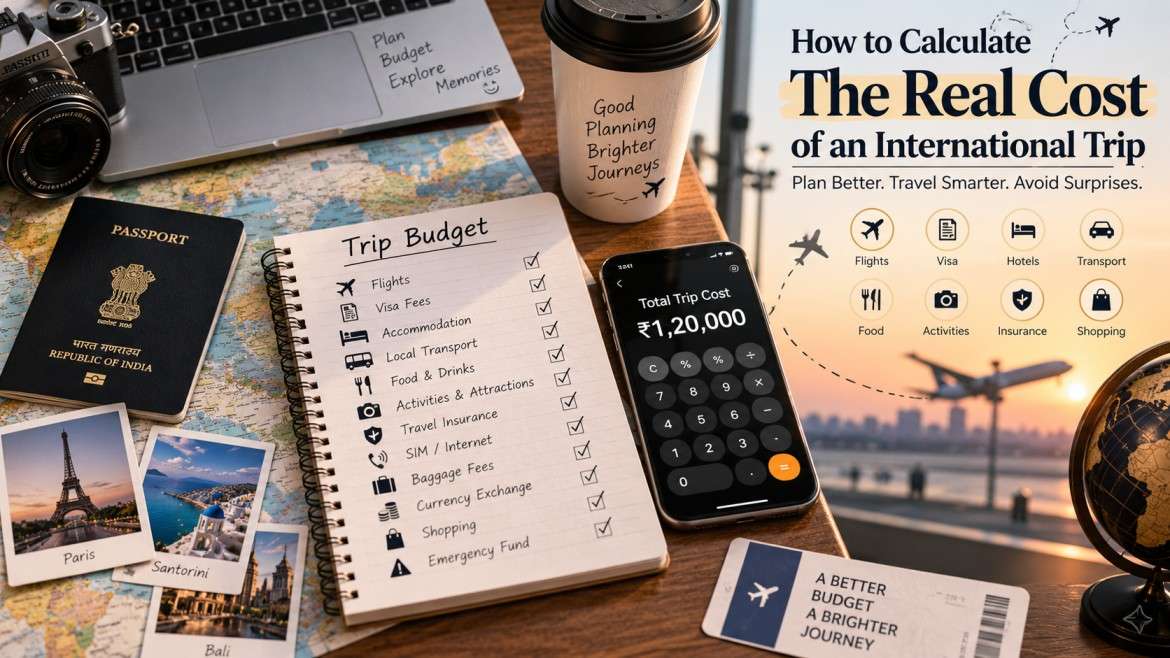
An international trip can contain several separate spending categories:
- Flights
- Visa and entry fees
- Accommodation
- Local transportation
- Food and drinks
- Attractions and activities
- Travel insurance
- Mobile data or eSIM
- Airport transfers
- Baggage fees
- Currency-exchange costs
- Shopping
- Emergency expenses
A simple formula is:
Total Trip Cost = Pre-Trip Costs + Daily Costs + Activity Costs + Travel Fees + Emergency Buffer
This approach gives you a much more realistic number before you book anything.
Step 1: Calculate Your Flight Cost Properly
Flights are usually one of the biggest expenses, but the displayed ticket price may not represent everything you will actually pay.
Check whether the fare includes:
- Checked baggage
- Cabin baggage
- Seat selection
- Meals
- Airport taxes
- Date-change flexibility
- Cancellation options
A ₹35,000 flight can become significantly more expensive once optional services are added.
Also remember that flight prices can vary depending on travel dates, destination, season and booking timing.
When planning your budget, don’t simply record the cheapest flight you find.
Use the realistic price you are actually willing to pay.
For example:
Round-trip flight: ₹45,000
Extra baggage: ₹5,000
Seat/other fees: ₹2,000
Real flight budget: ₹52,000
That number is much more useful than the original ₹45,000 headline price.
Step 2: Don’t Forget Visa and Entry Costs
Visa expenses are easy to overlook because they happen before the trip.
Depending on your destination and nationality, you may need to account for:
- Visa fees
- Application-center charges
- Biometric fees
- Document costs
- Photographs
- Translation or certification
- Travel insurance requirements
- Tourist taxes or entry charges
Some destinations may also require proof of sufficient funds or onward travel.
Before finalizing your budget, check the destination’s official immigration or embassy information rather than relying solely on travel blogs.
This is especially important because visa rules and fees can change.
Step 3: Calculate Accommodation by Night
Accommodation is another area where travelers underestimate costs.
Suppose your hotel costs ₹6,000 per night.
For a seven-night trip:
₹6,000 × 7 = ₹42,000
But check whether the displayed price includes:
- Taxes
- Resort or city taxes
- Breakfast
- Cleaning fees
- Service charges
- Extra-person charges
- Security deposits
Some accommodation platforms display prices differently depending on the destination and booking conditions.
Therefore, use the final payable amount, not the first price you see.
A useful rule
Calculate your accommodation budget using the actual number of nights you need—not simply the number of days of the trip.
A seven-day trip may require six hotel nights, while another itinerary may require seven depending on arrival and departure times.
Step 4: Build a Daily Spending Budget
This is where your destination starts making a major difference.
Your daily budget should include:
Food + local transport + small purchases + activities
For example, imagine a seven-day trip with this daily estimate:
- Food: ₹2,000
- Local transport: ₹1,000
- Activities: ₹1,500
- Miscellaneous: ₹500
Daily spending:
₹5,000
Seven days:
₹5,000 × 7 = ₹35,000
This approach is much better than simply saying, “I’ll take ₹20,000 for spending.”
Step 5: Separate Food From Activities
One of the easiest ways to lose control of your travel budget is combining everything into one daily figure.
Instead, separate your expenses.
Food
Estimate:
- Breakfast
- Lunch
- Dinner
- Snacks
- Coffee or drinks
You can then decide whether you want a budget, mid-range or premium food experience.
Activities
List the attractions you actually want to visit.
For example:
- Museum: ₹1,500
- Guided tour: ₹3,000
- Theme park: ₹5,000
- Boat trip: ₹2,500
This gives you a more realistic activity budget before leaving home.
Step 6: Don’t Underestimate Local Transportation
Transportation does not end when your plane lands.
You may need:
- Airport transfer
- Metro or train
- Buses
- Taxis
- Ride-hailing services
- Rental cars
- Intercity trains
- Ferries
The cheapest option is not always the most practical.
If you arrive late at night, for example, you may need a taxi instead of public transportation.
A useful strategy is to divide transportation into two categories:
Fixed transport: airport transfers, pre-booked trains, intercity flights.
Variable transport: taxis, buses, metro, ride-hailing and other daily travel.
This makes your budget easier to control.
Step 7: Understand Currency Exchange
This is one of the most overlooked parts of international budgeting.
The exchange rate you see on Google or a currency website may not be the exact rate you receive when making a purchase.
Your actual cost can be affected by:
- Card exchange rates
- Foreign transaction fees
- ATM fees
- Currency-conversion charges
- Dynamic currency conversion
- Cash-exchange spreads
The U.S. Consumer Financial Protection Bureau explains that foreign transactions can involve currency-conversion rates and foreign transaction fees, demonstrating why the exchange rate alone may not represent the complete cost of an international purchase. (consumerfinance.gov)
So when learning how to budget for an international trip, don’t convert every expense using the perfect mid-market exchange rate and assume that is what you will pay.
Build in some margin.
Step 8: Be Careful With Dynamic Currency Conversion
You may sometimes be asked:
“Would you like to pay in your home currency or local currency?”
This can happen when using a card abroad.
The option that displays the amount in your home currency may look convenient, but the conversion rate and fees can make it more expensive.
Before accepting the conversion, understand what exchange rate is being used and whether additional charges are included.
When in doubt, check your card provider’s international transaction terms before traveling.
A small percentage difference on individual purchases may not seem significant.
Across a two-week trip, however, those differences can add up.
Step 9: Add Travel Insurance
Travel insurance is another cost that should be included before calculating the final trip price.
Depending on the policy, coverage may include:
- Emergency medical treatment
- Medical evacuation
- Trip cancellation
- Trip interruption
- Lost baggage
- Travel delays
- Other specified risks
The U.S. Department of State recommends that international travelers consider travel medical insurance and carefully review what their policy actually covers. It also notes that medical evacuation and healthcare expenses abroad can be significant. (travel.state.gov)
You can read its detailed Travel Insurance guidance before deciding what coverage makes sense for your trip.
Don’t simply choose the cheapest policy.
Check:
- Coverage limits
- Exclusions
- Medical coverage
- Emergency evacuation
- Pre-existing-condition rules
- Activities covered
- Cancellation conditions
Step 10: Budget for Mobile Data and Connectivity
Your phone can become an unexpected travel expense.
Depending on your destination and mobile provider, you may need:
- International roaming
- Local SIM
- eSIM
- Portable Wi-Fi
For a short trip, an eSIM may be convenient.
For a longer trip, a local SIM or local data plan may be more economical.
Whatever you choose, include it in your initial budget rather than treating it as a minor expense that does not count.
Step 11: Don’t Forget Airport and Transfer Costs
Your itinerary may technically say:
Home → Airport → Destination → Hotel
But each transition can cost money.
Consider:
Home → departure airport
Destination airport → hotel
Hotel → attractions
Hotel → departure airport
Arrival airport → home
Airport transfers can be particularly expensive compared with ordinary city transportation.
This is why a good travel budget considers the entire journey rather than only the destination.
Step 12: Create an Emergency Buffer
This is one of the most important parts of learning how to budget for an international trip.
Do not allocate every rupee to planned expenses.
Set aside an emergency buffer.
For example, if your calculated trip cost is:
- Flights: ₹50,000
- Accommodation: ₹40,000
- Food: ₹25,000
- Transport: ₹15,000
- Activities: ₹15,000
- Visa/insurance/data: ₹10,000
Total:
₹1,55,000
You could then add a 10–15% contingency:
₹15,500–₹23,250
Your practical trip budget becomes approximately:
₹1.70–₹1.78 lakh
You may not spend the buffer.
That’s the point.
It is there so that one unexpected expense doesn’t force you to use debt or abandon your plans.
A Simple International Trip Budget Example
Let’s put everything together.
Imagine a seven-night international trip for one person.
| Expense | Estimated Cost |
|---|---|
| Return flight | ₹45,000 |
| Visa and documentation | ₹8,000 |
| Accommodation | ₹42,000 |
| Food | ₹25,000 |
| Local transport | ₹12,000 |
| Activities | ₹15,000 |
| Insurance | ₹3,000 |
| SIM/eSIM | ₹2,000 |
| Airport transfers | ₹5,000 |
| Miscellaneous | ₹5,000 |
| Base total | ₹1,62,000 |
Now add a 10% emergency buffer:
₹16,200
Realistic trip budget: ₹1,78,200
Notice what happened.
The initial flight and hotel combination might have made the trip look like approximately ₹87,000.
But the actual travel budget is closer to ₹1.78 lakh.
That difference is why travelers sometimes return home wondering where all their money went.
Use Three Budget Levels
Another useful method for how to budget for an international trip is to create three versions of your budget.
Minimum budget
The cheapest realistic version of the trip.
You use:
- Budget accommodation
- Public transport
- Affordable food
- Limited paid activities
Comfortable budget
A realistic mid-range trip.
You allow:
- Better accommodation
- Some taxis
- Restaurants
- Several attractions
- More flexibility
Premium budget
You include:
- Better hotels
- Private transfers
- Expensive restaurants
- More activities
- Shopping
- Greater flexibility
This gives you a range rather than one rigid number.
How Much Should You Save Before the Trip?
Once you know your target, turn it into a monthly savings goal.
Suppose your realistic trip budget is:
₹1,80,000
You want to travel in nine months.
Your monthly target would be:
₹1,80,000 ÷ 9 = ₹20,000 per month
If that amount is too high, you have several options:
- Extend the savings timeline
- Choose a cheaper destination
- Reduce trip duration
- Travel during a lower-cost season
- Choose cheaper accommodation
- Reduce paid activities
- Increase your travel fund
This is much better than booking first and worrying about the money later.
The Final Rule: Budget for Reality, Not the Advertisement
The biggest lesson in how to budget for an international trip is simple:
The price you see is rarely the total price you pay.
A flight is not the whole trip.
A hotel price is not necessarily the final accommodation cost.
An exchange rate is not necessarily your actual card conversion rate.
And a daily spending estimate does not account for every unexpected expense.
A realistic international travel budget should therefore include:
Flights + Visa + Accommodation + Food + Transport + Activities + Insurance + Connectivity + Fees + Emergency Buffer
Once you calculate all of these, you can answer the question that actually matters:
“Can I comfortably afford this trip?”
Not just:
“Can I afford the ticket?”

Frequently Asked Questions
How much should I budget for an international trip?
There is no universal amount. Your budget depends on the destination, duration, travel style, exchange rate and activities. Calculate your fixed costs first, estimate daily expenses, then add a contingency buffer.
What is the biggest international travel expense?
For many travelers, flights and accommodation are the largest fixed expenses. However, the balance changes significantly depending on the destination and length of the trip.
Should I include an emergency fund in my travel budget?
Yes. A contingency of around 10–15% can provide flexibility for unexpected transportation, medical, booking or other expenses. The appropriate amount depends on your destination and personal circumstances.
Are exchange rates important when planning a trip?
Yes. Currency fluctuations and conversion fees can change the actual amount you spend. The rate displayed online may not be identical to the rate applied by your bank, card provider or merchant.
Is travel insurance worth including in the budget?
It can be an important part of international travel planning, particularly because unexpected medical or evacuation expenses can be substantial. Read the policy carefully to understand coverage and exclusions. (travel.state.gov)
Conclusion
Learning how to budget for an international trip is not about finding one magic number.
It is about understanding where your money will actually go.
Start with flights and accommodation, but then add visas, food, transportation, activities, insurance, connectivity, currency-conversion costs and an emergency buffer.
Most importantly, calculate your budget using realistic prices, not the cheapest possible prices you can find online.
A good travel budget should make your trip exciting—not financially stressful.
Because the best international trip is not necessarily the cheapest one.
It is the one you can enjoy fully without worrying about how you’re going to pay for it when you get home.
Want to explore more about articles like click here to see more