Table of Contents
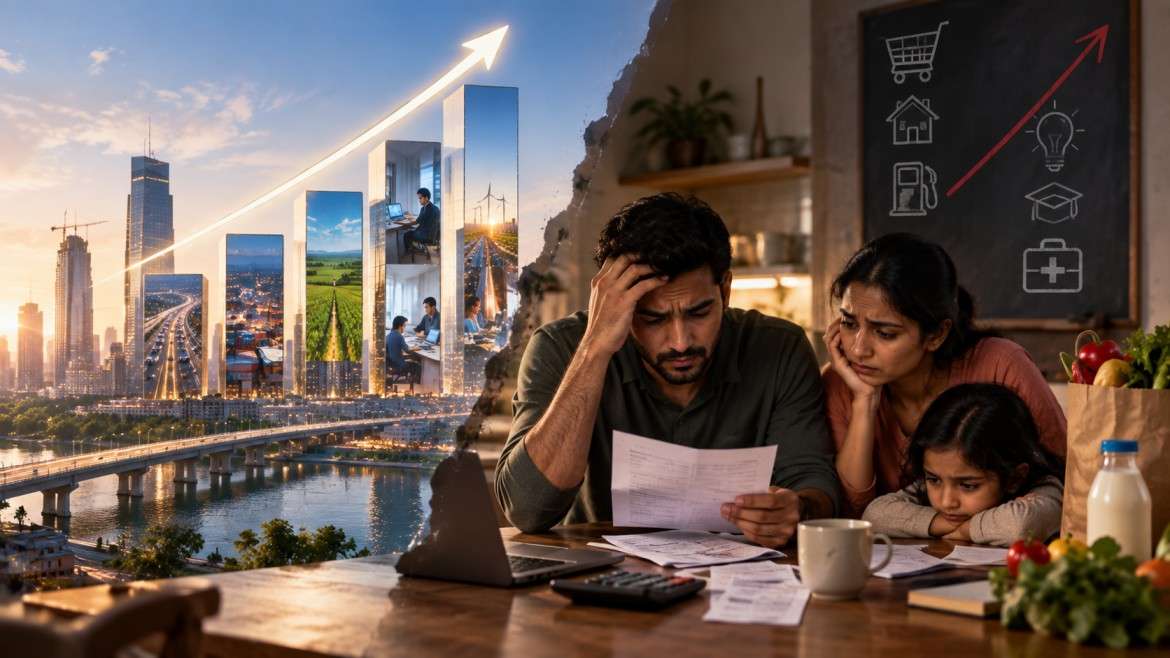
A country announces strong economic growth.
The headlines celebrate.
Businesses are expanding. Investment is rising. GDP is climbing. Policymakers point to the numbers as evidence that the economy is becoming stronger.
But then you talk to an ordinary household.
Rent is higher. Groceries cost more. Electricity bills have increased. School fees are rising. Healthcare is becoming more expensive. Even after receiving a salary increase, the family feels like there is less money left at the end of the month.
So, which story is true?
Both can be true at the same time.
This apparent contradiction is at the heart of the gdp vs cost of living debate.
GDP can grow because the economy is producing more goods and services, while households can simultaneously feel financially squeezed because their incomes are not increasing as quickly as the prices they face.
Understanding why this happens requires looking beyond GDP and examining inflation, real income, wages, household disposable income, inequality and the distribution of economic growth.
What Does GDP Actually Measure?
Before understanding the gdp vs cost of living relationship, it is important to understand what GDP is actually measuring.
Gross Domestic Product (GDP) represents the monetary value of final goods and services produced within an economy over a particular period.
If factories produce more, companies provide more services, businesses invest more and government activity increases, GDP can rise.
That makes GDP an important measure of economic activity.
But GDP does not directly tell us how comfortable the average household feels.
The International Monetary Fund explains that GDP is a measure of production and economic activity, but it is not a direct measure of overall living standards or well-being. It does not fully capture factors such as income distribution, environmental costs or quality of life. (imf.org)
This is the first key to understanding the gdp vs cost of living question:
Economic output and household financial well-being are related—but they are not the same thing.
GDP Can Grow While Prices Rise Faster Than Incomes
Imagine a worker earns ₹50,000 per month.
The next year, their salary rises to ₹52,000.
That sounds positive.
But suppose the cost of their regular household expenses rises by 8%.
Rent, food, transport, electricity and other essential expenses have all become more expensive.
The worker has more money in nominal terms, but their purchasing power may have fallen.
This is where inflation becomes crucial.
The IMF explains that when household incomes do not increase as quickly as prices, households become worse off because they can purchase fewer goods and services with the same income. This decline in inflation-adjusted income is a decline in real purchasing power. (imf.org)
So when discussing gdp vs cost of living, the question is not simply:
“Did incomes increase?”
It is:
“Did incomes increase faster than the prices households actually face?”
Nominal Income vs Real Income
This distinction explains a huge amount of economic confusion.
Nominal income is the amount of money you receive.
Real income reflects what that money can actually buy after accounting for inflation.
Suppose your salary increases by 5%, but the prices of the goods and services you regularly purchase increase by 7%.
Your nominal income has increased.
But your real purchasing power has decreased.
That means you may feel poorer even though your payslip shows a larger number.
The same principle applies to pensions, savings, benefits and other household income.
This is one of the most important concepts behind the gdp vs cost of living discussion.
The Inflation Rate Doesn’t Tell Everyone’s Story
Another reason households can feel poorer even when the economy is growing is that inflation affects people differently.
Official inflation statistics are based on a basket of goods and services designed to represent average price changes.
But no household has an exactly average spending pattern.
Consider two families.
One owns a home, rarely drives and spends relatively little on food.
Another rents an apartment, commutes long distances and spends a large share of its income on groceries and energy.
If rent, fuel and food prices rise rapidly, the second household may experience a much greater increase in its personal cost of living.
This means the headline inflation rate may not perfectly represent the financial pressure experienced by every household.
The IMF notes that prices do not rise uniformly. Different goods can experience very different price changes, meaning inflation can affect households unevenly. (imf.org)
Housing Can Make the Difference Feel Even Bigger
Housing is one of the clearest examples.
GDP can grow because construction, real estate services and related industries are expanding.
But a household renting a home may simultaneously face rising housing costs.
If rent increases faster than wages, more of the household’s income has to go toward keeping the same standard of housing.
The household may therefore feel worse off despite the broader economy becoming larger.
Housing costs can also affect younger households disproportionately because they may have lower savings and less accumulated wealth.
This is why national economic growth does not automatically translate into the same improvement in living standards for every demographic group.
GDP Growth Doesn’t Tell Us Who Gets the Income
Perhaps the biggest weakness of using GDP as a measure of household prosperity is that GDP is an aggregate number.
Imagine an economy produces ₹100 trillion worth of goods and services.
If the economy grows by 7%, total production becomes larger.
But who receives the additional income generated by that growth?
If a large share goes to corporate profits, high-income households or owners of capital, the typical worker may experience little improvement in disposable income.
This is one reason the gdp vs cost of living comparison becomes especially important when discussing inequality.
The OECD has found that GDP growth and household income growth can diverge. Its research identifies factors including differences between producer and consumer prices and changes in the share of income going to corporations. (oecd.org)
In simple terms:
A bigger economy does not guarantee that every household receives a proportionate share of the gains.
GDP Per Capita Helps—but Still Doesn’t Tell the Whole Story
You might think the solution is simply to divide GDP by population.
That gives us GDP per capita.
It is certainly more informative than looking at total GDP alone.
If GDP grows faster than the population, GDP per person can increase.
But even GDP per capita is an average.
Imagine ten people.
Nine earn ₹30,000 each.
One person earns ₹10 lakh.
The average income can look relatively high even though most people have much less.
The same problem can occur at the national level.
GDP per capita tells us something useful about average economic output, but it does not tell us exactly how income and wealth are distributed.
The World Bank similarly notes that GDP per capita has limitations as an indicator of household material well-being because GDP includes economic activity that may not directly translate into household consumption or income. (worldbank.org)
Why Corporate Profits Matter
Another important part of the story is the distribution between profits and wages.
Suppose productivity rises.
A company becomes more efficient and produces significantly more output.
GDP increases.
But if most of the additional income goes toward corporate profits rather than employee compensation, workers may not experience a similar improvement in their financial position.
This does not mean profits are inherently bad.
Profits can finance investment, innovation, expansion and job creation.
The point is simply that GDP measures the total economic activity—not how evenly the benefits are distributed.
This is another reason the gdp vs cost of living relationship cannot be understood by looking at one economic statistic.
What About Employment?
Employment is another bridge between economic growth and household well-being.
Strong GDP growth can encourage businesses to hire more workers.
That can increase household incomes and improve financial security.
But the quality of employment matters.
A country can create jobs while still experiencing:
- Low wage growth
- Informal employment
- Unstable working hours
- High housing costs
- Weak job security
- Rising household debt
The headline employment number may therefore look encouraging while some households continue to struggle.
This is particularly important in economies where a large share of workers operate in informal or less-protected employment.
India’s Economy Shows Why the Question Matters
The issue is particularly relevant for rapidly growing economies such as India.
The OECD’s June 2026 Economic Outlook projected India’s real GDP growth at 6.3% for FY2026–27 and 6.4% for FY2027–28.
At the same time, the OECD warned that higher inflation could weigh on private consumption and household purchasing power, particularly through food and energy costs. (oecd.org)
This illustrates the central point perfectly.
An economy can continue expanding while households face pressure from specific costs.
Growth and affordability can move in different directions over shorter periods.
Why the Cost of Living Can Feel Worse Even After Inflation Falls
There is another important distinction.
Suppose inflation falls from 8% to 4%.
That sounds like prices are becoming cheaper.
But that is not necessarily what happened.
It means prices are generally rising more slowly.
If prices increased substantially during the previous years, the new 4% inflation rate is being applied to an already higher price level.
For example:
- Year 1: ₹100
- After 8% inflation: ₹108
- After another 4% inflation: ₹112.32
Inflation has fallen, but the price has not returned to ₹100.
This is why households can continue feeling the effects of an earlier inflation surge even after inflation begins to moderate.
The gdp vs cost of living gap can therefore persist because households care about the level of prices, not just the current rate at which prices are changing.
Why Household Sentiment Can Lag Behind GDP
Economic statistics often move at different speeds.
GDP can respond relatively quickly to investment, exports, government spending or business activity.
Household sentiment may depend on accumulated experiences.
People remember:
- Higher grocery bills
- Higher rents
- Expensive loans
- Increased school costs
- Higher insurance premiums
- Reduced savings
- Previous salary pressures
Even if the economy improves, it may take time before households feel financially secure again.
This helps explain why economic headlines can sound optimistic while consumer sentiment remains cautious.
What Should We Look At Instead of GDP Alone?
GDP remains extremely useful.
The problem is using it as the only measure of economic well-being.
To understand whether households are actually becoming better off, economists and policymakers should also examine:
Real household disposable income
This tells us how much purchasing power households have after accounting for taxes, transfers and price changes.
Real wages
This shows whether workers’ earnings are keeping pace with inflation.
GDP per capita
This provides a rough measure of output relative to population.
Household consumption
Consumption patterns can provide clues about how households are managing their finances.
Inflation
Especially important are the prices of essentials such as food, housing, energy and transportation.
Employment quality
The number of jobs matters, but so do wages, stability and working conditions.
Inequality
An economy can grow rapidly while the gains are distributed unevenly.
Together, these indicators provide a much clearer picture than GDP alone.
So, Can GDP Growth and Financial Stress Exist Together?
Absolutely.
A growing economy and financially pressured households are not contradictory statements.
GDP answers one question:
“How much economic activity is taking place?”
Household well-being asks a different set of questions:
“How much can people afford?”
“Are their wages keeping up with prices?”
“How much of the economy’s growth reaches households?”
“What are their biggest expenses?”
“How secure are their jobs and incomes?”
These questions overlap, but they are not identical.
The OECD has even documented periods in which real GDP per capita increased while real household disposable income per capita declined. Its analysis explains that differences in consumer prices, producer prices, taxes, transfers and income distribution can all contribute to the divergence. (oecd.org)

Frequently Asked Questions
What does GDP growth mean for ordinary households?
GDP growth means the economy is producing more goods and services, but it does not guarantee that every household becomes financially better off. The impact depends on wages, inflation, employment, taxes, transfers and how economic gains are distributed.
Why can people feel poorer when GDP is rising?
People can feel poorer when their incomes grow more slowly than the prices of goods and services they regularly buy. Their nominal income may rise while their real purchasing power falls.
Is GDP a measure of the cost of living?
No. GDP measures economic production. The cost of living is more closely related to consumer prices, household spending patterns and purchasing power.
What is the difference between GDP and household income?
GDP measures the value of goods and services produced in an economy. Household income measures the income actually received by households. The two are connected but can grow at different rates.
Does lower inflation mean prices are falling?
Not necessarily. Lower inflation usually means prices are rising more slowly. Prices only fall when there is deflation or when individual products become cheaper.
Is GDP per capita a better measure of living standards?
GDP per capita is useful, but it is still an average and does not show income distribution, household purchasing power or many aspects of well-being.
Conclusion: A Bigger Economy Doesn’t Always Feel Like a Richer Life
The gdp vs cost of living debate becomes much easier to understand once we recognize that economic growth and household prosperity are different concepts.
GDP can rise because businesses produce more, investment increases, exports expand or government activity grows.
At the same time, households can feel poorer if food, housing, energy and other essential expenses rise faster than their incomes.
The distribution of economic gains matters too.
If GDP grows rapidly but real wages remain weak, household disposable income stagnates or inequality increases, the benefits of growth may not be widely felt.
That does not make GDP meaningless.
It simply means GDP is one part of the economic picture.
To understand whether people are actually becoming better off, we need to look at GDP alongside real household income, real wages, inflation, employment, consumption and inequality.
Because ultimately, people don’t experience GDP growth directly.
They experience their paycheck, their rent, their grocery bill, their savings and what they can afford at the end of the month.
And that is why an economy can look richer on paper while many households still feel financially squeezed.
Click here to explore more about economics.