Table of Contents
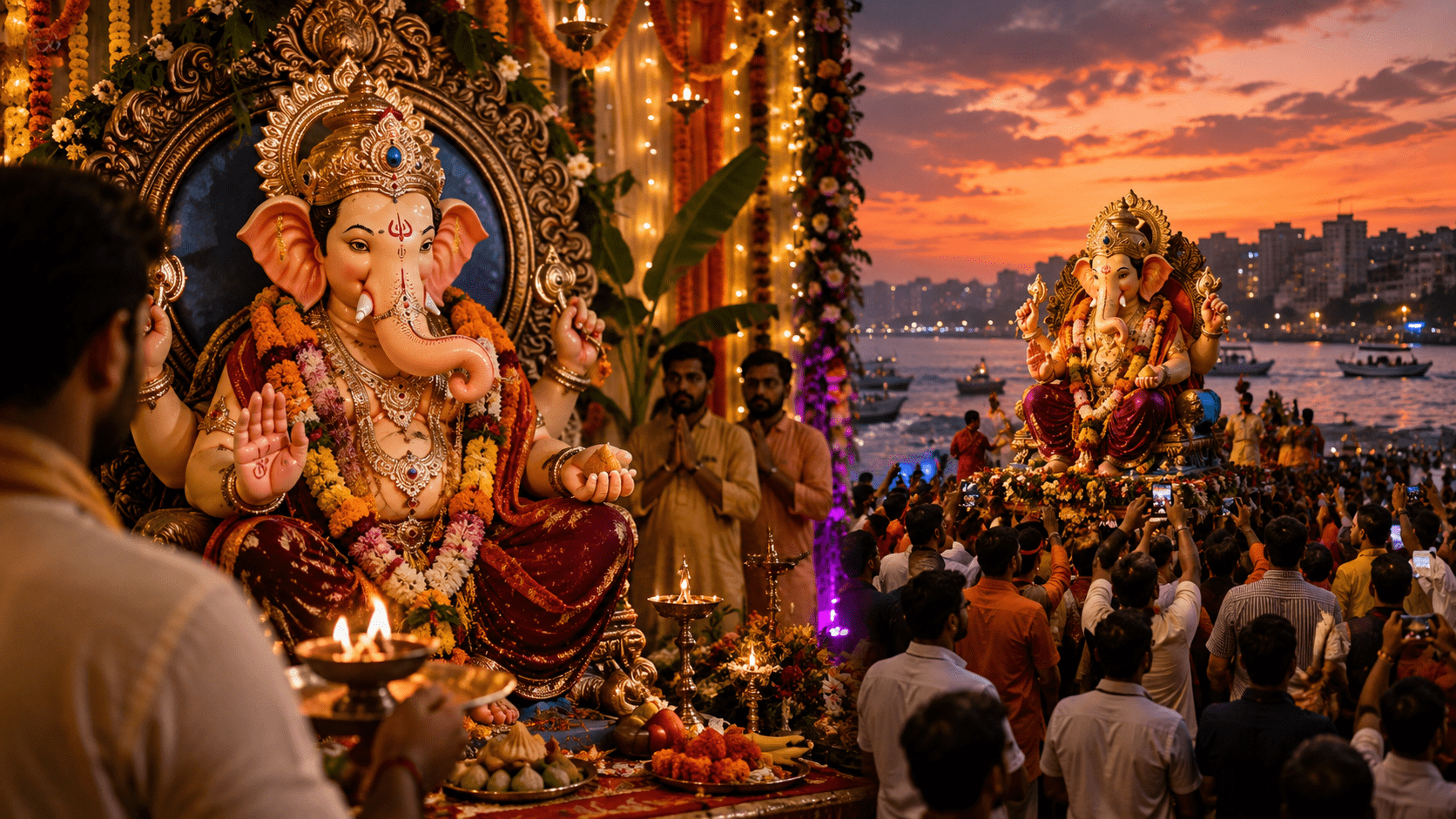
Every year, millions of people across India celebrate Ganesh Chaturthi, a Hindu festival dedicated to Lord Ganesha. Homes, temples and public spaces are decorated, Ganesha idols are installed, prayers are performed and communities come together for days of religious and cultural celebrations.
But why is Ganesh Chaturthi celebrated? What does Lord Ganesha represent, and why are his idols immersed in water at the end of the festival?
Ganesh Chaturthi, also known as Vinayaka Chaturthi, is traditionally associated with the birth of Lord Ganesha. The festival is observed on the fourth day of the bright fortnight of the Hindu month of Bhadrapada, which generally falls in August or September.
Although the festival has deep religious roots, Ganesh Chaturthi has also developed into a major cultural and community celebration, particularly in Maharashtra. Today, it is observed in many parts of India and by Hindu communities outside the country.
What Is Ganesh Chaturthi?
Ganesh Chaturthi is a Hindu festival dedicated to Lord Ganesha, one of the most widely worshipped deities in Hindu traditions.
Ganesha is traditionally associated with wisdom, knowledge, prosperity, auspicious beginnings and the removal of obstacles. His distinctive elephant-headed form has made him one of the most recognisable figures in Hindu religious traditions.
The festival centres on the installation and worship of a Ganesha idol. Depending on family and regional traditions, devotees may keep the idol for one or several days before performing Ganesh Visarjan, the ritual immersion of the idol in water.
The religious significance of Ganesha extends well beyond this festival. Encyclopaedia Britannica’s overview of Ganesha provides further background on the deity, his mythology and his place within Hindu traditions.
Why Is Ganesh Chaturthi Celebrated?
The primary religious purpose of Ganesh Chaturthi is to honour Lord Ganesha and commemorate his birth or manifestation.
Ganesha is traditionally regarded as the son of Shiva and Parvati. Hindu traditions contain several accounts and variations concerning his origin, but one of the best-known stories describes Parvati creating Ganesha and asking him to guard her while she bathed.
When Shiva arrived, Ganesha prevented him from entering. Because neither recognised the other, a confrontation followed. In the traditional story, Shiva eventually replaced Ganesha’s severed head with that of an elephant and restored him to life.
Different Hindu texts and regional traditions tell the story in different ways. These accounts belong to Hindu religious mythology and should therefore be understood within their religious and cultural context rather than as historically verified events.
For devotees, Ganesh Chaturthi provides an opportunity to seek Ganesha’s blessings for wisdom, prosperity, success and the removal of obstacles.
What Is the Religious Significance of Lord Ganesha?
Ganesha occupies an important place in Hindu worship.
He is commonly invoked before important activities because of his traditional association with removing obstacles and ensuring auspicious beginnings. This is one reason Ganesha may be worshipped before starting a new business, beginning a major project, undertaking studies or entering an important new stage of life.
Ganesha is also strongly associated with intelligence and learning.
His physical form carries considerable symbolic meaning in Hindu traditions.
The elephant head
The elephant is traditionally associated with wisdom, intelligence and strength. Ganesha’s elephant head is therefore often interpreted as a representation of these qualities.
Large ears
Ganesha’s large ears are commonly interpreted as a reminder to listen carefully and absorb knowledge.
Large belly
His large belly is often understood symbolically as representing the ability to accept and digest the experiences of life.
The mouse
Ganesha is traditionally depicted with a mouse as his vahana, or vehicle. Various interpretations associate the mouse with desires, restlessness or the ability to overcome seemingly difficult obstacles.
These symbolic interpretations can differ among religious traditions and teachers.
When Is Ganesh Chaturthi Celebrated?
Ganesh Chaturthi follows the Hindu lunar calendar, so its date changes from year to year on the Gregorian calendar.
The festival is traditionally observed on Bhadrapada Shukla Chaturthi, the fourth lunar day of the bright fortnight of Bhadrapada. It usually falls during August or September.
When is Ganesh Chaturthi in 2026?
In 2026, Ganesh Chaturthi falls on Monday, September 14.
The exact timing of the Chaturthi tithi and the most suitable time for performing the main puja can vary according to location and the calendar tradition being followed. Devotees generally consult a local Hindu calendar or panchang for the precise puja timing.
How Is Ganesh Chaturthi Celebrated?
Ganesh Chaturthi is observed differently across India. Some families conduct a relatively private religious ceremony at home, while communities in cities may organise large public celebrations.
Common practices include installing a Ganesha idol, performing puja and aarti, offering food and flowers, holding cultural events and eventually immersing the idol.
The Government of India’s Incredible India guide to Ganesh Chaturthi also highlights the festival’s religious rituals, public celebrations and immersion traditions.
1. Bringing home a Ganesha idol
Many families begin the festival by bringing a Ganesha idol into their homes.
The idol may be placed on a decorated platform or altar where the family performs prayers throughout the celebration.
In public celebrations, larger idols are installed in specially constructed structures known as pandals.
2. Ganesh Sthapana
The installation of the idol is commonly referred to as Ganesh Sthapana.
In traditions involving Pran Pratishtha, religious rituals are performed to ritually invoke the presence of the deity in the idol.
The exact ceremonies vary according to family, regional and religious traditions.
3. Daily puja and aarti
Devotees may perform daily puja and aarti during the period for which the idol is kept.
Flowers, fruits, sweets, coconuts and other offerings may be presented to Ganesha.
Families may also recite prayers and devotional songs as part of their observance.
4. Offering modak
Modak is one of the foods most closely associated with Lord Ganesha.
It is a sweet dumpling prepared in different forms across India. In Maharashtra, ukadiche modak, traditionally made using rice flour with a filling of coconut and jaggery, is particularly associated with Ganesh Chaturthi.
Food traditions vary by region, so there is no single preparation that represents the festival everywhere.
5. Public pandals and community celebrations
Ganesh Chaturthi can become a major public event in towns and cities.
Communities may construct elaborately decorated pandals and install large Ganesha idols. Cultural programmes, devotional music, performances and community activities can take place throughout the festival.
The scale of these celebrations is particularly notable in Maharashtra, especially in Mumbai and Pune.
Why Is Ganesh Chaturthi Especially Famous in Maharashtra?
Ganesh Chaturthi has long-standing religious traditions, but the modern form of large-scale public celebration in Maharashtra is closely associated with the late 19th century.
Indian nationalist leader Bal Gangadhar Tilak, popularly known as Lokmanya Tilak, played an important role in promoting public Ganesh celebrations during British colonial rule.
Public celebrations provided opportunities for people to gather collectively at a time when colonial authorities placed restrictions on certain political and public gatherings.
Over time, these celebrations developed into an important part of Maharashtra’s social and cultural life.
Mumbai is now particularly famous for its large public Ganesh festival, with major community organisations installing enormous idols and attracting thousands of devotees.
However, the festival is not limited to Maharashtra. Ganesh Chaturthi is observed in many parts of India, with each region developing its own customs, foods, decorations and styles of worship.
Is Ganesh Chaturthi Celebrated Only in Maharashtra?
No.
Maharashtra is the state most strongly associated with large-scale Ganeshotsav celebrations, but Ganesh Chaturthi is celebrated across many parts of India.
Major celebrations can also be found in states and regions including:
- Karnataka
- Goa
- Gujarat
- Telangana
- Andhra Pradesh
- Tamil Nadu
- Madhya Pradesh
- Chhattisgarh
- Odisha
The way the festival is observed can vary considerably.
A family may keep a small clay idol at home for a day or two, while a neighbourhood may organise a large public celebration lasting several days.
This regional diversity is an important part of India’s festival culture.
What Is Ganesh Visarjan?
Ganesh Visarjan is the ritual immersion of the Ganesha idol in water at the conclusion of the period of worship.
The immersion may take place after one and a half days, three days, five days, seven days, ten days or another period depending on local and family traditions.
During large public celebrations, the immersion can involve enormous processions. Devotees may carry the idol through the streets while chanting devotional slogans, singing, dancing and accompanying the procession with music.
The Incredible India account of Ganesh Chaturthi describes the immersion and public procession as important parts of the festival’s observance.
Why Are Ganesha Idols Immersed in Water?
Ganesh Visarjan has an important symbolic meaning.
The idol represents the physical form through which devotees worship Ganesha. After days of worship, the idol is returned to water through immersion.
The ritual can be understood as a reminder of the temporary nature of physical existence and the cycle of creation and dissolution.
The sequence is often represented symbolically as:
Creation → Worship → Celebration → Dissolution → Renewal
The immersion therefore does not necessarily represent the end of devotion to Ganesha. Instead, it marks the conclusion of a particular period of worship.
For many devotees, the farewell is accompanied by the belief that Ganesha will return again the following year.
Ganesh Chaturthi and Environmental Concerns
The environmental impact of Ganesh Chaturthi has become an increasingly important subject of discussion.
Traditionally, many Ganesha idols were made using natural clay. However, the widespread use of materials such as plaster of Paris and synthetic paints in some modern idols has raised concerns about their effects when immersed in natural water bodies.
Potential concerns include:
- Water pollution
- Increased sediment and solid waste
- Chemical contamination from certain paints
- Damage to aquatic ecosystems
- Accumulation of non-biodegradable materials
Encyclopaedia Britannica’s explanation of environmental concerns associated with Ganesh Chaturthi discusses the environmental challenges connected with idol immersion.
These concerns have encouraged many communities and individuals to adopt more environmentally responsible practices.
Eco-friendly Ganesh Chaturthi
Eco-friendly celebrations may involve:
- Choosing natural clay idols
- Using natural or less-toxic colours
- Avoiding plastic decorations
- Using smaller idols
- Reducing single-use materials
- Using designated artificial immersion tanks
- Reusing decorative materials
The goal is to preserve the religious tradition while reducing its environmental impact.
How Long Does Ganesh Chaturthi Last?
Ganesh Chaturthi does not have one fixed duration for every devotee.
Depending on family and regional traditions, an idol may be kept for:
- One and a half days
- Three days
- Five days
- Seven days
- Ten days
Large public celebrations often culminate in Anant Chaturdashi, traditionally associated with the conclusion of the major Ganesh festival period.
This is why Ganesh Chaturthi is sometimes described as a 10-day festival, although individual families may follow shorter observances.
What Does Ganesh Chaturthi Symbolise?
Ganesh Chaturthi has several layers of religious and cultural symbolism.
Wisdom
Ganesha’s association with knowledge and intelligence makes wisdom one of the festival’s central themes.
New beginnings
Devotees traditionally seek Ganesha’s blessings when starting something new or entering an important phase of life.
Overcoming obstacles
As the remover of obstacles, Ganesha represents the hope that difficulties can be overcome through wisdom, determination and divine blessings.
Community
Public celebrations create opportunities for neighbours and communities to participate in shared religious and cultural activities.
Impermanence
The immersion of the idol highlights the temporary nature of physical forms and the broader idea of creation and dissolution.
Ganesh Chaturthi as a Cultural Festival
Although Ganesh Chaturthi is fundamentally a religious festival, its contemporary observance also has a major cultural dimension.
Public celebrations bring together artists, craftsmen, musicians, volunteers, organisers, local businesses and residents.
Pandal decorations may feature religious stories, historical themes, artistic designs or social messages. Some communities also organise cultural programmes, competitions, charitable activities and educational events.
This combination of religion, art, food, community participation and public culture has helped make Ganesh Chaturthi one of India’s most recognisable festivals.
Frequently Asked Questions About Ganesh Chaturthi
What is Ganesh Chaturthi?
Ganesh Chaturthi is a Hindu festival dedicated to Lord Ganesha. It is traditionally associated with his birth and is celebrated during the Hindu month of Bhadrapada, generally in August or September.
Why is Ganesh Chaturthi celebrated?
Ganesh Chaturthi is celebrated to honour Lord Ganesha and seek his blessings for wisdom, prosperity, auspicious beginnings and the removal of obstacles.
When is Ganesh Chaturthi in 2026?
Ganesh Chaturthi falls on Monday, September 14, 2026. The exact puja timing depends on the location and the Hindu calendar followed.
Why is Ganesha worshipped before starting something new?
Ganesha is traditionally associated with auspicious beginnings and the removal of obstacles. For this reason, many Hindus invoke him before beginning important activities.
Why is Ganesha immersed after Ganesh Chaturthi?
The immersion, known as Ganesh Visarjan, symbolises the dissolution of the physical form and the temporary nature of material existence. It marks the conclusion of the period of idol worship.
How many days is Ganesh Chaturthi celebrated?
The duration varies according to family and regional traditions. Some devotees observe it for one and a half, three, five or seven days, while many major public celebrations continue until Anant Chaturdashi.
What is Ganesha’s favourite sweet?
Modak is traditionally associated with Lord Ganesha and is one of the most common sweets offered to him during Ganesh Chaturthi.
Is Ganesh Chaturthi only celebrated in Maharashtra?
No. Although Maharashtra is particularly famous for its large public celebrations, Ganesh Chaturthi is observed in many parts of India and by Hindu communities around the world.
What is Ganesh Visarjan?
Ganesh Visarjan is the ritual immersion of the Ganesha idol in water after the period of worship has ended.
Why are eco-friendly Ganesha idols becoming popular?
Eco-friendly idols, particularly those made from natural clay and decorated with environmentally safer materials, can help reduce pollution associated with idol immersion.
The Deeper Meaning of Ganesh Chaturthi
Ganesh Chaturthi is much more than the installation of a Ganesha idol followed by a public procession.
At its religious core, the festival is an expression of devotion to Lord Ganesha, who is traditionally associated with wisdom, auspicious beginnings, prosperity and the removal of obstacles.
At the family level, it creates a period of prayer, celebration and togetherness. At the community level, it brings people together through public worship, art, music and cultural activities.
And at the end of the celebration, Ganesh Visarjan provides one of the festival’s most powerful symbols: the physical form created for worship is eventually dissolved and returned to nature.
That cycle of creation, devotion, dissolution and renewal helps explain why Ganesh Chaturthi continues to hold such an important place in India’s religious and cultural landscape.
For millions of devotees, the farewell is therefore not simply goodbye. It carries the hope expressed in the familiar devotional chant:
Ganpati Bappa Morya — come again next year.